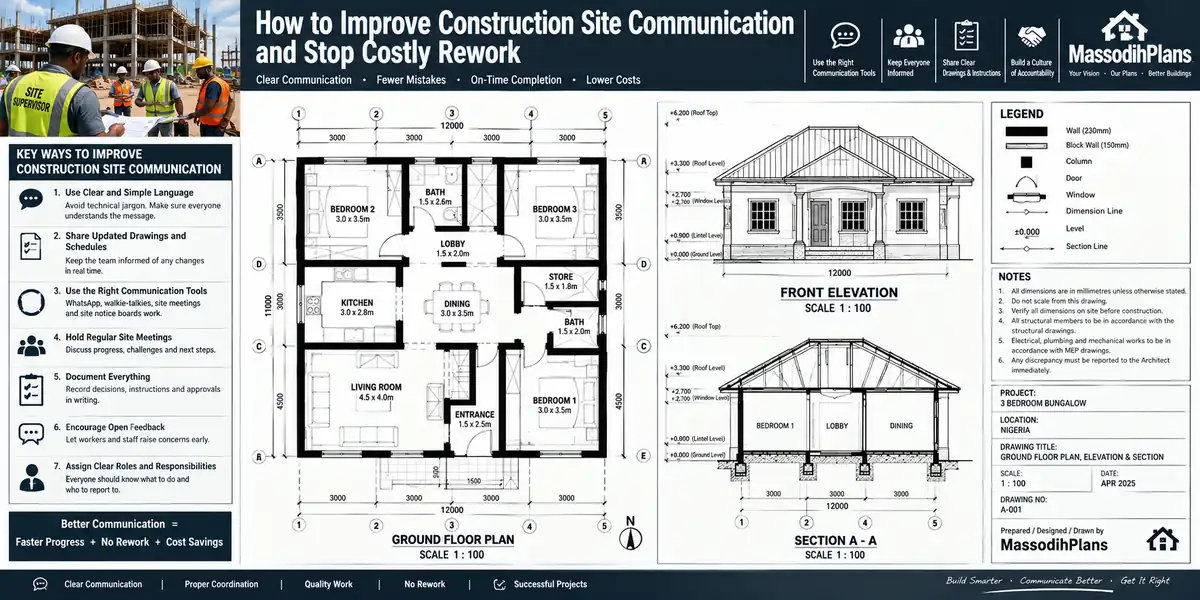
How to Improve Construction Site Communication: Avoid Delays and Rework Now
Let me tell you about a wall that got built twice.
Not because anyone was lazy. Not because the mason didn’t know his job. It got built twice because the supervisor told him one dimension on Monday, the drawing said something different, and nobody checked which one was current before the blocks went up. By Thursday, that wall was rubble, the client was asking hard questions, and everyone on site had a slightly different story about whose fault it was.
I’ve watched this exact scene play out more times than I can count in over years of supervising residential builds across Akwa Ibom and other States in Nigeria. And here’s what I want you to sit with before we go any further: nobody on that site was incompetent. The mason could build. The supervisor knew the project. The information just didn’t move correctly between them and that gap is where money, time, and trust quietly disappear on almost every construction site I’ve ever worked on.
This isn’t a “communication skills” article with vague advice about “active listening.” It’s a working system the one I actually use for making sure the right information reaches the right person, at the right time, in a form that can’t be misremembered or argued about later. Whether you’re a supervisor trying to run a tighter site, a client managing a build from Lagos or from London, or a student trying to understand how real projects actually function, this is built for you.
Why Construction Site Communication Fails Even When Everyone Is Working Hard
Here’s the thing people get wrong first: they assume communication failure means someone was careless. On a real construction site, that’s rarely the diagnosis. A single residential project involves masons, carpenters, electricians, plumbers, a site supervisor, a structural engineer, an architect, material suppliers, and a client often all active on the same small plot in the same week. Every one of those people is working from a slightly different piece of the puzzle, and the puzzle only stays whole if information keeps moving correctly between them.
It breaks down in a few very specific, very human ways:
Unclear instructions. “Make the opening bigger” means nothing without a number. “Bigger” to one mason is 10cm; to another, it’s 30cm.
Wrong information reaching workers. A supervisor relays an instruction from the architect, but a detail gets lost or altered somewhere between the phone call and the site a classic game of telephone, except the consequence is a wall in the wrong place.
Verbal instructions being forgotten. Someone gives an instruction on Tuesday morning. By Thursday, when the work actually reaches that point, nobody remembers exactly what was said, and the worker fills the gap with a guess.
Outdated drawings still on site. A revised drawing gets sent, but the old printout is still pinned to the site office wall, and whoever glances at it first uses it.
Delayed decisions. A question goes to the client or architect and sits unanswered for four days while the work that depends on that answer either stalls or, worse, continues on a guess.
Information staying with one person. The supervisor knows something the foreman doesn’t. The foreman knows something the mason doesn’t. Nobody deliberately hoards information it just never gets deliberately shared either.
Workers being afraid to report problems. This one is quiet but expensive. A worker notices something looks wrong but says nothing, worried about being blamed or seen as incompetent so the small problem grows into an expensive one before anyone official hears about it.
None of these require a villain. They require a system that doesn’t currently exist on most sites. That’s what the rest of this guide gives you.
How to Know Your Construction Site Has a Communication Problem
Before you fix something, you need to know it’s actually broken and communication problems are sneaky because they don’t announce themselves. They show up as other problems first. Here’s your diagnostic list. If you recognize three or more of these on your current project, you don’t have a “small hiccup.” You have a communication system that needs rebuilding.
- Workers keep asking the same question, days apart, because the first answer never actually stuck or spread
- Different workers give different answers when asked about the same detail
- Construction keeps moving even though everyone privately knows a drawing issue hasn’t been resolved
- The supervisor finds out about a problem days after it started, not the day it happened
- Subcontractors blame each other when something goes wrong, and nobody can point to who actually approved what
- Materials arrive at site before the site is even ready to receive or use them
- Work gets demolished and redone this is the loudest, most expensive symptom of all
- The client only hears about a problem once it’s already turned expensive to fix
If you’re nodding along to several of these, don’t panic and don’t start pointing fingers either pointing fingers is actually part of the problem, not the solution. What you need is structure, and that’s exactly where we’re headed next.
What Information Must Reach Workers Before Construction Starts Each Day
Every single day on site should start with workers knowing ten specific things. Not vaguely knowing actually knowing, out loud, confirmed. This is the checklist I run through, or have my supervisors run through, before a single block gets touched each morning:
- What work is planned for that day, specifically
- Where on site that work is happening
- Which drawing, and which revision of that drawing, applies to it
- The exact dimensions or specifications involved numbers, not descriptions
- What materials are required and whether they’re actually on site
- Any safety concerns specific to that day’s work
- Which other trades are working nearby, and how their work might interact
- Any problems carried over unresolved from the previous day
- Who is responsible for making decisions if a question comes up
- What must be completed before the next activity can start
This takes ten minutes, maybe fifteen. Skipping it “to save time” is exactly how you lose an entire day later to rework which brings us to one of the biggest culprits behind that rework in the first place: the spoken instruction that nobody wrote down.
How to Stop Verbal Instructions From Causing Expensive Rework
“Do it this way” is the single most expensive sentence in construction. Not because it’s wrong in the moment it’s usually right in the moment. The problem is what happens to it three days later, when the person who said it, the person who heard it, and the actual work no longer line up.
Here’s the difference between an instruction that survives and one that doesn’t:
“Do it this way” spoken, unrecorded, dependent entirely on two people’s memory matching perfectly for days or weeks.
Documented instruction → responsible person → drawing/reference → confirmation → implementation a chain where each link can be checked against something real.
In practice, this means treating a handful of tools as your actual instruction record, not just casual chatter:
WhatsApp for quick alerts fine, as long as anything important gets pulled out and confirmed properly (we’ll come back to this)
Site meetings where decisions are made out loud in front of the people affected, not just two people in a corner
Written instructions even a simple site diary entry beats no record at all
Marked-up drawings the fastest way to remove all ambiguity about a dimension or detail
Photographs dated, timestamped proof of what a space looked like before a decision was made
Approval records who said yes, and when
Change records what changed from the original plan, and who authorized it
None of this needs to be fancy software. A notebook and a phone camera, used consistently, will outperform the most expensive project management app used carelessly. What matters is that an instruction leaves a trace that isn’t just two people’s memory of a conversation.
How to Communicate Drawing Changes Without Confusing the Site Team
If verbal instructions are the most common source of small errors, unclear drawing revisions are the most common source of expensive ones because a wrong drawing doesn’t just misinform one worker, it misinforms everyone who looks at it.
Here’s what actually prevents this:
Use revision numbers, always. Every drawing that goes out should have a clear revision marker Rev A, Rev B, Rev 2 printed on it. No exceptions, no “just send the file.”
Make old versus current unmistakable. Don’t rely on people remembering which is newer. Stamp superseded drawings clearly, or better yet physically remove them from site.
Highlight what actually changed. Don’t make the site team hunt for the difference between two nearly identical drawings. Cloud, circle, or note the changed area directly.
Remove superseded drawings from the site office and from workers’ hands. This sounds obvious, but it’s the step almost everyone skips, and it’s exactly how an old dimension ends up built into a wall.
Keep the current drawing genuinely accessible not locked in someone’s email, not only on the architect’s laptop. On site, visible, and referenced.
Inform supervisors before work starts, not after. A revision that arrives after the concrete is poured has already failed at its one job.
Record who received the revision and when. This protects everyone the designer, the supervisor, the contractor when a dispute later asks “did you know about this change?”
This is where good drawing discipline stops being a paperwork exercise and starts being the actual difference between a site that runs smoothly and one that keeps discovering, mid-construction, that “we were building off the wrong version.”
Put one rule on every site I run the current drawing lives in exactly one place, and everyone knows where that place is. The moment a drawing exists in two locations, you’ve created the exact conditions for one person to be working off the wrong one.
What the Site Supervisor Should Report to the Project Team Every Day
A supervisor’s job includes reporting, and vague reporting is almost as bad as no reporting. Here’s the structure I use eight things, every day, no exceptions:
| Information | What to Report |
|---|---|
| Work completed | What was actually finished, not what was attempted |
| Work remaining | What is still unfinished and why |
| Materials | What’s available on site, and what’s missing |
| Labour | Which trades were actually active that day |
| Problems | What is currently preventing progress |
| Drawings | Any clarification needed before work continues |
| Safety | Any hazards observed or incidents that occurred |
| Next activity | What happens next, and what needs to be ready for it |
Notice this isn’t a diary of feelings about the day it’s eight concrete data points. That’s deliberate. A report that’s easy to fill in consistently gets filled in consistently; a report that demands a paragraph of prose every day quietly stops happening after week two.
Getting this daily reporting right inside the site solves half the problem. The other half is making sure the professionals feeding information into that site architect, planner, engineer, contractor aren’t tripping over each other before it even reaches the ground.
How to Improve Communication Between Architect, Planner, Engineer and Contractor
Every one of these professionals is responsible for a different layer of the same building, and confusion usually starts the moment someone assumes another professional’s role without saying so out loud. Here’s the actual division of responsibility:
The planner communicates land use, planning requirements, and how the site is organized within its zoning and regulatory context
The architect communicates architectural design, floor plans, elevations, and space planning intent
The engineer communicates structural requirements, foundation design, and reinforcement specifications
The surveyor communicates boundaries, levels, and survey data the ground truth everyone else’s drawings sit on top of
The contractor communicates construction execution, actual site conditions, and practical buildability feedback
The client communicates decisions, scope changes, and approvals
Where this breaks down, almost every time, is at the seams between these roles not within them. A contractor discovers a structural detail doesn’t match site conditions and, instead of routing that back to the engineer, tries to solve it on the spot. A client gives a verbal approval to the contractor directly instead of through the architect, and the architect’s drawings never get updated to reflect it. Each professional was doing their job correctly in isolation; the failure happened in the handoff between them.
The fix isn’t complicated, even if it takes discipline: every handoff between these roles should have a clear, named point of contact, and every decision that crosses a professional boundary should be confirmed in writing, however briefly even a two-line message that says “confirmed, proceed” beats a verbal nod that three people remember differently a month later.
How to Handle a Contractor Who Says “The Drawing Cannot Work”
This happens on almost every project, and how you respond to it decides whether it costs you a day or costs you a redesign. Here’s the sequence, in order, every time:
- Stop the affected work not the whole site, just the specific portion in question
- Identify the exact problem precisely, in measurable terms, not “it just doesn’t feel right”
- Check the approved drawing against the actual site condition to confirm the discrepancy is real
- Consult the appropriate professional the architect for design issues, the engineer for structural ones
- Document the proposed change clearly, with a sketch or note, before anyone touches material
- Confirm whether formal approval is required some changes need sign-off from the relevant planning or building authority, not just a nod from the site
- Issue the corrected instruction in writing, referencing the drawing it modifies
- Record the decision who approved it, when, and why
What you must never do is let an artisan quietly make a design decision on the spot because it’s faster. A contractor’s job is to flag buildability problems; it is not their job to redesign a structural element without the engineer’s input, however confident they sound standing there with a trowel in hand. I’ve seen “small on-site adjustments” turn into structural liabilities precisely because nobody paused to run this sequence.
Before You Build: If a contractor tells you a drawing “cannot work,” treat that as valuable information, not an inconvenience but route it through the process above, every time, even when the fix looks obvious. The obvious fix is exactly where undocumented mistakes hide.
How to Communicate Construction Problems Before They Become Expensive
Small problems are cheap. The exact same problem, discovered two weeks later, is not. Here’s the difference laid out plainly.
Scenario: wrong opening dimension.
Poor communication path: the error is noticed by a worker, who says nothing because it’s “not my place.” Work continues around it for a week. By the time it’s flagged, three other elements have been built assuming that opening is correct. Result: partial demolition, wasted materials, a week of lost time, and an uncomfortable conversation with the client about cost.
Better communication path: the worker who notices reports it immediately, the drawing is checked within the hour, the correction is confirmed before the next block goes on top. Result: perhaps half a day lost, no demolition, no wasted material.
Scenario: plumbing route conflicts with a structural beam.
Poor communication path: the plumber routes around it on instinct without telling anyone, creating an awkward, hard-to-maintain detour that only gets noticed at finishing stage.
Better communication path: the plumber flags the conflict the moment it’s discovered, the engineer and architect resolve it together, and the fix gets built once, correctly.
The pattern in both cases is identical: the cost of a problem rises the longer it stays unreported, and the person best placed to catch it early is almost always the worker standing in front of it which is exactly why “workers being afraid to report problems” belongs on the list of root causes we started with. A site where reporting a problem gets you blamed is a site training its own workers to stay quiet, and silence is expensive.
How to Improve Communication Between the Construction Site and Client
This is where trust either builds or erodes, and it matters just as much whether your client is fifteen minutes from site or fifteen time zones away. The core problem is simple: clients don’t need to know everything happening on site every single day, but they absolutely need a reliable channel for the things that actually require their input.
Build that channel around these elements:
Weekly written reports a consistent, predictable update rhythm, not sporadic messages only when something’s wrong
Progress photographs taken from the same vantage points each time, so progress is genuinely visible, not just described
Short site videos for context photographs can’t fully capture a walkthrough narrated in thirty seconds is often worth more than ten photos
Milestone updates tied to actual construction stages (foundation complete, roofing complete, and so on), not arbitrary time intervals
Outstanding decisions clearly flagged, with a deadline attached an unanswered question sitting silently in a chat thread is how decisions get delayed for weeks
Material requests communicated with enough lead time that a client abroad can actually act on them
Variations any change from the original scope, explained and costed before it’s built, not after
Payment milestones tied transparently to verified physical progress
Problems requiring client approval surfaced immediately, with options attached, not just a description of the problem
This structure works whether your client is checking on a project from Uyo or from Toronto the distance changes the urgency of your reporting rhythm, not the substance of what needs reporting.
What Should Be in a Weekly Construction Site Communication Report?
Here’s an actual template you can start using this week, not a description of one:
Project:
Location:
Reporting period:
Work completed:
Current stage:
Materials received:
Problems encountered:
Decisions required:
Changes requested:
Safety observations:
Work planned next week:
Photographs attached:
Fill every line, even briefly “none” is a perfectly valid entry for “problems encountered,” and it tells the client something useful too. What kills this template is inconsistency: sending a beautiful report in week one and a two-line WhatsApp message in week four. Pick a rhythm you can actually sustain for the whole project, and sustain it.
How to Use WhatsApp Without Turning It Into Your Construction Project Management System
WhatsApp isn’t the enemy here on Nigerian sites, it’s often the fastest way to get a photo or an urgent alert to the right person in seconds, and I’m not going to pretend otherwise. The problem isn’t the tool. It’s what people quietly let the tool become.
Use WhatsApp for:
- Quick alerts “materials have arrived,” “please come to site”
- Photographs a fast visual check on progress or a problem
- Urgent, time-sensitive communication that genuinely can’t wait
Don’t rely on WhatsApp for:
- Important decisions, because they disappear inside a long scrolling group chat within days
- Drawing revisions, unless the message also states the revision number clearly a photo of a drawing sent casually with no reference is a future argument waiting to happen
- Formal approvals, because “ok go ahead” typed by a busy client at 11pm is not the same as a documented, dated approval you can point back to later
The test I use: if losing this message in three weeks would cause a real problem, it doesn’t belong only in WhatsApp pull it out into your written record the same day. WhatsApp is your alert system. It was never meant to be your filing cabinet.
How to Communicate on a Noisy Construction Site
Not every communication failure is about drawings and reports sometimes it’s simply that a generator is running, a worker is thirty metres away, and shouted words get lost between them. This is a physical problem with physical solutions:
- Reduce reliance on shouted instructions across distance or over machinery noise walk over instead
- Use hand signals for common, repeated instructions where noise makes speech unreliable
- Use radios where the site is large enough or loud enough to genuinely need them
- Insist on face-to-face confirmation for anything critical don’t accept a nod from thirty metres away as confirmation
- Repeat critical instructions back ask the worker to say what they understood, not just whether they understood
- Use visual instructions (marked drawings, taped-out dimensions on the ground, sample pieces) wherever words alone are unreliable
- Treat safety communication as non-negotiable a safety instruction that gets lost in noise is not a communication inefficiency, it’s a hazard
Research into construction communication has specifically identified the physical site environment, information flow, and language barriers as recurring, serious problems not minor inconveniences, but genuine contributors to delay, cost overrun, and safety incidents on real projects. Treating “the site is loud” as a real design constraint on your communication system, not just background noise, is part of taking this seriously.
How Language Differences Cause Construction Instructions to Be Misunderstood
Even where everyone speaks the “same” language, construction instructions fail in some very specific, very avoidable ways:
Technical terminology assumed to be understood by everyone, when it isn’t “damp-proof course” means nothing to a worker who’s never been told what it does
Local language and dialect differences between supervisor and worker, especially on sites drawing labour from different regions
Ambiguous instructions “make it deep enough” instead of an actual measurement
Abbreviations used casually on drawings or in speech that not everyone on site has been taught
Drawings as the real universal language a well-marked drawing communicates across a language gap far more reliably than speech ever will
Asking workers to repeat critical instructions back, in their own words, so you catch a misunderstanding before it gets built rather than after
Using measurements instead of vague descriptions, always, everywhere, without exception
This is a genuinely Nigerian construction-site reality a labour force that often includes workers from different states and language backgrounds working the same plot and it’s also universal enough that anyone managing a mixed crew anywhere in the world will recognize it instantly.
(One thing this taught me early: never assume “he agreed” means “he understood.” I once told a mason to “leave small gap” for a service duct small to me was 15cm. Small to him was almost nothing. We opened that wall back up two days later. Omo, that day I learn say “small” no be measurement o na opinion. Since then, na number I dey give, no more “small” or “small small.”)*
How to Create a Simple Construction Site Communication Chain
Every project needs a clear line of who reports to whom, so information has an obvious path instead of bouncing randomly between whoever happens to be standing nearby.
Client
↓
Project Lead / Consultant
↓
Site Supervisor
↓
Foremen
↓
Artisans / Workers
Information moves down this chain as instructions decisions, approvals, drawing updates flowing from client and consultant toward the people building. It moves up as reports progress, problems, and questions flowing from the ground back toward the people who can approve a change. And it occasionally needs to move across a foreman flagging something directly to another foreman on an adjacent trade but even then, the supervisor should know it happened, or the chain quietly breaks and nobody at the top knows what’s actually going on at the bottom.
The chain doesn’t need to be rigid to the point of paralysis. It needs to be clear enough that everyone knows who to go to when something doesn’t add up.
What to Do When Two Construction Workers Receive Different Instructions
This happens more than anyone likes to admit, and the instinct to ask “who should I believe?” is exactly the wrong question it turns a systems problem into a popularity contest. Instead, establish:
- The source of each instruction who actually said it, and to whom
- The latest drawing revision, checked physically, not from memory
- The responsible professional for that specific detail architect for design, engineer for structural
- The documented decision, if one exists, that should override any conflicting verbal instruction
- Then communicate the resolution to everyone affected not just the two people who disagreed, but anyone whose work touches that detail
The goal isn’t to figure out who was “right.” It’s to figure out what’s actually correct, and make sure that correct version reaches everyone standing near the confusion, so it doesn’t quietly resurface a week later from someone who never got the memo.
How Poor Communication Causes Rework, Delays and Material Waste
Let’s connect the whole chain, because this is the promise this article opened with, and it deserves to be stated plainly:
Poor communication → wrong work gets built → the error is discovered → the wrong work is demolished → materials already used are wasted → labour has to redo the same task twice → the schedule slips → the project costs more than it should have.
Nationally, one widely cited joint industry study of contractor executives found that nearly half of construction rework was attributed to poor communication between project stakeholders, with communication-related problems costing the industry tens of billions of dollars annually and consuming hours of professionals’ time every single week. That’s not a Nigerian statistic specifically, but it maps directly onto what I see on residential sites here a wrongly built wall in Uyo and a delayed commercial project in another country are, underneath the surface, often the exact same failure: information that should have moved correctly didn’t.
(I always tell my students: rework na the only “gift” wey nobody wan receive twice, but everybody dey package am nicely for you if you no communicate well. You go build am, break am, build am again and the only person wey dey smile through all of that na the block seller.)
A Simple Daily Communication System for a Nigerian Residential Building Site
Here’s the actual rhythm I run, structured across a single day:
Morning — 10-minute briefing. Cover the ten items from the daily checklist above, out loud, with everyone active that day present.
During work — immediate reporting of problems. No waiting for the end of the day. A problem gets reported the moment it’s noticed, to whoever is responsible for that decision.
Midday — a quick progress check. Not a full meeting a walk-through to confirm the morning’s plan is actually matching reality, and to catch a drift before it compounds.
End of day — a completed/unfinished work report. The eight-point supervisor report from earlier in this guide, filled in before anyone leaves site.
Weekly — a client/consultant progress report. The weekly template above, sent consistently, on the same day each week.
This isn’t a theoretical framework it’s the actual rhythm, and its whole value is in the repetition. Miss a Monday briefing “just this once” and you’ll notice its absence by Thursday, in the form of a question three different workers ask you separately.
Construction Site Communication Checklist Before You Start Work
Print this. Pin it up. Run through it before work begins, every day it applies:
☐ Current drawings available on site
☐ Drawing revision confirmed against the master copy
☐ Work scope understood by everyone doing it
☐ Materials required actually available
☐ Responsible supervisor clearly identified for the day
☐ Safety information communicated to everyone present
☐ Other trades working nearby informed of overlap
☐ Outstanding decisions identified and flagged
☐ Client decisions documented, not just remembered
☐ Any changes recorded, with who approved them
If any box is unchecked, that’s not a small gap it’s the exact spot where your next rework problem is quietly forming.
Global Relevance: This Isn’t Only a Nigerian Problem
Wherever I share this framework with clients building in the US, UK, Germany, UAE, Iceland, Luxembourg, Switzerland, Qatar, Canada, Australia, or Singapore, the same pattern holds the trades are different, the regulations are different, but the underlying failure is identical: information that should move reliably between people instead depends on memory, assumption, or a message buried in a chat thread. A client managing a build remotely from Toronto faces the exact same “outstanding decision sitting unanswered” problem as one managing from Lagos; the time-zone gap just makes the cost of delay slightly higher. The system in this guide daily checklist, drawing revision discipline, weekly reporting template, clear communication chain travels well precisely because it isn’t tied to any one country’s regulations. It’s tied to how people, information, and buildings actually interact.
Frequently Asked Questions About Construction Site Communication
How do you improve communication on a construction site?
Build a repeatable daily system a morning briefing covering ten specific items, immediate problem reporting during work, and an end-of-day supervisor report rather than relying on ad-hoc conversations that depend on memory.
What causes poor communication on construction sites?
Multiple trades and professionals working simultaneously without a shared, documented information system unclear instructions, outdated drawings, delayed decisions, and workers hesitant to report problems are the most common specific causes.
How does poor communication cause construction delays?
It leads to wrong work being built, which then has to be discovered, demolished, and rebuilt each step adding lost time on top of the original delay caused by the miscommunication itself.
How do you prevent construction rework caused by miscommunication?
Document instructions instead of relying on verbal ones, control drawing revisions strictly, and create a reporting culture where problems are flagged the moment they’re noticed rather than after they compound.
Should construction instructions be written down?
Yes, especially anything that affects dimensions, structural details, or scope. A verbal instruction is only as reliable as two people’s matching memory of it days or weeks later.
How should drawing revisions be communicated to contractors?
With a clear revision number, the changed area highlighted, superseded drawings physically removed from site, and confirmation recorded of who received the update and when.
Can WhatsApp be used for construction project communication?
Yes, for quick alerts and photographs, but not for formal approvals or drawing references without a stated revision number anything that would cause a real problem if lost in a scrolling chat should be documented separately.
How often should a construction site report be sent?
At minimum, weekly to the client and consultant, with immediate reporting of anything urgent or decision-requiring as it happens consistency in timing matters as much as the content itself.
Who should communicate changes to workers?
The site supervisor, after the change has been properly documented and, where needed, confirmed by the relevant professional never an informal instruction passed directly from an artisan to another artisan without going through that chain.
How can a client monitor construction remotely?
Through a consistent weekly reporting system written updates, dated photographs from the same vantage points, short walkthrough videos, and a clear channel for decisions that need their approval rather than depending on sporadic phone calls.
Conclusion
Every expensive rework story I’ve ever supervised traces back to the same root cause: information that should have reached someone, on time, in a form that couldn’t be misremembered and didn’t. Fixing that isn’t about hiring more careful people. It’s about building a system where the right information has nowhere to go except where it needs to be a daily checklist, a controlled drawing revision process, a reporting rhythm that doesn’t depend on anyone’s memory holding up under pressure.
(And if nothing else sticks from this article, remember this one: for construction site, “I thought you said…” na the most expensive sentence for the whole industry. E don cost people foundation, e don cost people roof, e never cost anybody anything good.)
If you’re building and want a process that catches these problems before they become expensive, our Services page outlines how we work with clients from design through site supervision. Browse our Plans Library for building plans developed with real construction-site buildability in mind, or visit Plan School to understand the documentation and approval process that keeps a site like this running cleanly from day one. You can also explore more construction and building process guides on our Homepage.
- How to Manage Construction Documents Properly for Nigerian Construction Sites
- How to Avoid Project Delays in Construction: A Nigerian Site Planning Guide
- Where Should Windows and Doors Go? Nigerian House Plan Design Guide
- Property Tax, Ownership and Legal Rights: A Complete Property Law Guide
- How to Plan and Manage Property: Land Measurement, House Plans, Value and Investment
Author
Massodih Okon is a Nigerian built-environment professional with academic and professional experience in urban and regional planning, geography, architectural design, Landscape Design, GIS and land development.
He holds a Master’s degree in Urban and Regional Planning from the University of Uyo and a first degree in Geography and Regional Planning.
Through MassodihPlans, he publishes practical guides on Nigerian house plans, building design, physical planning, site planning, development approval and residential construction. Read the full author profile →