I Wish Someone Had Shown Me This Before I Started Drawing My First House Plan in Nigeria
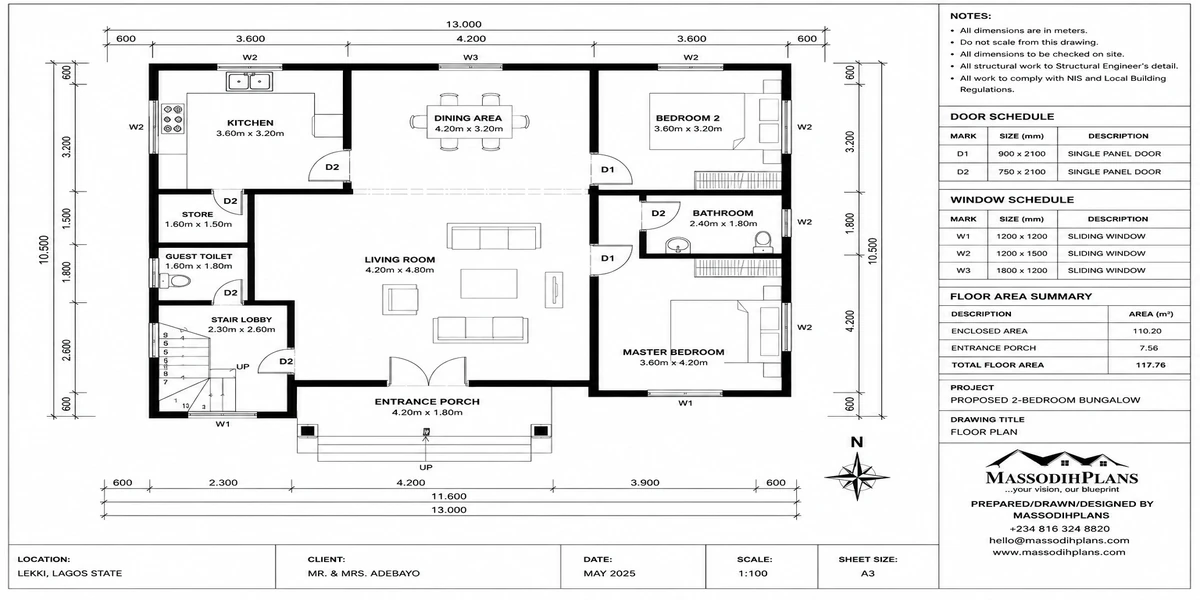
house plan design drawing
If you have ever unrolled a set of building drawings and felt completely lost, you are not alone. I have sat across the table from engineers, landlords, and young graduates who all shared the same confession: nobody ever walked them through the basics of house plan drawing in Nigeria in plain language.
This guide changes that.
Whether you are trying to understand a plan your architect drew, learning to sketch your first layout on paper, or seriously considering a career path in architectural drafting, this tutorial is for you. I will take you from zero knowledge to confident understanding; covering tools, dimensions, plot reading, room arrangement, Nigerian climate realities, setbacks, drainage, and the professional habits that separate decent drawings from great ones.
Let us begin.
What Is a House Plan and Why Does It Matter in Nigeria?
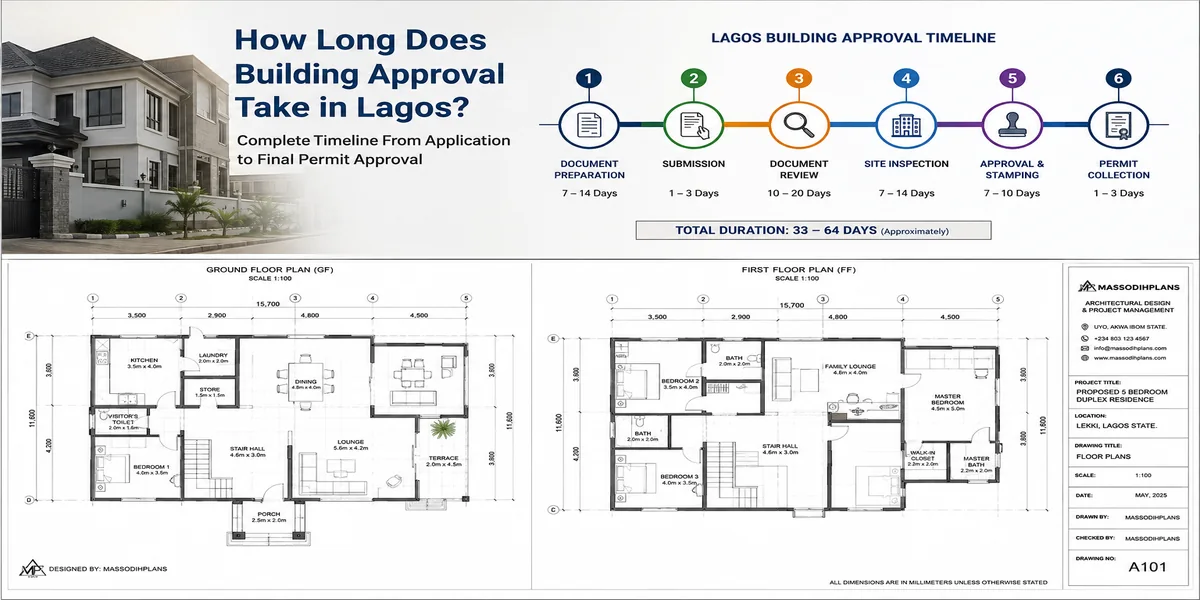
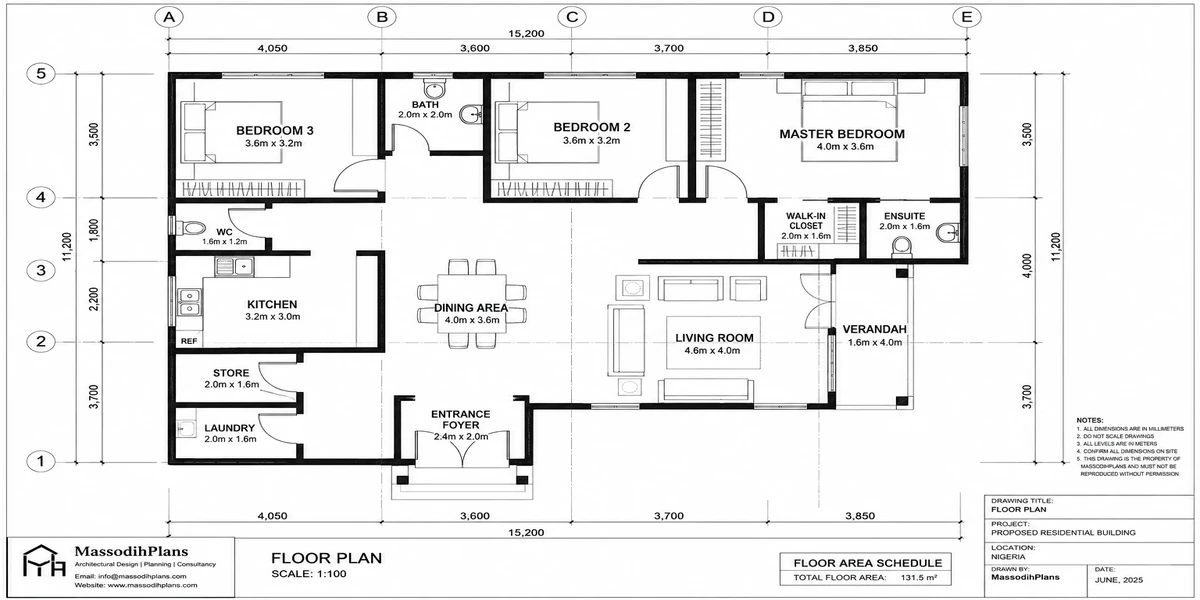
A house plan is a scaled, technical drawing that shows a building from above as if you removed the roof and looked straight down. It shows the arrangement of rooms, wall positions, door and window openings, staircase locations, and the relationship between indoor and outdoor spaces.
In Nigeria, a house plan matters for several reasons beyond aesthetics:
It is a legal document required for building approval from your local government or town planning authority.
And it guides your contractor and labourers on what to build and where.
It determines your material quantities and therefore your budget.
It communicates your vision clearly so that no one guesses what you want.
A poorly drawn plan leads to a poorly built house. I have seen Nigerian families spend over ₦40 million on construction only to realize midway that the rooms were too narrow, the kitchen had no cross-ventilation, or the septic tank was placed directly under the living room foundation. All of that pain starts with a weak drawing.
Learn more about what a complete set of architectural drawings includes → What Are Working Drawings in Nigeria?
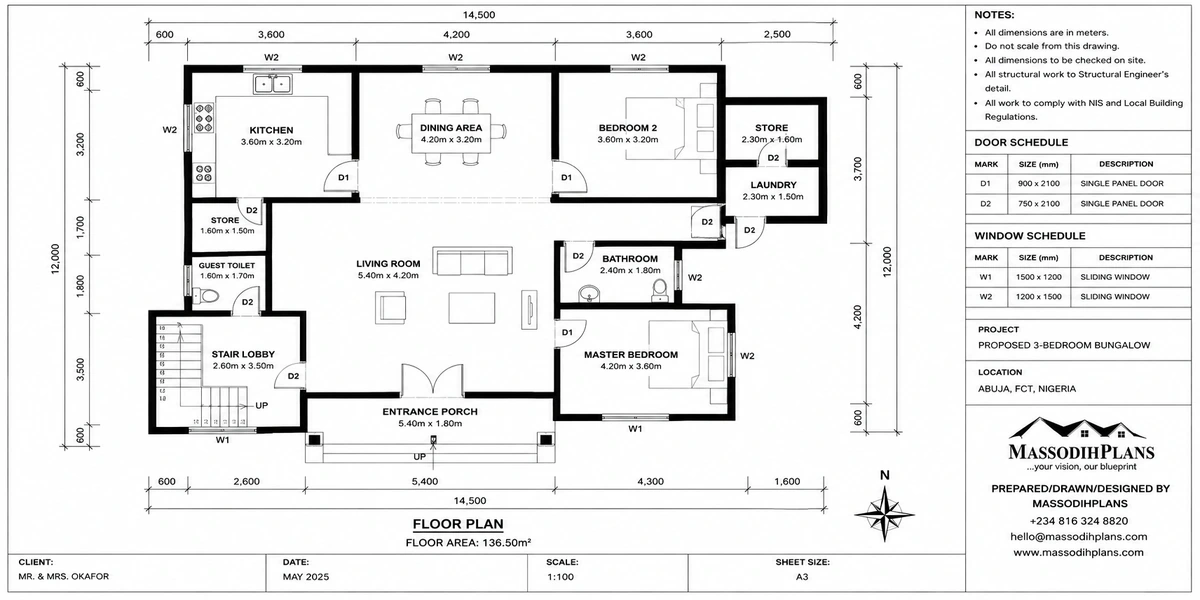
floor house plan design
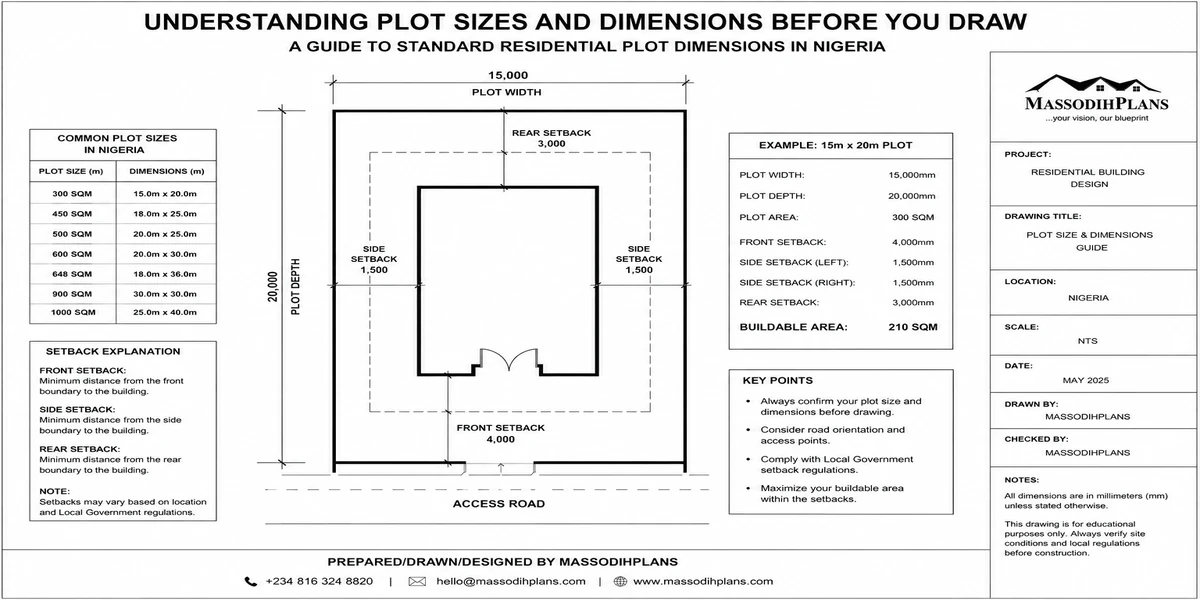
Understanding Plot Sizes and Dimensions Before You Draw
Before you put pen to paper, you must understand the land your building will sit on. In Nigeria, plot sizes vary by state and by estate type, but the most common dimensions are:
| Plot Type | Approximate Dimensions | Common Location |
|---|---|---|
| Standard Full Plot | 18m × 36m (648 sqm) | Lagos, Abuja, Enugu |
| Half Plot | 18m × 18m (324 sqm) | Urban outskirts, Port Harcourt |
| Narrow Urban Plot | 7.5m × 30m or 6m × 36m | Lagos Island, Yaba, Surulere |
| Government Layout Plot | 15m × 30m (450 sqm) | Abuja, Rivers State layouts |
| Village Plot | Irregular, often 20m × 40m+ | Rural areas |
Understanding your plot dimensions is the very first step in any house plan drawing exercise. A 13.7m × 30m plot in Surulere is a completely different design challenge from a 15m × 30m government layout plot in Uyo.
Practical tip: Always work with a surveyor’s deed plan before drawing. The deed plan shows your exact plot corners, true north orientation, road frontage, and existing features like drainage channels. Never design based on estimated measurements.
See how Nigerian architects design for narrow plots → MassodihPlans: Small Plot House Plans Nigeria
Understanding Plot Sizes and Dimensions Before You Draw
Tools You Need to Start Drawing House Plans in Nigeria
You do not need expensive software on day one. Here is what beginners should gather:
Manual Drawing Tools (For Paper Drafting)
Drawing board (A1 size is standard): Available at major stationery shops in Lagos, Abuja, and Port Harcourt. Cost: ₦8,000 to ₦25,000
T-square or parallel rule: For drawing horizontal lines accurately
Set squares (30/60 and 45/45): For perpendicular and angular lines
Scale ruler (1:100 and 1:50 are most used in residential work)
Pencils: HB for sketching, 2H for construction lines, B for final visible lines
Compass: For drawing arcs showing door swings
Eraser and erasing shield
Drawing paper or tracing paper: Use A1 cartridge paper for practice
Total beginner setup cost: approximately ₦15,000 to ₦40,000
Digital Drawing Tools (For CAD and Software Drawing)
AutoCAD: Industry standard. Available as a subscription. Many Nigerian professionals use cracked versions, but the legitimate student version is free.
ArchiCAD: More architecture-specific, used widely in Nigerian universities
SketchUp Free: Excellent for 3D visualization of your plans
RoomSketcher or Planner 5D: Web-based, beginner-friendly, no installation needed
Floor Planner (floorplanner.com): Free, simple, works well on Nigerian internet speeds
For beginners, I recommend starting with paper drafting first. It builds your spatial instincts. Once you understand what you are drawing and why, transitioning to AutoCAD becomes significantly easier.
Tools You Need to Start Drawing House Plans in Nigeria
The Scale Rule: Nigeria’s Most Misunderstood Drawing Tool
Scale is the relationship between drawing size and real size. If I draw a wall that is 5 metres long at a scale of 1:100, it will appear as 5 centimetres on paper.
The most common scales used in Nigerian residential house plan drawing are:
- 1:100 — Most common for floor plans. 1 centimetre on paper equals 1 metre on site.
- 1:50 — Used for detailed sections, toilet layouts, kitchen drawings
- 1:200 — Site plans and layout drawings for large compounds
- 1:20 — Very detailed: door frames, window sections, structural joints
Common beginner mistake: Drawing walls without confirming scale. I have seen students draw a sitting room that looks fine on paper at 1:100, only to discover on site that the room is just 2.4 metres wide barely enough to fit a three-seater sofa.
Always double-check: if your scale ruler reads 3.6m, confirm that is physically sensible. A bedroom must be at least 3m × 3m. A living room needs a minimum of 4m × 4.5m to feel comfortable in a Nigerian household.
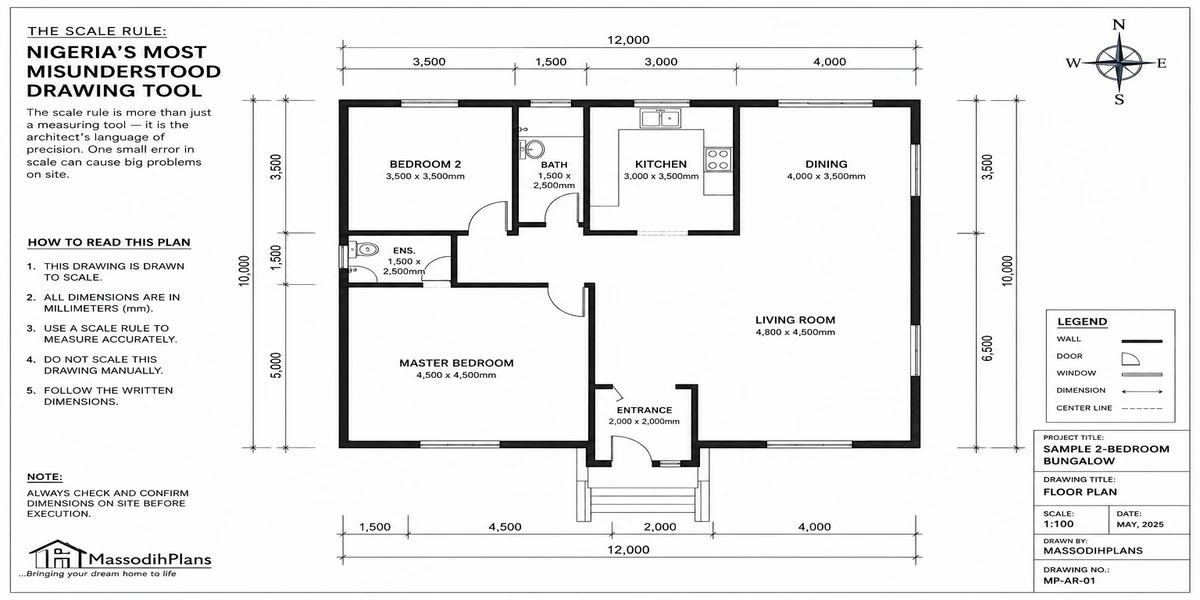
The Scale Rule: Nigeria’s Most Misunderstood Drawing Tool
Step-by-Step Guide to Drawing a Simple Nigerian House Plan
Let us walk through the process of drawing a basic two-bedroom flat plan on paper. This is the foundation of all residential drawing in Nigeria.
Step 1: Start With the Plot Boundary
Draw the outer boundary of the plot to scale. If your plot is 15m × 30m at 1:100 scale, draw a rectangle 15cm × 30cm on your drawing paper.
Mark true north with an arrow. In Nigerian practice, the building is usually oriented so that the main façade faces the road and secondary spaces face the rear or sides.
Step 2: Apply Your Setbacks
Setbacks are the legally required distances between your building and the plot boundaries. These vary by state and zone type, but common Nigerian setback requirements are:
- Front setback (from road): 3m to 6m depending on road classification
- Side setbacks: 1.5m to 3m on each side
- Rear setback: 3m minimum in most urban zones
Draw lighter lines at these setback distances. The buildable area within these lines is your building envelope — the maximum footprint your house can legally occupy.
Nigerian Reality Note: In many informal urban areas, setbacks are routinely ignored. Do not copy that practice. Beyond legality, proper setbacks allow natural light penetration, emergency access, and future infrastructure like water service lines. Town planning authorities in states like Lagos, Abuja FCT, and Rivers State are increasingly enforcing setbacks during inspection.
Understand Nigerian building setback requirements → MassodihPlans: Town Planning Setbacks Explained for Nigerian Builders
Step 3: Sketch the Outer Walls
Draw the external walls of your building within the building envelope. Standard wall thickness in Nigerian residential construction is:
External walls (sandcrete block): 230mm (9 inches) drawn as 2.3mm at 1:100 scale
Internal partition walls: 150mm (6 inches) drawn as 1.5mm at 1:100 scale
Keep lines clean and consistent. At this stage, you are only establishing the building outline.
Step 4: Divide Into Functional Zones
A basic Nigerian house plan is divided into three zones:
- Public zone: Entrance porch, sitting room, dining area
- Semi-private zone: Kitchen, store, visitor toilet, staircase (if duplex)
- Private zone: Bedrooms, bathrooms, master en suite
Separate these zones clearly in your layout. Guests should never need to walk through the bedroom corridor to reach the toilet. This is one of the most common layout errors in Nigerian self-built houses.
Step 5: Assign Room Dimensions
Minimum practical room dimensions for Nigerian residential use:
| Room | Minimum Dimension | Recommended Size |
|---|---|---|
| Master bedroom | 3.6m × 4.0m | 4.0m × 4.5m |
| Standard bedroom | 3.0m × 3.6m | 3.3m × 3.9m |
| Sitting room | 4.0m × 4.5m | 4.5m × 5.5m |
| Dining area | 3.0m × 3.5m | 3.5m × 4.0m |
| Kitchen | 2.4m × 3.0m | 2.7m × 3.6m |
| Toilet/bathroom | 1.5m × 2.0m | 1.8m × 2.4m |
| Corridor width | 1.2m minimum | 1.5m preferred |
Work within these numbers. Resist the temptation to shrink rooms to squeeze more into a small plot. A cramped layout on paper becomes a suffocating house in reality.
Step 6: Draw Door and Window Openings
Doors and windows are shown on plan as openings in the wall. Doors include a swing arc showing which way they open.
Standard Nigerian door sizes:
- Main entrance door: 900mm to 1000mm wide
- Internal doors: 800mm to 900mm wide
- Toilet doors: 700mm wide minimum
- Window openings: 900mm to 1200mm wide in residential spaces
Mark each opening carefully. Ensure doors do not swing into pathways or collide with each other when opened simultaneously. I always check what I call the “morning rush test” if two people leave adjacent rooms at the same time, do their doors clash?
Step 7: Add Ventilation Planning
This is where Nigerian building realities demand special attention. Nigeria’s tropical climate means your house plan must work hard to keep spaces cool without relying entirely on air conditioning.
Cross-ventilation principles for Nigerian house plans:
- Every room should have at least two window openings on different walls if possible
- Position windows on opposite walls to create airflow paths
- In a long narrow plan, use courtyard or light-well features to pull air through deep spaces
- Kitchen ventilation must be deliberate position the kitchen so prevailing winds carry cooking heat outward, not into bedrooms
- Roof design affects ventilation: a high-pitched roof with vented ridge tiles or soffit vents significantly reduces heat buildup in upper-floor rooms
Nigerian Climate Note: The hottest period in most southern Nigerian cities like Lagos, Warri, and Port Harcourt occurs between February and April. Your plan should be optimized for passive cooling, not just peak-season comfort. North-facing walls receive less direct solar heat in the northern hemisphere, but Nigeria sits just north of the equator, meaning east and west-facing walls receive intense morning and afternoon sun respectively. Design accordingly.
Learn how to design naturally cool houses in Nigeria → MassodihPlans: Passive Cooling Design Strategies for Nigerian Homes
Step 8: Add Electrical and Plumbing Symbols (Basic Notation)
Even at beginner level, it is good practice to mark:
- Electrical points: Wall socket symbols (typically a small circle with lines)
- Light positions: Centre-room ceiling rose symbols
- Plumbing fixtures: Standard symbols for WC, basin, shower, kitchen sink
- Generator room location: This is mandatory in any serious Nigerian house plan — a 2m × 2m enclosure at minimum, with ventilation and a concrete pad for vibration absorption
- Borehole and overhead tank: Mark water source and tank stand positions on your site plan
Utility planning on the drawing board saves enormous confusion on site. When the plumber and the electrician know from drawings where pipes and conduits should run, material waste drops significantly.
Step 9: Draw the Site Plan
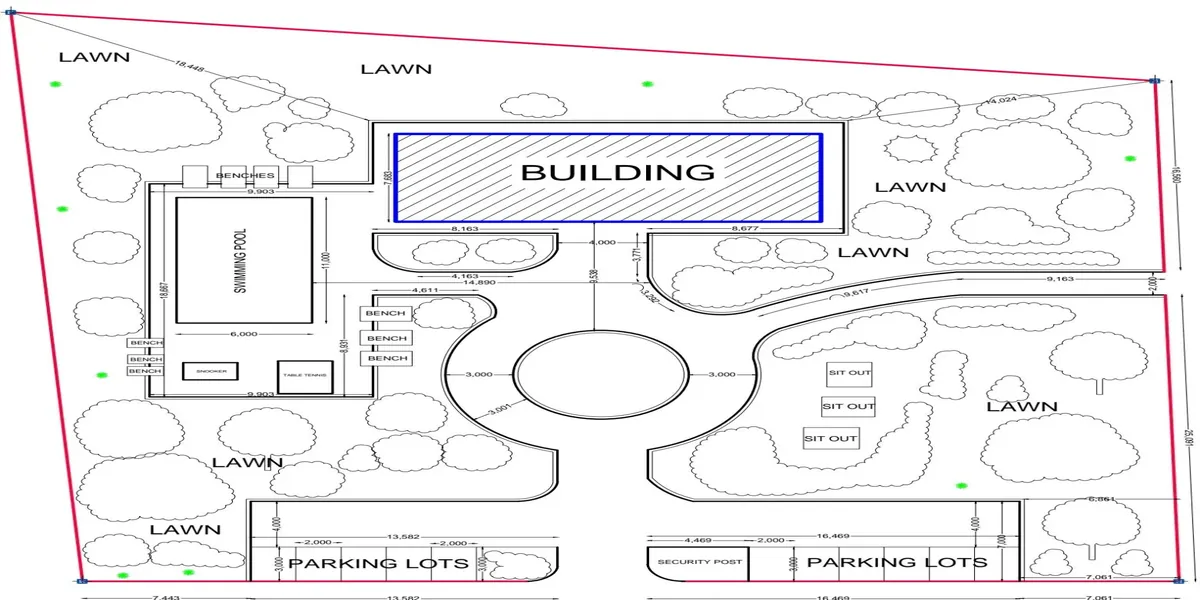
The site plan shows your building’s position within the full plot, including:
- Building footprint with setback dimensions labelled
- Gate and driveway position
- Parking space (minimum 2.7m × 5.5m per car)
- Compound landscaping or paving
- Septic tank location (minimum 3m from building, 10m from borehole)
- Soakaway pit position
- Generator/utility room
- Gatehouse if applicable
In Nigerian urban planning, the site plan is the most scrutinized document during building approval. A well-drawn, accurate site plan signals professionalism and speeds up approval.
Step 10: Review, Annotate, and Title Your Drawing
Every professional house plan includes:
- North arrow
- Scale bar
- Drawing title: e.g., “Ground Floor Plan”
- Drawing number
- Revision box
- Client name and project address
- Drawn by, checked by, approved by
- Date
This title block is non-negotiable in professional practice and required by Nigerian town planning authorities during submission.
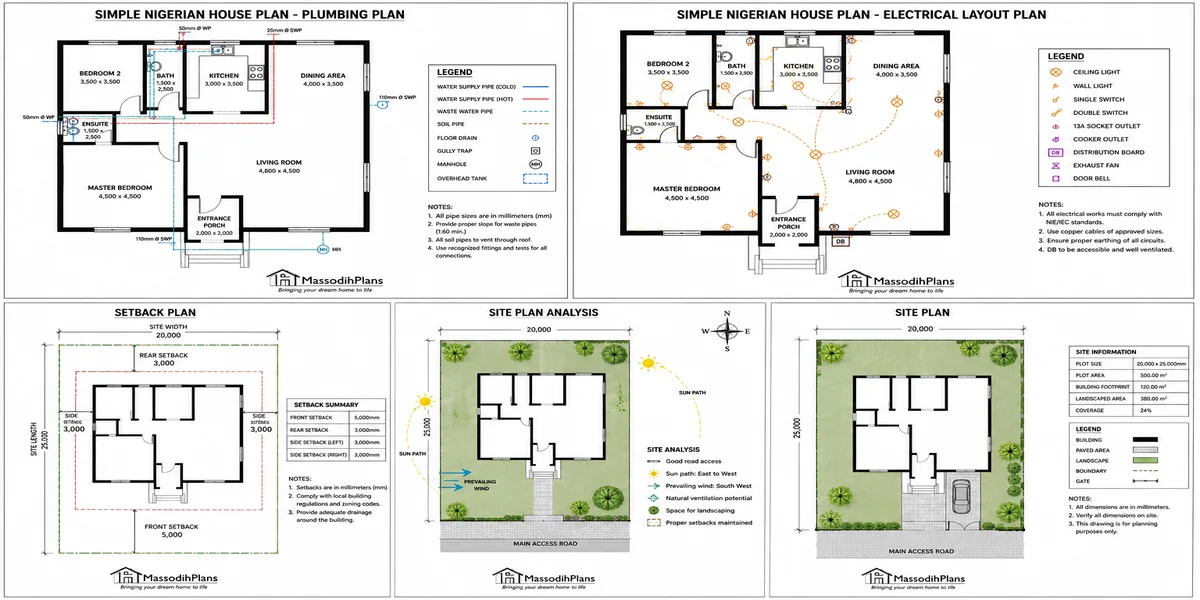
plumbing, electrical, setback and site plans
Nigerian Realities Your House Plan Must Address
Most tutorials skip the realities that every Nigerian builder faces. Here are the issues your house plan must honestly confront:
Flooding and Drainage
Nigeria’s annual rainy seasons bring intense rainfall that poorly designed compounds cannot handle. Your house plan must show:
- Ground floor finished level raised at least 600mm above surrounding grade in flood-prone areas like Lagos Island, Warri, Asaba, and coastal states
- Clear drainage channels from the compound to the street drain
- No building footprint blocking natural drainage paths
Power Supply and Generator Planning
Load-shedding is a permanent Nigerian reality. Every house plan should include:
- A properly ventilated generator room (not just a corner of the compound)
- Cable routes from generator room to distribution board clearly planned
- Inverter/battery room if the owner intends a solar-hybrid system
Compound Security
In most Nigerian urban environments, compound perimeter walls and gate positioning are critical. Your site plan should show:
- Perimeter fence height and type
- Gate position (typically off-centre on the plot to allow vehicle turning)
- Gatehouse position — usually near the gate with a window facing the driveway
- Security lighting positions on site plan
Water Supply: Borehole and Tank Planning
Water authority supply in most Nigerian cities is unreliable. Your plan needs:
- Borehole position (away from septic tank, following your state’s minimum separation distances)
- Overhead water tank stand shown in section, confirming structural support
- Storage tank capacity appropriate for household size
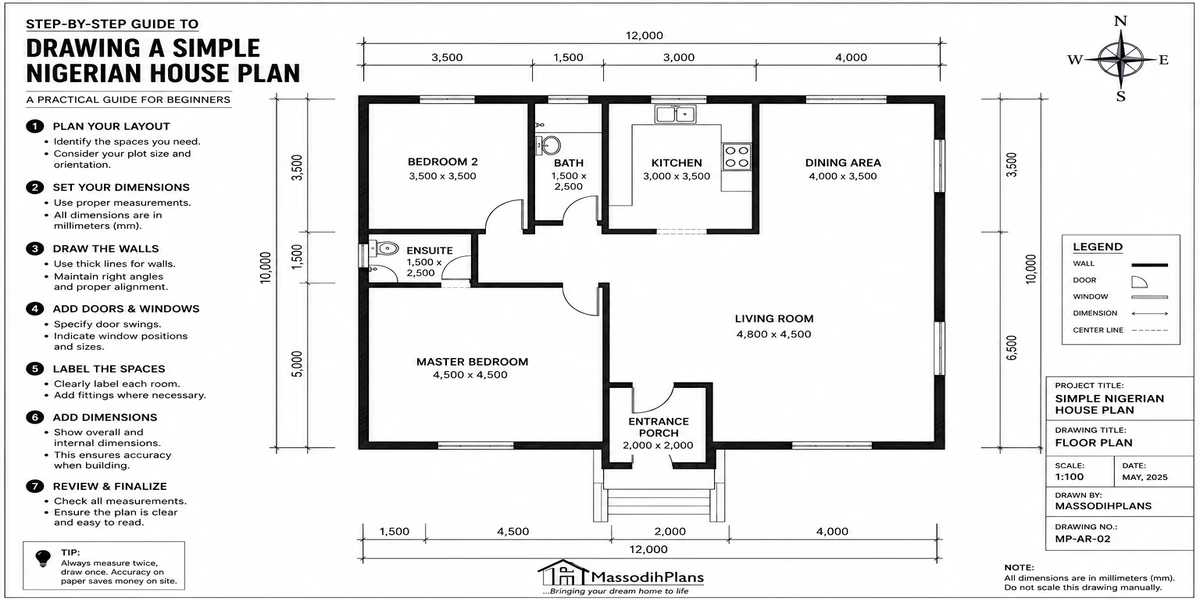
Step-by-Step Guide to Drawing a Simple Nigerian House Plan
Small Plot Optimization in Nigerian House Plan Drawing
If your plot is under 400 sqm or particularly narrow, you need space-making strategies that go beyond simply making rooms smaller.
Multifunctional spaces: Design a dining area that doubles as a study alcove. A corridor can double as a library wall with built-in shelving. These are shown clearly in plan as annotated features.
Vertical expansion: On a small footprint, build upward. A well-designed duplex on a 180 sqm footprint can deliver four bedrooms comfortably. Your plan must then include staircase design the staircase takes up valuable floor area and must be positioned efficiently.
Open-plan layouts: On narrow plots, an open-plan sitting room and dining room creates the feeling of space without increasing the building footprint.
Setback utilization: Where planning regulations allow, the front setback can be used for semi-covered parking or a garden that visually extends the building’s perceived space.
See compact duplex designs for small Lagos plots → MassodihPlans: 3-Bedroom Duplex Plans for 13.7m × 30m Plots in Lagos
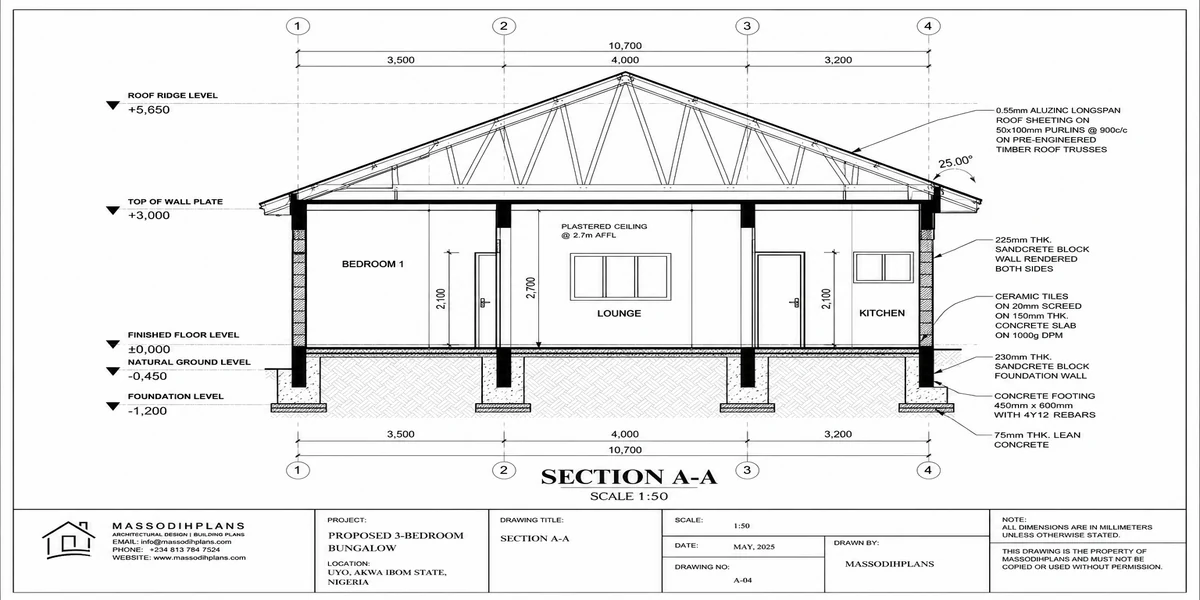
section a-a plan
Common Beginner Mistakes in House Plan Drawing in Nigeria
I see these errors constantly, even from people who have read architectural textbooks:
Drawing without a scale ruler. Freehand sketches have their place, but the moment you call something a “plan,” it must be to scale.
Ignoring setbacks. Buildings drawn wall-to-wall from plot boundary look impressive on paper but cannot get building approval and may be demolished.
No cross-ventilation planning. Single-aspect rooms with one window are design failures in Nigeria’s climate.
Staircase positioned as an afterthought. The staircase controls circulation for the entire building. Plan it first, not last.
Thin walls. Drawing 100mm walls because “it looks cleaner on paper” produces buildings that crack within two years under Nigeria’s temperature swings and expansive clay soils.
No utility spaces. Forgetting the generator room, store, domestic staff room, or refuse area creates serious practical problems on site.
Toilet against the main entrance. A toilet door that opens into the sitting room or porch is both culturally uncomfortable and professionally embarrassing.
No site plan. Many beginners draw only the floor plan and consider the job done. Town planning authorities will reject this submission immediately.
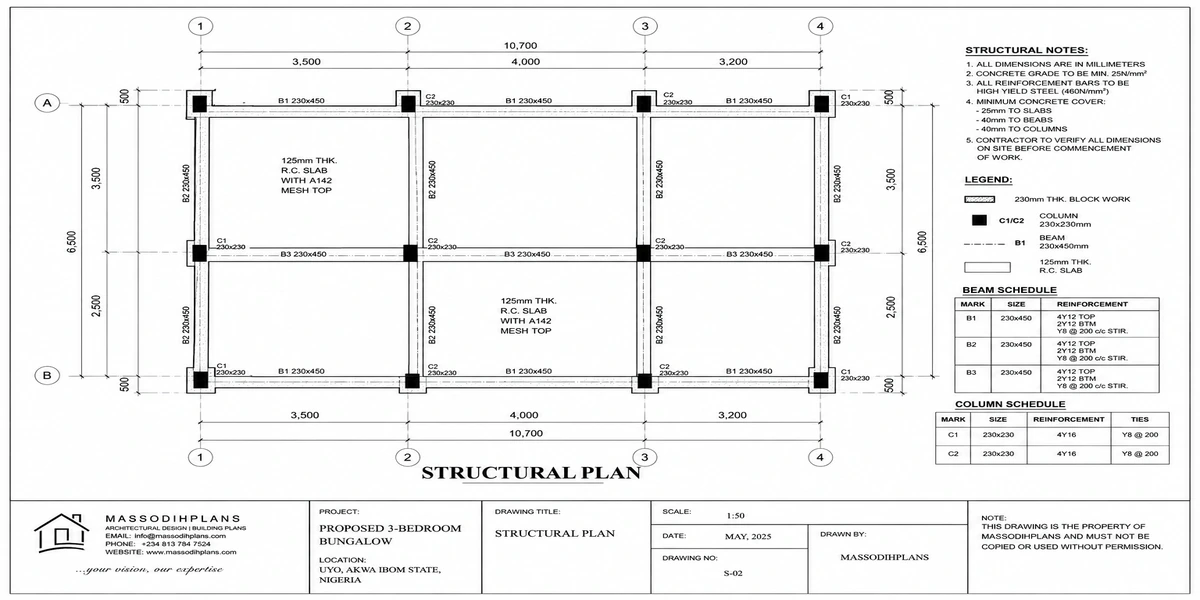
Structural plan
Investment and Long-Term Value Considerations
A well-drawn house plan is not just a construction document. It is a financial blueprint.
Resale value: Properties with professional, approved drawings command higher resale prices because the buyer has documentation. An undocumented building creates title complications that depress value significantly.
Rental profitability: A plan that separates zones well, particularly one that can be rented out in sections if needed increases your property’s earning potential. Many Lagos investors specifically request plans with self-contained potential.
Estate suitability: If you are building in an estate or controlled development, your plan must conform to estate architectural guidelines. This affects roof shape, fence height, exterior material, and setbacks. Plans that match estate character sell faster.
Urban investment value: In cities like Lagos, Abuja, Onitsha, and Aba, buildings on narrow plots are increasingly being valued per square metre of lettable floor area. A well-optimized plan maximizes this metric.
Roof Types Relevant to Nigerian House Plan Drawing
Your house plan must eventually connect to a roof plan. Common roof types shown in Nigerian architectural drawings:
| Roof Type | Appearance on Plan | Common Use | Notes |
|---|---|---|---|
| Hipped roof | Diagonal lines from all corners | Most Nigerian residential | Good wind resistance |
| Gable roof | Lines on two sides only | Bungalows, urban houses | Allows attic storage |
| Flat roof (RC slab) | No slope shown | Urban terraces, rooftop use | Requires proper waterproofing |
| Combination | Mix of hip and gable | Larger, complex footprints | Common in Nigerian elite housing |
For Nigerian coastal and high-rainfall areas, steep roof pitches (30 degrees and above) are preferred for faster water runoff. Always mark roof pitch on your drawing.
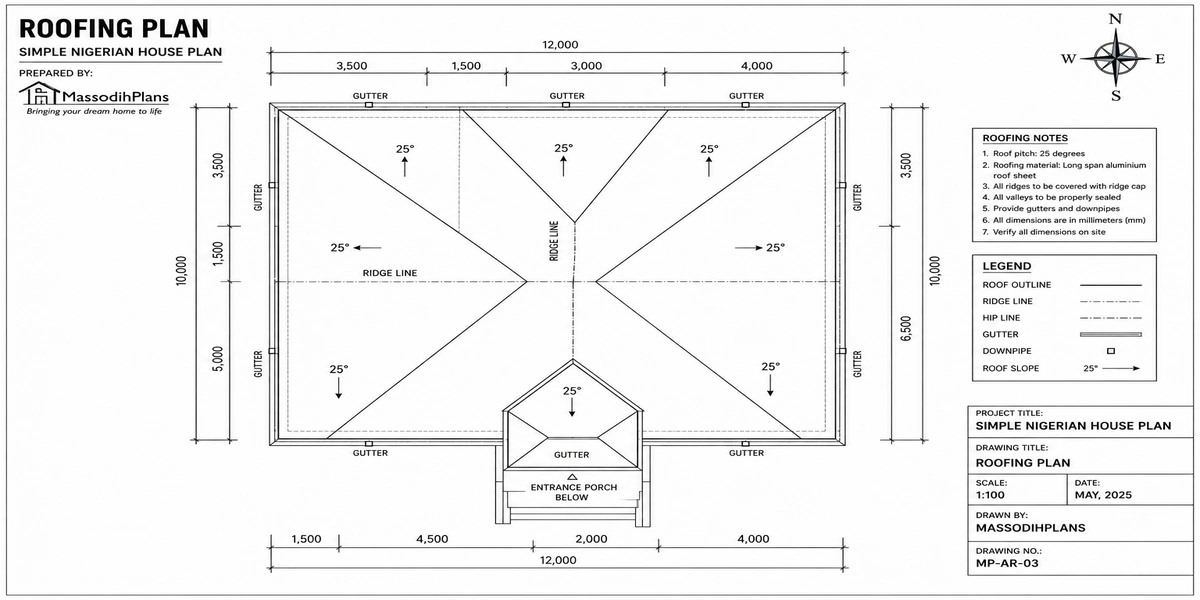
Roof Types Relevant to Nigerian House Plan Drawing
Material Considerations That Affect Your Drawing Decisions
Your drawing choices must reflect Nigerian material realities:
Sandcrete blocks remain the dominant wall material. Standard Nigerian block sizes mean wall thicknesses are typically 150mm (6-inch) or 230mm (9-inch).
Reinforced concrete (RC) slabs are used for intermediate floors and roofs in duplexes. Mark slab direction and span on your structural notes.
Aluminum or PVC windows are now preferred over timber in most urban markets due to humidity, termite exposure, and maintenance costs.
Ceramic or porcelain floor tiles are standard. Tile sizes affect room dimension planning some tile patterns require room dimensions to be multiples of the tile size to avoid awkward cuts at edges.
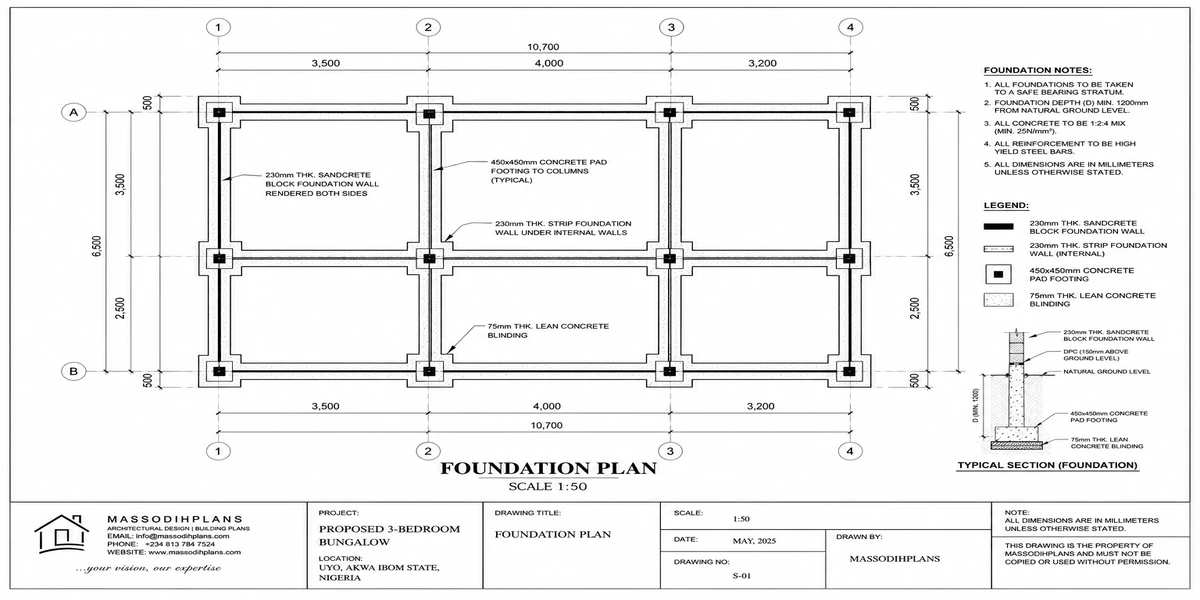
foundation plan design
Building Advice for Those Supervising Construction from a Plan
Drawing is only half the work. When your plan goes to site, here is what separates projects that go well from those that go badly:
Mark out the building yourself (or have your architect do it). The process of transferring your plan’s dimensions to actual ground positions is called “setting out.” A contractor who sets out without an architect present regularly introduces errors that compound through every subsequent trade.
Supervise wall-raising against the plan. Visit site weekly at minimum during wall construction. Compare actual wall positions against drawing dimensions using a tape measure. Errors caught at block level cost almost nothing to correct. The same errors caught at roof level cost hundreds of thousands to remedy.
Do not allow contractors to “adjust” opening sizes. Door and window openings are dimensioned deliberately. Contractors who reduce opening sizes to save blocks are also reducing your light, ventilation, and egress capacity.
Refuse plan changes that are not re-drawn. “We can just move this wall a bit” is how Nigerian buildings acquire unofficial extensions that later cause structural and legal problems.
FAQs: Beginner’s Guide to House Plan Drawing in Nigeria
Q: Can I draw my own house plan in Nigeria without an architect?
Technically, you can sketch a plan but legally, building approval in most Nigerian states requires drawings signed and stamped by a registered architect (NIA or ARCON) and/or a registered engineer. Even if you design the layout yourself, you will need a licensed professional to certify the drawings.
Q: What is the standard scale for a house floor plan in Nigeria?
The most commonly used scale for Nigerian residential floor plans is 1:100 (1 centimetre represents 1 metre). Detailed drawings like toilet layouts or door frame sections use 1:50 or 1:20.
Q: How long does it take to learn house plan drawing?
With consistent practice, a beginner can draw a basic two-bedroom flat plan competently within 4 to 8 weeks of daily study and practice. Software proficiency (AutoCAD) typically takes 3 to 6 months to reach a working professional standard.
Q: What are the standard setback requirements in Lagos State?
Lagos State setback requirements vary by zone and road classification, but the general standard for residential zones is a 3m front setback from plot boundary, 1.5m side setbacks, and 3m rear setback. Urban Planning zones and GRA areas may have stricter requirements. Always confirm with the Lagos State Physical Planning Permit Authority (LASPPPA).
Q: How do I make my house plan Nigeria-ready in terms of ventilation?
Design for cross-ventilation by placing window openings on opposing walls in every room. Avoid single-aspect rooms. Use high window placements for hot-air extraction in kitchens and bathrooms. Incorporate roof ventilation through ridge vents or gable louvres. In hot, humid coastal areas, an overhanging roof of at least 900mm on all sides reduces direct solar heat gain on walls significantly.
Q: Can I draw house plans using free software on my phone or laptop?
Yes. Applications like Planner 5D, Floor Planner, and RoomSketcher work on mobile browsers and free desktop versions. They are ideal for initial layout exploration before committing to professional CAD production.
Q: What is the minimum plot size I can build a 3-bedroom bungalow on in Nigeria?
With good design, a 3-bedroom bungalow can fit on a half plot (approximately 18m × 18m or 324 sqm) in most states. In Lagos, narrow plots as small as 7.5m × 30m have accommodated 3-bedroom layouts in two-storey arrangements. Setback compliance will determine your actual buildable area.
Q: What is the difference between a floor plan and a site plan?
A floor plan shows the interior room arrangement of a single level from above. A site plan shows the building footprint positioned within the full plot, including setbacks, driveway, parking, utility locations, and surrounding features. Both are required for Nigerian building approval. Nigerian Institute of Architects (NIA)
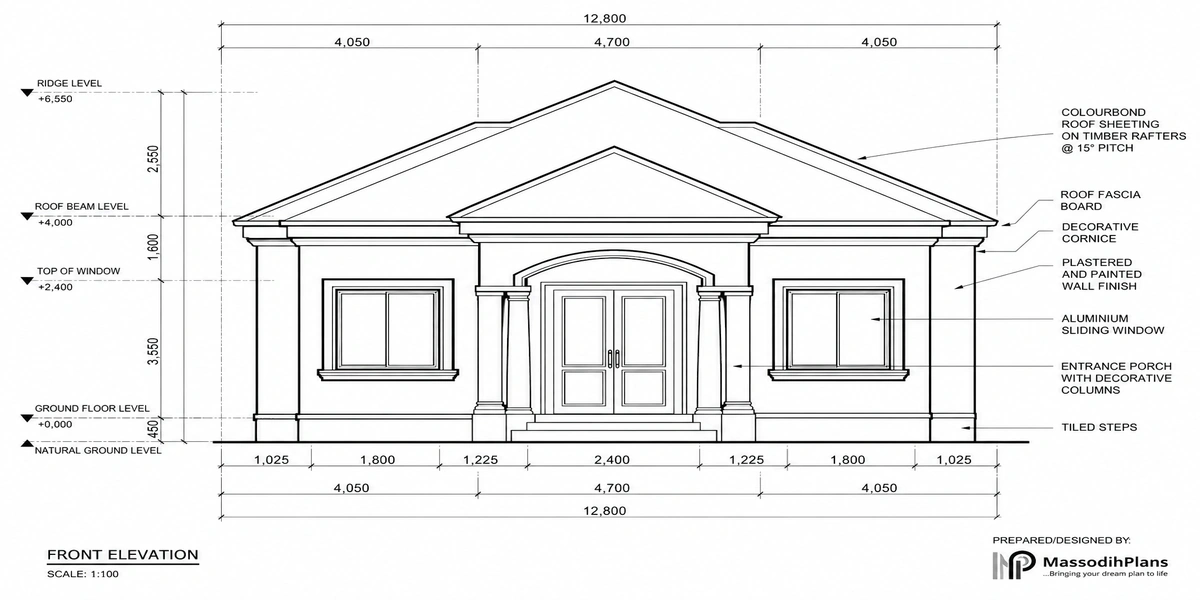
front elevation view plan
Ready to Go Beyond the Basics?
You now have a solid foundation in house plan drawing for Nigerian conditions. But reading a guide is just the beginning. Real learning happens when you pick up a pencil or open your software and start drawing.
Here is your next move: browse the MassodihPlans Library for real, professionally drawn Nigerian house plans that you can study, analyse, and learn from. Every plan on this platform is drawn to proper scale, annotated for Nigerian conditions, and optimized for the plots and climate realities we actually live with.
If you are ready to take the professional step, the MassodihPlans design team offers custom architectural drawing services for residential and mixed-use projects across Nigeria. We understand your plot, your budget, and your building culture because we work in it every day.
Browse House Plans on MassodihPlans → Request a Custom House Plan Design → Continue Learning in Plan School →
Quick Reference Summary
The 10 Steps to Drawing a Nigerian House Plan:
- Draw the plot boundary to scale
- Apply setback lines to define the buildable envelope
- Sketch external walls within the envelope
- Divide the plan into public, semi-private, and private zones
- Assign room dimensions using Nigerian minimum standards
- Draw door and window openings with correct sizes
- Plan ventilation with cross-ventilation as the goal
- Add electrical, plumbing, and utility notations
- Produce a full site plan with drainage and utility positions
- Annotate with a professional title block
Read these related articles to complete the lesson
- How to Fast-Track Building Approval in Lagos Without Breaking the Rules: Legal Ways to Avoid Costly Delays
- Building Legally in Lagos: Complete Guide to Planning Approval, Permits, Inspections, and Construction Rules
- What Lagos Government Says About Manual Building Permit Processing: Current Rules, Applications, and Alternatives
- Why Building Approval Gets Delayed in Lagos: Common Rejection Problems and How to Get Your Plans Approved
- Lagos ePPPS Explained: Complete Guide to the Online Planning Permit System, Application, Fees, and Approval
- How to Apply for Building Approval Online in Lagos Using ePPPS: Complete Step-by-Step Application Guide
- How Long Does Building Approval Take in Lagos? Complete Timeline From Application to Final Permit Approval
- Lagos Building Approval Documents: Complete Checklist of Survey, Title, Drawings, Tax Clearance, and More
- How Much Is a Building Permit in Lagos State? Complete Current Fee and Approval Cost Guide for Developers
- Building Plan Approval Cost in Lagos: Complete Guide to Official Fees, Assessments, and Extra Charges
- Terraced Duplex Cost in Lagos: Complete Buying, Building, Construction, and Budget Guide for Homeowners
- Detached House Building Cost in Lagos: Complete Landed Property and Construction Budget Planning Guide
- 5 Bedroom Duplex Cost in Lagos: Complete Construction Budget for Materials, Labour, Finishing, and Design
- 4 Bedroom House Construction Cost in Lagos: Standard, Mid-Range, and Luxury Building Budget Explained
- 3 Bedroom House Construction Cost in Lagos: Complete Budget Breakdown From Foundation to Final Finishes
- 2 Bedroom House Construction Cost in Lagos: Complete Budget, Materials, Labour, and Finishing Cost Guide
- How Much Does It Cost to Build a House in Lagos? Complete Construction Budget and Cost Breakdown Guide
- Nigeria House Plan Approval Costs: Complete Guide to Getting Building Approval Faster Without Costly Delays
- Lagos Building Plan Approval: Complete Guide to Fees, Documents, Application Process, Timeline, and ePPPS
- Cost of Building a House in Lagos: Complete Budget Guide to Materials, Labour, Design, and Approval Costs
- Architecture & Architectural Design: Complete Guide to Modern Houses, Building Design and Modern Architecture
- Sustainable Landscaping: Complete Guide to Xeriscaping, Landscape Lighting and Water-Efficient Gardens
Massodih Okon is a Nigerian built-environment professional with academic and professional experience in urban and regional planning, geography, architectural design, Landscape Design, GIS and land development.
He holds a Master’s degree in Urban and Regional Planning from the University of Uyo and a first degree in Geography and Regional Planning.
Through MassodihPlans, he publishes practical guides on Nigerian house plans, building design, physical planning, site planning, development approval and residential construction. Read the full author profile →