Smart Estate Layout Ideas for Small Plots in Nigeria
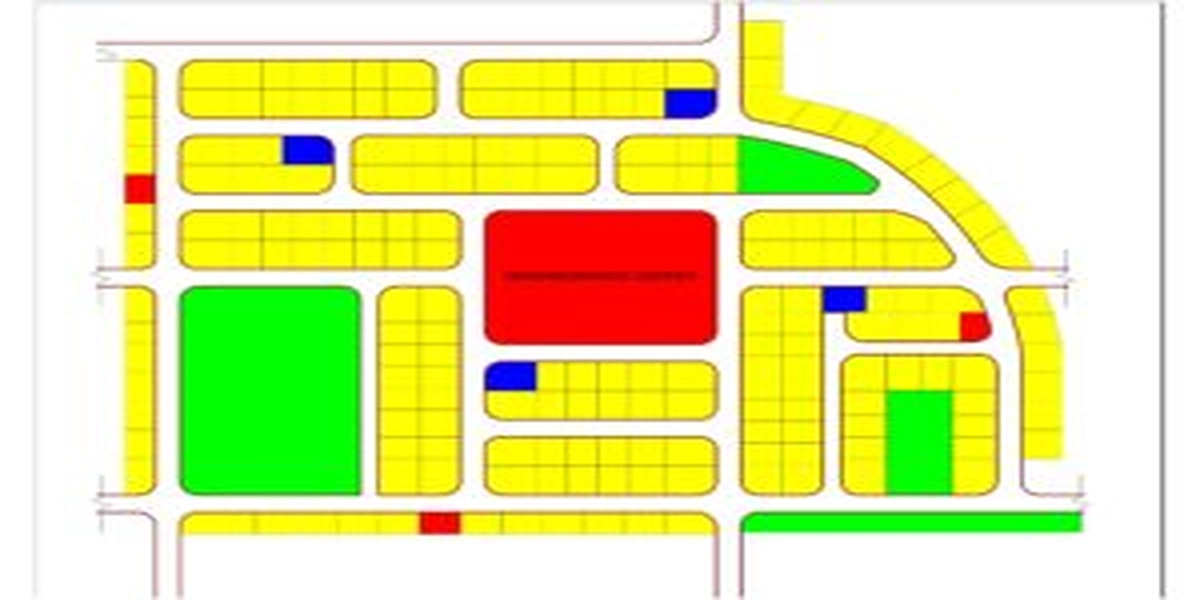
Small Residential Estate Layout Design in Nigeria
How to Plan a Small Residential Estate in Nigeria
To plan a small residential estate in Nigeria properly, you must treat the entire site as one coordinated system roads, plots, drainage, open spaces, parking, utilities, access, security, and individual house plans must work together before construction begins. Getting this wrong can turn a promising piece of land into an estate that is difficult to access, expensive to service, uncomfortable to live in, and difficult to sell.
You have probably seen the consequences: roads too narrow for two cars to pass, houses packed against one another, inadequate parking, drainage overflowing after heavy rain, awkward plot shapes, and gatehouses positioned where security officers cannot properly see approaching vehicles.
These are rarely problems caused by the land itself. They are usually problems created by poor estate planning and they can often be prevented on paper before the first foundation is excavated.
In this practical guide, I will take you through how to plan a small residential estate in Nigeria from the raw site to a functional, buildable layout. Whether you are developing two acres in Uyo, subdividing a 10-plot property in Ibadan, or studying town planning, you will see how planners and designers approach the decisions that determine whether an estate succeeds or struggles.
We will examine road hierarchy, plot sizes, setbacks, drainage, parking, open spaces, infrastructure, security, circulation, planning requirements, and the relationship between estate layouts and house plans, floor plans and building design.
More importantly, I will show you the mistakes that look harmless on paper but can become extremely expensive once construction begins.
What a Small Residential Estate Layout Design Actually Means
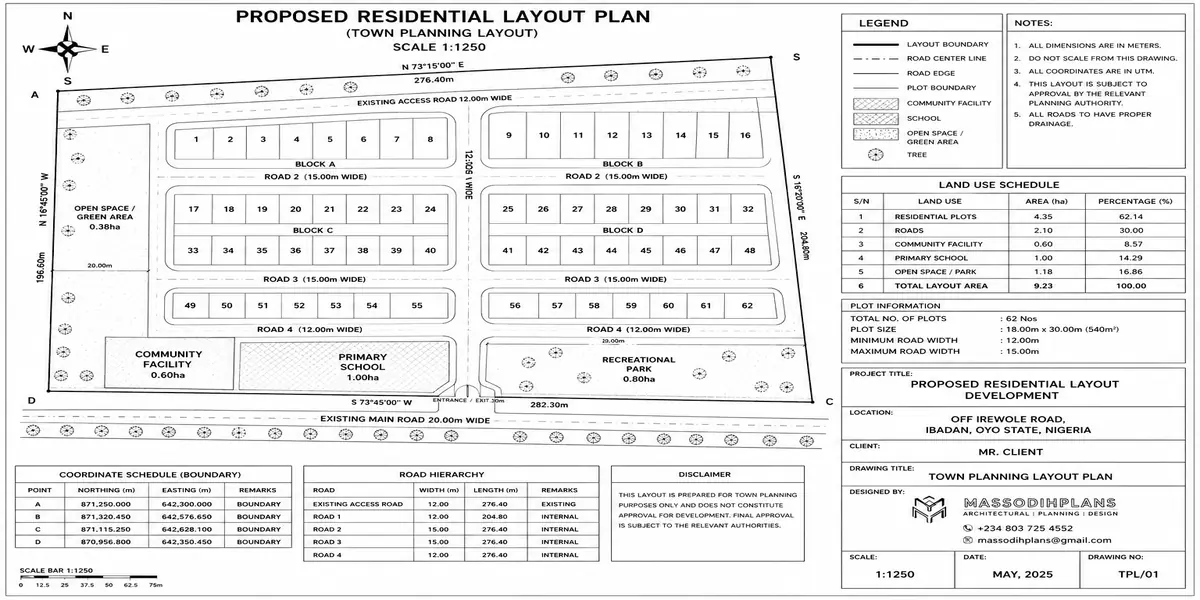
A small residential estate layout design is the master plan that organizes how a compact housing development sits on limited land. It is not just about where the buildings go. It is a coordinated plan for how people move, how water drains, how cars park, how services connect, how security works, and how the entire site breathes together as a community.
Everything in this list must be resolved before construction starts:
- Road arrangement and hierarchy
- Plot subdivision and sizes
- Drainage system design
- Building setbacks from roads and boundaries
- Parking allocation for residents and visitors
- Generator, borehole, and utility positioning
- Security and gatehouse design
- Green areas and recreational pockets
- Pedestrian circulation and child safety zones
- Waste collection points
In Nigeria, small estate layouts are typically developed on land ranging from 1 acre to about 10 acres. Below that scale, you are planning a single residential compound. Above that scale, the project enters medium-density estate territory with its own set of infrastructure demands.
Why Small Estate Development Is Growing Across Nigerian Cities
I want to be specific about what is driving this, because the reasons matter when you are making investment decisions.
Land prices have increased faster than construction costs in most Nigerian cities. In Uyo, a plot that sold for N800,000 in 2018 now trades at N3.5 million or more in sought-after areas. Developers who waited for large tracts to become affordable are still waiting. The ones who moved on smaller parcels are already generating rental income.
Urban infill land has become the dominant opportunity. The large undeveloped stretches near city centres are mostly gone. What remains are smaller parcels, abandoned properties, underused compounds, and subdivision opportunities within existing neighbourhoods. A developer who knows how to extract value from a 2-acre parcel has more opportunities available than one who only works on 20-acre schemes.
Middle-income Nigerians want organized, gated environments but cannot afford luxury estate pricing. Compact estates that offer security, good drainage, and organized infrastructure at moderate entry prices sell faster today than sprawling developments that take years to complete. This is the market that small estate development serves best.
Understanding Your Land Before You Draw Anything
This is where most Nigerian estate layouts fail. Developers commission an architect, receive a plan, and begin construction without properly studying the land first. I will tell you what happened on a project I reviewed in Akwa Ibom where this exact mistake was made. The developer had 3 acres in a transitional area between established development and undeveloped land. He did not study the water flow patterns. And he did not commission a topographic survey. He built roads at the wrong levels. By the second rainy season, surface water from the undeveloped land upslope was channelled directly into his estate through his own road network. Three road sections failed. Remediating the drainage cost more than the original drainage budget.
Before any layout design begins, study these four things on your site:
Natural water flow direction. Stand on the land after heavy rain and observe where water moves. That natural direction must be preserved and managed in your drainage design, not blocked.
Existing trees and vegetation. Mature trees on an estate increase property value. Cutting all of them to lay roads and then spending money on landscaping later is a common and avoidable waste.
Neighbouring development levels. Is your land lower than the surrounding plots? If yes, you have a flood management problem to solve before you place a single building.
Soil conditions. A basic soil test before design saves enormous money during foundation construction. Soft or waterlogged soil on a site that looks fine on the surface has collapsed many small estate projects in Nigeria.
For learners who want to understand the design principles behind how buildings are positioned on sites like this, the Plan School section on MassodihPlans explains site analysis and plot planning in practical terms that even non-architects can follow directly.
Recommended Plot Sizes and What They Actually Deliver
Let me give you realistic expectations for different land sizes, because many developers are either underestimating or overestimating what their land can produce.
| Land Size | Realistic Housing Units | Suitable Housing Types | Infrastructure Flexibility |
|---|---|---|---|
| 1 Acre (0.4 ha) | 4 to 8 units | Terrace duplexes, compact bungalows, mini serviced apartments | Very limited, requires tight planning |
| 2 Acres (0.8 ha) | 8 to 16 units | Semi detached duplexes, terrace houses, mixed bungalows | Moderate, allows visitor parking and small recreational area |
| 3 Acres (1.2 ha) | 14 to 22 units | Mixed density housing, detached and semi detached | Good, allows proper drainage, wider roads, green pockets |
| 5 Acres (2 ha) | 22 to 40 units | Full mixed housing types, medium density | Excellent, allows full estate infrastructure standard |
| 10 Plots (varies) | 6 to 14 units | Compact cluster housing | Depends entirely on plot dimensions and arrangement |
The 2 to 3 acre range is often the sweet spot for first-time estate developers in Nigeria because it is large enough to create a proper estate identity with shared infrastructure, but small enough to be funded and completed in one or two phases without excessive capital exposure.
Smart Zoning: The Strategy Most Developers Skip
Zoning means dividing your estate land into specific areas reserved for specific uses. When zoning is skipped, the transformer ends up next to a bedroom window. The borehole sits too close to the septic tanks. The waste collection point is right at the entrance where the first thing visitors see is refuse.
Every small Nigerian estate, no matter how compact, needs three defined zones.
Residential zones contain all the housing units. Within this zone, decide early whether your housing types will be uniform or mixed. A uniform estate of terrace duplexes is easier to design, faster to build, simpler to price, and usually easier to sell than a mixed collection of bungalows, duplexes, and flats that were added in different phases without a coherent plan.
Service zones accommodate everything that supports the estate but is not living space. This includes the transformer pad, generator enclosure, water tank and borehole headworks, waste collection bay, and any estate maintenance storage. These areas need to be accessible but not visible from the main circulation. Place them where they can be reached by service vehicles without crossing residential circulation paths.
Recreational zones are frequently treated as luxuries that get eliminated when land is tight. This is a financial mistake. Even a small 6-metre by 10-metre landscaped seating area with a couple of concrete benches and a shade tree adds measurable value to every surrounding unit. I have seen compact Nigerian estates in Lekki and GRA Port Harcourt where a tiny green pocket at the end of a cul-de-sac was a stronger selling point in marketing conversations than the building specifications themselves.
Road Hierarchy and Width: The Exact Numbers That Work in Nigeria
Roads consume more land than most developers plan for, and roads that are too narrow create problems that cannot be fixed without demolishing fences or buildings. Get this right at the layout stage.
Main Access Road (Estate Entrance Road)
This is the road from the public street into the estate interior. It must allow:
- Two vehicles to pass simultaneously without either pulling over
- Emergency vehicles including fire trucks and ambulances to enter at full width
- Delivery vehicles including concrete mixers during construction
Recommended carriageway width: 7.3 metres to 9 metres
If your estate will have more than 20 units, design for 9 metres. Below 12 units, 7.3 metres is workable if space is genuinely tight.
Secondary Internal Roads
These serve clusters of housing units branching off the main access road.
Recommended carriageway width: 6 metres minimum
Do not go below 6 metres for a road that serves occupied residential units. I have seen 4-metre internal roads on small estates in Nigeria that could not accommodate a moving van. Every new tenant’s move-in day becomes a neighbourhood crisis.
Cul-de-Sacs
A cul-de-sac is a road that ends in a turning circle instead of connecting through to another road. They are excellent for small Nigerian estates because:
- They eliminate through-traffic and speeding
- They create quieter residential environments
- They naturally define housing clusters around a shared turning area
- They increase the sense of privacy and security for units that face them
- They reduce the total road length needed, saving land and construction cost
The turning circle diameter at the end of a cul-de-sac should be a minimum of 12 metres to allow a vehicle to complete a full turn without reversing.
| Road Type | Minimum Width | Recommended Width | Notes |
|---|---|---|---|
| Main access road (under 12 units) | 6.5 m | 7.3 m | Include drainage channels on both sides |
| Main access road (12 to 30 units) | 7.3 m | 9 m | Design for emergency vehicle access |
| Secondary internal road | 5.5 m | 6 m | Absolute minimum for occupied residential use |
| Cul-de-sac turning circle | 12 m diameter | 14 m diameter | Check with local planning authority for requirements |
| Pedestrian path | 1.2 m | 1.5 m | Especially important near recreational zones |
Building Setbacks: What the Regulations Say and What They Mean on the Ground
Setbacks are the mandatory clear distances between a building and the boundaries of its plot. In estate layouts, they apply both to the individual housing unit plots and to the overall estate boundary.
Always verify setback requirements with your state’s physical planning authority before finalizing any layout. Requirements vary by state, by zone classification, and sometimes by specific estate regulations. What I give you here are the working norms I use in practice and that align with Nigerian urban planning standards across most southern states.
| Setback Type | Typical Range | What It Accommodates |
|---|---|---|
| Front setback (from road to building face) | 3 m to 6 m | Parking, drainage, landscaping, pedestrian movement |
| Side setback (from building to side boundary) | 1.5 m to 3 m | Ventilation, maintenance access, natural light |
| Rear setback (from building to rear boundary) | 3 m minimum | Utility access, septic system clearance, air circulation |
| Estate boundary setback (building from perimeter wall) | 1.5 m to 3 m | Buffer space, structural separation, future access |
The front setback is where most developers try to save space and where they create the most problems. A 3-metre front setback on a small estate might look acceptable on a drawing but produces a crowded street experience where parked cars immediately narrow the usable road width. Where land allows, favour 4.5 metres to 6 metres of front setback on your unit plots.
The side setback is where heat accumulation becomes a problem when buildings are too close. A 1.5-metre gap between two buildings in Nigerian tropical heat is the absolute minimum for ventilation. I prefer 2 metres on both sides wherever the land can afford it.
Climate Responsive Planning: The Part That Determines Comfort
Nigeria sits within the tropical climate zone. This means estate planning that ignores heat, rainfall, humidity, wind, and solar orientation will produce buildings that are uncomfortable to live in regardless of how good they look from the road.
Wind Orientation and Cross Ventilation
In most parts of southern Nigeria, the dominant wind comes from the southwest during the wet season and from the north and northeast during harmattan. Buildings oriented to receive southwest breezes perform significantly better in terms of natural cooling than buildings oriented with their narrow faces toward the prevailing wind.
In estate layouts, this means:
Place your main building facades facing south or southwest where possible. This captures prevailing wet season breezes which carry moisture and cooling.
Avoid blocking the space between buildings with solid walls or structures that interrupt airflow. A gap between buildings is not just a setback compliance issue. It is a ventilation channel.
Use internal courtyards where density is high enough to make them practical. A 4-metre by 6-metre central courtyard in a terrace duplex cluster acts as a chimney that draws warm air upward and pulls cooler air through ground floor openings.
Solar Orientation
West-facing walls in Nigeria receive the most intense heat because afternoon sun strikes them at a lower angle and for longer duration than east or north-facing walls. In your estate layout, try to orient building long axes along an east-west direction, which means the larger facades face north and south. North-facing and south-facing walls receive more balanced and manageable solar exposure.
Where west-facing walls are unavoidable because of plot geometry, compensate with:
- Overhanging roofs or canopies that shade the wall surface
- Perforated screen walls or brise soleil elements on the exterior
- Strategic planting of fast-growing shade trees that will screen the wall within two to three seasons
Rainfall and Flood Management
This is where I see the most expensive mistakes in Nigerian small estate development. If you understand only one thing from this entire guide, let it be this: water obeys gravity, and it has no respect for property boundaries or building finishes.
Before design begins, understand where water from your site will go after heavy rain. Your drainage design must then move that water efficiently from the site without flooding units, collapsing roads, or discharging uncontrolled onto neighbouring land.
The current cost of building a house in Port Harcourt post on MassodihPlans documents how infrastructure costs including drainage represent a significant portion of total project budgets in flood-prone Nigerian cities, which reinforces why drainage is a design priority and not an afterthought.
Complete Drainage Planning for Nigerian Small Estates
Drainage is the single most frequently under-budgeted element in Nigerian estate development and the single most expensive failure to fix after construction.
Surface Drainage Components
Every small Nigerian estate needs these drainage elements designed and sized before road construction begins:
Concrete side drains along both sides of every road. The drain cross-section size depends on the catchment area they serve. A typical secondary estate road drain in a 2 to 3 acre estate needs a minimum clear width of 300 millimetres and a minimum clear depth of 250 millimetres. Main access road drains should be 450 millimetres wide and 300 millimetres deep at minimum.
Catch pits at all drain intersections and low points. These are the rectangular chambers where flow changes direction or where multiple drain channels meet. They trap sediment and prevent drain blockage. They also provide access points for cleaning. Space them at maximum 30-metre intervals along straight drain runs.
Controlled slope gradients throughout the site. Roads and open ground should slope toward drains, not away from them. The minimum effective slope for road drainage in Nigeria is 1 in 200, which means the road drops 1 centimetre for every 200 centimetres of horizontal distance. Less than this and water stagnates. More than 1 in 30 and erosion becomes a problem.
A clearly designated outfall point. Your drainage system must have a defined exit where collected water leaves the site and enters a municipal drain, a natural watercourse, or a designed infiltration area. Never let drainage outfall discharge directly onto a neighbour’s property.
Flood Prevention: The Pre-Design Checklist
Complete this checklist before finalizing any small estate layout:
- Study the natural ground water flow patterns on the site during and after rainfall
- Map the finished levels of all surrounding land and roads
- Identify whether your site is lower than, equal to, or higher than the surrounding development
- Avoid building on areas with visible seasonal waterlogging
- Raise building finished floor levels a minimum of 300 millimetres above finished road level at the plot entrance
- Confirm the capacity of any existing municipal drain that will receive your estate outfall
- Design retention space into your layout if the municipal drain is at capacity or unreliable
Parking Strategy: A Problem Most Developers Only Discover After Tenants Move In
I want to give you a specific example of what happens when parking is not planned. I reviewed an estate in a GRA area where the developer allocated exactly one parking space per unit on each individual plot. No visitor parking. No overflow area. The estate had 18 units. On a Saturday afternoon when tenants had family visiting, the main estate road was completely blocked by parked vehicles. The estate management eventually had to restrict visitor parking to outside the gate, which irritated residents and affected property values. The developer could have prevented this with four shared visitor bays at a cost of less than 2% of total project value.
Parking Allocation Table for Small Nigerian Estates
| Housing Unit Type | Minimum Dedicated Parking | Recommended Parking | Notes |
|---|---|---|---|
| Compact bungalow (2 to 3 bedrooms) | 1 space | 1 space plus overflow access | Ground level, within setback area |
| Semi detached duplex (3 to 4 bedrooms) | 1 space | 2 spaces | Side or front of individual plot |
| Terrace duplex (3 to 4 bedrooms) | 1 space per unit | 1.5 spaces per unit average | Some spaces shared between end-of-terrace units |
| Visitor parking (whole estate) | 1 bay per 4 units | 1 bay per 3 units | Located near gatehouse or central point |
| Estate management vehicle | 1 space | 1 space | Near gatehouse |
Tandem Parking for Narrow Plots
Tandem parking means two vehicles park one behind the other in a single lane. This approach works well in Nigerian small estates where individual plot widths are tight. The rear vehicle belongs to the resident. The front space can accommodate a second resident vehicle or a regular visitor. The limitation is that the rear vehicle cannot exit without the front vehicle moving first, which is manageable within a single household but awkward if the two spaces serve different tenants.
Housing Arrangement Concepts That Maximize Limited Land
Cluster Planning
Cluster planning groups buildings around shared circulation courts rather than arranging them in straight rows along a road. In a cluster arrangement, four to six housing units face a shared courtyard or turning area. This reduces the total length of road needed, creates more intimate residential groupings, and produces a more interesting estate layout visually.
A cluster of six terrace duplexes arranged around a 10-metre by 12-metre central court uses less road length than the same six units arranged in a straight row and produces better cross ventilation between units.
Courtyard Concepts
An internal courtyard within an individual housing unit serves multiple purposes in Nigerian tropical conditions. It improves ventilation dramatically by creating a temperature differential that draws air through ground floor rooms. It provides natural light to rooms that would otherwise have no external window exposure. And it creates a private outdoor space that is protected from the street, which matters greatly for Nigerian families who value outdoor living without street exposure.
Even a 3-metre by 4-metre internal courtyard changes how a compact duplex feels to live in.
Mixed Housing Arrangement
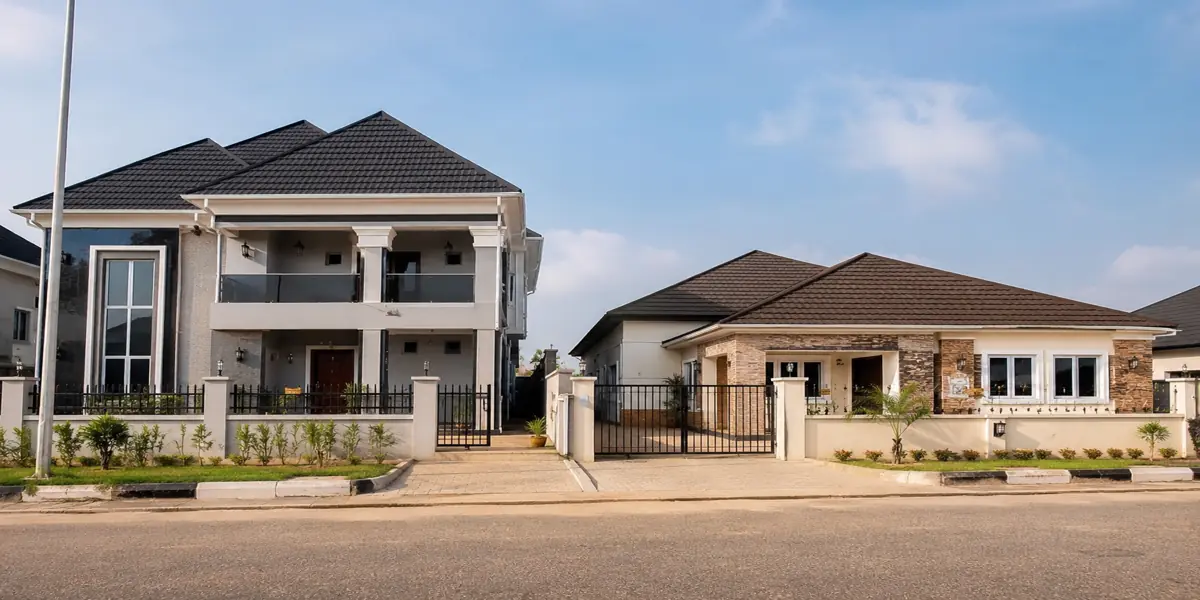
An estate that combines bungalows, terrace duplexes, and semi detached duplexes on the same site can serve different buyer categories and maximize revenue from a single site. The challenge is maintaining visual coherence. Mixed housing types that share the same architectural language, roofline style, wall colour scheme, and window proportions can feel unified. Mixed housing types with completely different aesthetic approaches look chaotic and undermine estate identity.
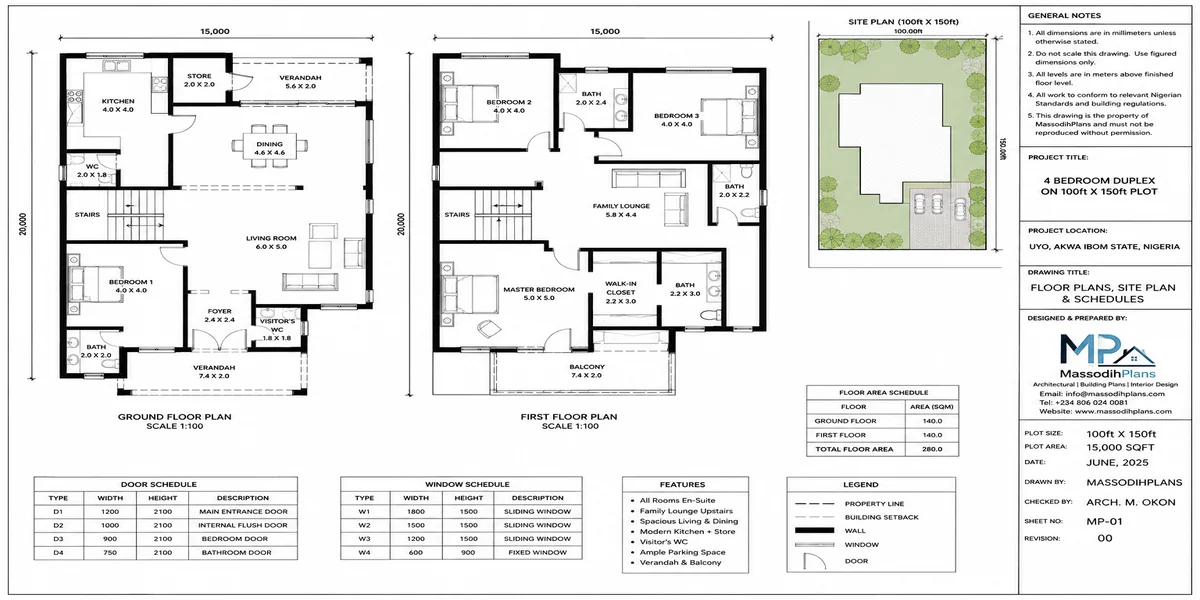
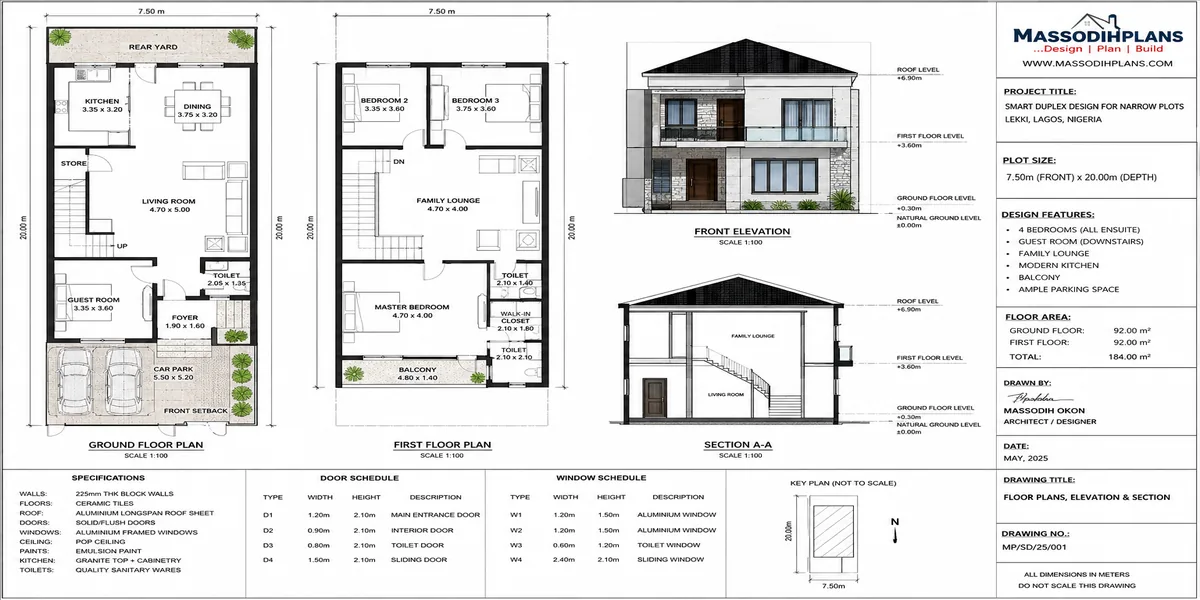
Readers considering how different housing forms sit on compact plots will find useful layout comparisons in the Plans Library on MassodihPlans, which shows practical Nigerian house designs for different plot sizes and housing types.
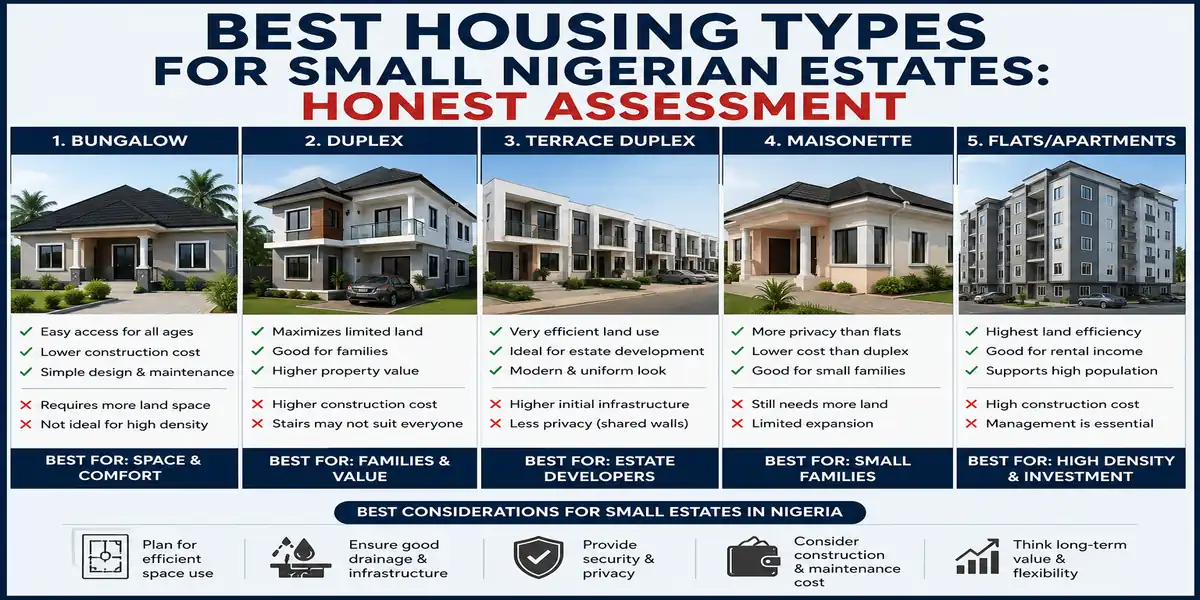
Best Housing Types for Small Nigerian Estates: Honest Assessment
Terrace Duplexes
Terrace duplexes are the most land efficient residential building type available for small Nigerian estates. They share structural walls between adjacent units, which reduces individual construction cost. They allow high density without appearing overcrowded because the vertical element of the duplex creates perceived space even on a compact floor footprint.
The key design requirement for Nigerian terrace duplexes is front to rear cross ventilation. If a terrace unit only has windows on the front and back facade, good ventilation is achievable. If the design blocks the back facade with a solid wall or an enclosed rear utility room, the unit traps heat.
For a detailed look at how duplex layouts work on small and narrow Nigerian plots, the guide on how to practically draw and design a duplex for small plots on MassodihPlans walks through the spatial logic from a drawing and design perspective.
Best suited for: Urban infill sites, high value areas, rental investment estates
Semi Detached Duplexes
Semi detached duplexes share one common wall between two units. They offer more privacy than terrace arrangements and allow side windows on the unshared wall. They require more land per unit than terrace duplexes but less than fully detached buildings.
Best suited for: Middle income residential estates, owner-occupier dominated developments, 2 to 5 acre sites
Compact Modern Bungalows
Single storey buildings on small estate plots work best when the target market includes elderly residents, families with young children who prefer ground level living, or developments where height restrictions make a second floor impractical.
The limitation is land efficiency. A bungalow on a 10-metre by 15-metre plot delivers 150 square metres maximum of built area minus setbacks. A duplex on the same footprint delivers 280 to 300 square metres. Where land cost is high, bungalows require careful justification.
Readers planning a bungalow on a tight plot will find specific layout guidance in the affordable bungalow plan for 40×80 plots in Port Harcourt post, which shows a working layout with realistic dimensions.
Ventilation and Natural Lighting Strategy for Estate Units
Practical Ventilation Design Rules
Position windows on opposite walls of every room. A room with a window only on one wall has intake but no exhaust. Air enters but cannot easily exit, creating a static hot pocket. A room with windows on two opposing walls creates a pressure gradient that moves air continuously.
Never allow a shared side wall to be the only wall available for window placement. In terrace arrangements, every unit needs front and rear window openings at minimum. End units have the advantage of a side wall and should use it.
Use high-level windows or ventilation strips near the ceiling in rooms that generate heat, particularly kitchens and bathrooms. Hot air rises. An opening near the top of the wall allows it to escape rather than accumulating.
Natural Lighting Rules
Natural lighting in compact estate units reduces daytime electricity consumption and improves the experience of being inside significantly.
Wide shallow rooms are better lit than narrow deep rooms. A room that is 5 metres wide by 4 metres deep will be well lit from a front window. The same floor area arranged as a room 3 metres wide by 6.7 metres deep will have a dark rear zone that no window can adequately light.
Use roof lights or sky windows in internal bathrooms and stairwells that cannot receive direct external window light. These are inexpensive to install during construction and eliminate the need for daytime artificial lighting in those spaces permanently.
Best Housing Types for Small Nigerian Estates: Honest Assessment
Security Planning That Actually Works in Nigerian Estates
Security in Nigerian small estates is not just about walls and guards. It is about how the layout creates or eliminates security vulnerabilities.
Gatehouse Positioning and Design
The gatehouse is the security nerve centre of the estate. Its positioning determines what it can and cannot control.
A gatehouse placed at the centre of the entrance width, with vehicles passing on either side, controls movement better than a gatehouse placed entirely to one side. The security personnel can observe both lanes of entry and exit from a central position.
The gatehouse must have clear sightlines along the main entrance road for at least 25 metres into the estate. If the road curves immediately past the gatehouse, the guard cannot see what happens 30 metres inside. Straighten the first section of the main entrance road to give the gatehouse an unobstructed view.
Perimeter Wall Design
Estate perimeter walls in Nigeria serve security, privacy, and identity functions simultaneously. The standard approach is a solid block wall to a height of 1.8 to 2.1 metres with a coping that discourages climbing.
For small estates where budget is a concern, a strong perimeter wall with a modest gatehouse is a better security investment than an elaborate gatehouse with a weak perimeter. The wall is the primary containment. The gatehouse is the access control point.
Lighting and Technology
Solar-powered perimeter lighting has become highly practical in Nigerian small estates because PHCN supply reliability remains poor across most of the country. Solar lights along the perimeter wall, at the gatehouse, at road intersections inside the estate, and along pedestrian paths provide security without generator running cost.
CCTV cameras positioned at the gatehouse entrance, at the main road junction inside the estate, and at any service zone access point cover the most critical monitoring zones.
The Nigerian Realities Layer That Most Estate Layouts Ignore
These are the practical Nigerian site conditions that foreign planning textbooks do not mention and that Nigerian architecture programmes often treat as secondary. They are not secondary. They determine whether the estate functions day to day.
Generator Space and Noise Management
Every residential unit in a Nigerian estate will operate a generator. Every one. Even in areas with relatively better power supply, generator ownership is universal.
Generator space must be designed into the building footprint or the individual unit plot, not treated as something residents will figure out after they move in. A generator placed in the wrong location creates noise and exhaust problems for the unit next door. Place generator enclosures on the side or rear of the unit, away from bedroom windows, ventilation openings, and neighbouring setback areas.
Estate-wide generator sets for shared infrastructure like borehole pumps, estate lighting, and security systems need a dedicated compound enclosure with acoustic block walls, proper exhaust direction, fuel storage, and maintenance access.
Borehole Placement and Water System
The borehole headworks must be located a minimum of 30 metres from any septic tank or soakaway pit. This is not a guideline. It is a contamination prevention requirement. Water from a borehole within 30 metres of active sewage can be contaminated even when the ground appears clean.
In small estate layouts, this separation distance sometimes means the borehole ends up in an inconvenient location relative to the central distribution tank. This is acceptable. Extend the pump line to reach the distribution tank. Do not compromise the separation distance.
Waste Collection Organization
Every small estate needs designated waste collection points that are accessible from the estate road for collection vehicles but screened from direct view from the main entrance and residential frontages. A concrete-walled enclosure approximately 3 metres by 4 metres with a gated front opening serves this purpose adequately.
Design one waste collection point per cluster of 6 to 8 residential units. Residents carry waste to the nearest collection point. The collection vehicle accesses it from the estate road on collection days.
Materials and Roofing Decisions That Affect the Whole Estate
Roofing Types for Nigerian Estate Housing
Roofing choices in a small estate must be consistent across units. Inconsistent rooflines create an informal, unfinished appearance that reduces overall estate value even when individual units are well built.
| Roofing Type | Best Suited For | Advantages | Limitations |
|---|---|---|---|
| Hip roof | Traditional and modern Nigerian residential | Handles rainfall from all directions, wind resistant, widely understood by contractors | More expensive than simple gable, complex at junctions |
| Modern parapet (flat roof with hidden drainage) | Contemporary urban estates | Clean modern appearance, excellent for solar panels, easier to maintain gutters | Requires properly designed internal drainage to avoid ponding |
| Gable roof | Budget-focused developments | Simpler construction, lower cost, faster build | Less wind resistant, less suited to high rain areas |
| Long span steel roofing | Secondary structures, service areas | Fast installation, lightweight, cost effective | Less aesthetic than tiled or corrugated iron in residential settings |
For an in-depth discussion of which roofing materials perform best in different Nigerian weather conditions, the best roofing sheets for Nigerian weather guide on MassodihPlans covers the full comparison with real cost data.
Building Materials Consistency
Within a small estate, all units should use the same external wall finish, the same window frame type, and the same roof covering material. This is not just aesthetics. It is also maintenance management. An estate where every unit has a different wall finish and different window type is an estate where common area maintenance becomes a negotiation rather than a standard.
For current material pricing to inform your estate budget, the building materials price guide in Nigeria provides a current cost reference for cement, roofing, blocks, and finishing materials.
Cost Structure for Small Nigerian Estate Development: Realistic Breakdown
Costs vary significantly by location, infrastructure quality, finish level, and contractor choice. What I give you here is a framework for understanding how your total project cost distributes across categories, not a fixed price list.
How Project Cost Divides in a Typical Small Nigerian Estate
| Cost Category | Percentage of Total Project Cost | Notes |
|---|---|---|
| Land acquisition | Varies (not included in construction budget) | Calculate separately before design |
| Site preparation and earthworks | 5% to 10% | Higher if site has poor drainage or significant level difference |
| Infrastructure (roads, drains, electricity, water, security) | 20% to 35% | This is the most frequently underestimated category |
| Building construction (all units) | 45% to 60% | Depends heavily on housing type and finish level |
| Professional fees (architect, engineer, surveyor, town planning) | 5% to 10% | Never skip these, approval costs are real and must be budgeted |
| Landscaping and external works | 3% to 7% | Often cut to save money, always regretted |
| Contingency | 10% to 15% | Nigeria’s material price volatility makes a 15% contingency prudent |
The infrastructure category is where I see the most dangerous underestimation. A developer who budgets 10% for infrastructure on a 3-acre estate where proper road construction, concrete drainage channels, security perimeter, gatehouse, borehole, water treatment, and electricity installation is required will run out of money before the buildings are roofed. Infrastructure in Nigerian small estates costs what it costs. The only honest way to estimate it is to price it line by line with current contractor rates before committing to any sales pricing.
For city-specific construction cost benchmarks, the cost of building a 4-bedroom duplex in Lagos analysis on MassodihPlans provides a detailed cost breakdown with current Lagos market figures that can serve as a useful reference starting point for developers in similar urban markets.
Common Estate Layout Mistakes and Their Real Costs
I am going to be direct about these because the same mistakes appear repeatedly on Nigerian estate projects.
Mistake 1: Starting construction before approvals
This is the most expensive mistake. A developer who builds a full road network and begins foundation work before receiving planning permission risks a stop order. Stop orders in Nigeria’s planning system can halt a project for months. When the issue is a setback violation or an unapproved layout plan, the fix often requires partial demolition of work already completed. The approval process costs money. It does not cost as much as a stop order and its consequences.
Mistake 2: Ignoring soil tests
Soft soil that looks firm and dry during the dry season can become unstable during the wet season. A geotechnical investigation before foundation design costs between N300,000 and N600,000 for a typical small estate site. Remedial foundation work after a building has begun settling costs between 5 and 15 times that amount depending on how far construction had progressed.
Mistake 3: Overcrowding units to increase revenue
Every additional unit on a small estate site increases the pressure on road width, parking capacity, drainage load, and water supply. A developer who adds four extra units to a 2-acre estate to improve revenue projections and in doing so reduces road widths to below standard, eliminates visitor parking, and cuts the drainage budget creates an estate that underperforms in the rental market and depreciates faster than a properly planned estate with four fewer units.
Mistake 4: Inconsistent architecture
Allowing individual purchasers to modify their building design before construction in ways that produce different rooflines, different facade treatments, or different storey heights across adjacent units permanently damages estate identity. Establish an architectural design code at the beginning and enforce it.
Mistake 5: Treating drainage as a finishing item
Drainage is infrastructure. It must be designed before the first road is constructed, not added around existing roads after they are built. Drainage channels that are cut into finished roads after construction damage the road structure, cost more, and rarely achieve the correct levels.
Phased Development Strategy for Budget-Constrained Developers
If your budget does not support completing the entire estate in one phase, phased development is a rational strategy. The key principle is that infrastructure must be planned for the full estate even if you only build phase one units initially.
Phase one should always include:
- Complete perimeter wall for the entire estate area
- Gatehouse with security infrastructure
- Full road network to standards for the entire estate
- Complete drainage system for the entire estate
- Borehole and water distribution infrastructure sized for the final unit count
- Phase one housing units fully completed and ready for occupation
Phase two and beyond should add:
- Additional housing units on pre-serviced plots
- Recreational facilities once phase one is generating income
- Estate aesthetic improvements such as additional landscaping
The reason phase one must include complete infrastructure for the whole estate is simple. Tearing up finished roads to extend drainage for phase two is expensive. Building roads to a lower standard for phase one and upgrading for phase two is expensive. It is almost always cheaper to do it right once for the whole site than to do it partially twice.
Investment Performance of Small Nigerian Residential Estates
Well planned small Nigerian estates consistently outperform individual standalone buildings as investment assets. Here is why this matters practically.
Organized estates command rental premiums. A three-bedroom duplex in a proper gated estate with good drainage, reliable borehole supply, functional estate roads, and organized security commands higher rent than an identical building on a standalone plot without these amenities. The premium varies by location and quality, but 15% to 30% above comparable standalone building rents is a consistent finding across Nigerian urban markets.
Organized estates retain value better during market downturns. When the property market softens, tenants downgrade from luxury to standard, not from standard with infrastructure to no infrastructure. An estate that consistently delivers organized security, reliable water, and maintained drainage retains tenants at reduced rates during downturns rather than losing them entirely.
Organized estates are easier to exit. A fully occupied, well-maintained small Nigerian estate is an attractive acquisition for a REIT, a corporate housing manager, a pension fund, or an institutional investor. A collection of individually titled plots is not. If your exit strategy includes selling the estate as a going concern, the organizational quality of your layout and management matters as much as the individual building quality.
Developers and landowners who want to discuss how their specific land can be structured to maximize investment performance can explore professional consultation options through the MassodihPlans Services section, which offers site planning and layout advisory work.
Practical Supervision Notes for Estate Construction
The layout plan is where decisions are made. The construction site is where those decisions are executed or ignored. Here are the supervision checkpoints I consider most critical for small Nigerian estate projects.
Verify road levels with a dumpy level before any road base is laid. The road profile drawn on paper must be confirmed on the ground. Roads built at incorrect levels will not drain to the side channels. Roads that do not drain create potholes in the first rainy season.
Inspect every drainage channel depth and width before concrete is poured. Workers frequently excavate shallower or narrower than the drawing specifies because it is less work. A drainage channel that is 50 millimetres too shallow fails its hydraulic capacity calculation. Once it is concreted, it cannot be corrected without breaking it out.
Confirm borehole to septic system separation distances on site before either is positioned. Measure from both the proposed borehole location and the proposed septic tank location to confirm the full separation distance is achieved on the actual ground, not just on the drawing.
Monitor concrete mix quality throughout road and drain construction. A concrete road base built with a weak mix will crack within two rainy seasons. Specify minimum concrete grade for all estate infrastructure and verify it through routine cube tests if the project volume justifies it, which a 2-acre estate generally does.
Protect reserved infrastructure expansion zones. Mark them clearly on the site and brief every foreman. Allowing material storage or spoil dumping in reserved zones leads to encroachments that are difficult to clear once the project is advanced.
A Quick Reference Summary Table
| Design Element | Minimum Standard | Best Practice | Failure Consequence |
|---|---|---|---|
| Main estate road width | 6.5 m | 9 m | Traffic conflicts, emergency vehicle obstruction |
| Secondary road width | 5.5 m | 6 m | Parking conflicts, moving vehicle obstruction |
| Front setback | 3 m | 4.5 to 6 m | Cramped street feel, parking problems |
| Side setback | 1.5 m | 2 m | Poor ventilation, heat accumulation |
| Rear setback | 3 m | 3.5 m | Utility access problems, poor air circulation |
| Borehole to septic distance | 30 m | 35 m | Water contamination risk |
| Cul-de-sac turning circle | 12 m | 14 m | Vehicles unable to turn, reversing accidents |
| Infrastructure budget share | 20% | 25 to 35% | Infrastructure failure, road collapse |
| Drainage channel depth | 250 mm | 300 mm | Flooding, road damage |
| Visitor parking | 1 per 4 units | 1 per 3 units | Road blockage, tenant complaints |
Frequently Asked Questions
What is the minimum land size for a proper small residential estate in Nigeria?
1 acre can accommodate a functional small estate with 4 to 8 units. However, 2 acres is a more comfortable minimum for achieving proper road widths, drainage, parking, and recreational space without compromising any of those elements.
Which housing type gives the best land efficiency in a small Nigerian estate?
Terrace duplexes consistently deliver the best ratio of usable floor area to land consumed. They also share structural walls, which reduces per-unit construction cost compared to semi detached or fully detached alternatives.
How wide should the main access road in a Nigerian estate be?
For estates below 12 units, 7.3 metres carriageway is workable. For estates with 12 to 30 units, 9 metres is the appropriate standard.
Why is drainage so critical in Nigerian estate planning?
Heavy tropical rainfall combined with high impermeable surface coverage from roads, buildings, and paved areas concentrates large volumes of water in short periods. Drainage channels that are undersized, incorrectly levelled, or blocked destroy roads, undermine foundations, and flood ground floor spaces within a single rainy season.
How do I prevent my estate from flooding during heavy rain?
Study natural water flow patterns on the site before design, raise building finished floor levels a minimum of 300 millimetres above road level, design drainage channels with adequate capacity for peak rainfall events, confirm the outfall point can accept your discharge, and never block existing natural water paths with fill or construction.
Is a small Nigerian estate a good investment?
Yes, when properly planned. Well-planned compact estates command rental premiums, retain tenants during market downturns, maintain value better than individual standalone buildings, and are more attractive to institutional buyers at exit. The key qualifier is properly planned.
What roofing style works best for Nigerian estate housing?
Hip roofs are the most reliable performer for traditional to moderately modern estate aesthetics. Modern parapet roofs work well for contemporary urban estates but require properly designed internal drainage. Consistency of roofing type across all estate units is as important as the type chosen.
How much should infrastructure cost as a percentage of a small estate project budget?
Between 20% and 35% of total construction cost is a realistic range. Developers who budget below 20% for infrastructure typically run out of money before infrastructure is complete or deliver substandard infrastructure that damages estate performance.
Can I develop a small estate in phases?
Yes, but design the complete infrastructure for the full site in phase one even if you only build some of the housing units. Extending roads, drainage, and utilities into unserviced areas later costs significantly more than installing them fully at the beginning.
Where can I get professional estate layout planning advice for my site?
The MassodihPlans Services section offers professional consultation for Nigerian developers and landowners working through estate layout, plot planning, and building design decisions.
Reference Link Nigerian Institute of Town Planners (NITP): for Nigerian physical planning regulations and standards reference
About Author
Massodih Okon is a built environment professional with a background in architecture and urban planning. He specializes in practical Nigerian house design guidance through MassodihPlans.com.. He has a Master’s degree in Urban and Regional Planning, a first degree in Geography and Environmental Management, and professional certificates in Architectural Design, Landscape Design, and GIS. With over 15 years of hands‑on experience in architecture, town planning, GIS, and building economics across Nigerian residential and institutional projects, he understands the real challenges Nigerians face when planning and building homes.
At MassodihPlans, Massodih shares practical Nigerian building guides, modern bungalow and duplex house plans, and built environment resources created specifically for Nigerian homeowners, developers, and property investors. His work is based on real‑life conditions in Nigeria, climate‑responsive design, and cost‑effective planning, aimed at helping everyday Nigerians make smarter, more confident building decisions.
Call to Action
Are you planning a residential estate on limited land in Nigeria and want a layout that actually works from day one?
The MassodihPlans Services section offers professional estate layout consultation tailored to Nigerian site conditions, state planning regulations, and your specific land size and investment goals.
You can also explore practical Nigerian house plans and design ideas in the Plans Library and build your planning knowledge through the Plan School guides that explain site analysis, setback calculations, and design principles in plain, practical language.
Smart planning is the one investment in your estate project that pays back more than it costs. Do it first.
For you to have a complete understanding about the lesson read the following parts of the this lesson:
- Nigerian Estate Master Plan for Small Plots: Modern Residential Layout Strategies That Maximize Space
- Industrial Estate Layout Design in Nigeria: Smart Master Plan for Small Industrial Plots
- How a State Master Plan Works: A Complete Guide to Modern Infrastructure Development
- The MegaRegion FlowPlan for Balanced Urban Expansion
- How a State Master Plan Works: A Complete Guide to Modern Infrastructure Development
- How to Build Cities That People Actually Want to Live In: The 2050 Urban Growth Blueprint
- What Happens When a City Develops Without a Master Plan
- 10 Problems Border Communities Face Without Proper Planning
- What Is a Structure Plan and Why Does It Matter for Nigerian Towns?
- Why Local Development Plans Matter for Communities
- Survey Plan Cost in Nigeria: Fees, Process and Hidden Expenses
- How to Build Cities That People Actually Want to Live In: The 2050 Urban Growth Blueprint
- How Much Does It Cost to Develop an Estate in Nigeria? A Town Planner’s Honest Breakdown
- Estate Layout Design in Nigeria: International Planning Principles That Actually Work
- How to Design an Estate Layout Plan That Works in Nigeria and Abroad
- What Is a Master Plan and Why Does Every Growing Community Need One?
- Estate Layout Design Services for Property Developers in Nigeria
- Estate Development Cost Breakdown: What Developers Should Budget For
- Layout Plan Cost in Nigeria and Abroad: What Every Landowner Must Budget Before Building
- Environmental Management Plan Cost Guide for Developers in Nigeria and Beyond
- Site Development Plan Cost: What Every Property Owner Must Know Before Building
- Why District Planning Is Important for Urban Development
- Commercial Development Planning Costs: What Every Investor Must Know Before Spending a Kobo
- Housing Estate Layout Plan: Why Every Estate Needs One in Nigeria and Beyond
- Master Plan Preparation Process Explained Step by Step
- Duplex vs Bungalow in Benin City: Which Should You Build?
- 10 Best House Plans for Small Plots in Nigeria: What Buyers Should Consider
- Cost of Master Plan Preparation for Communities and Institutions
- What Makes a Good Estate Layout Plan? A Practical Guide for Nigeria and Beyond
- Estate Layout Planning Standards in Nigeria: Roads, Drainage, Open Spaces and Plot Sizes
- Step-by-Step Guide to Preparing an Estate Layout Plan in Nigeria
- Estate Layout Design in Nigeria: International Planning Principles That Actually Work