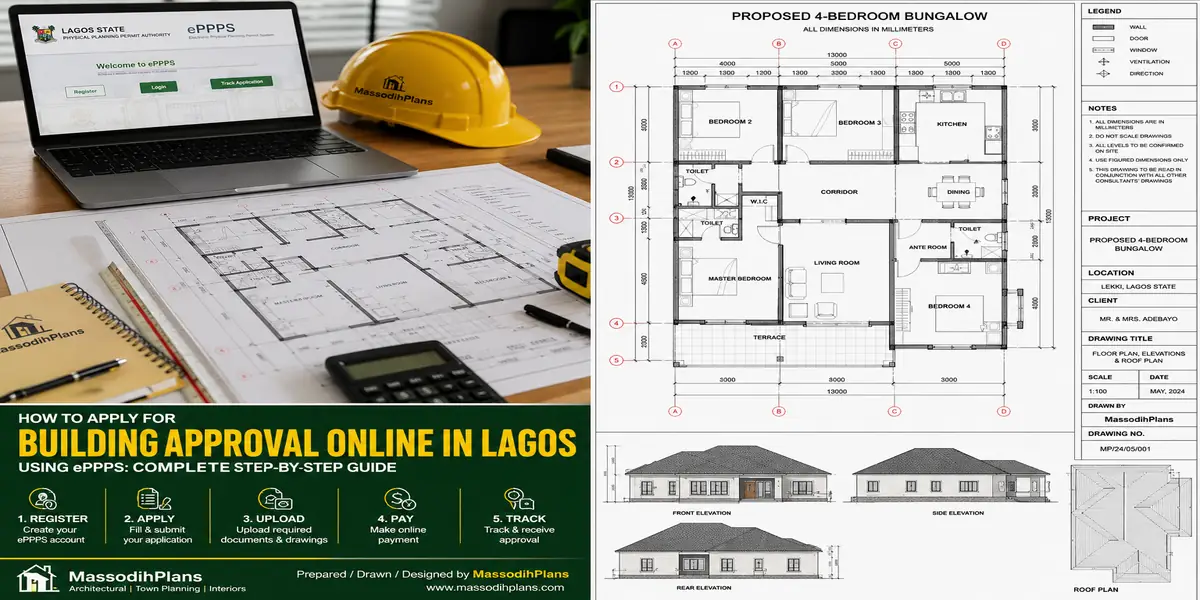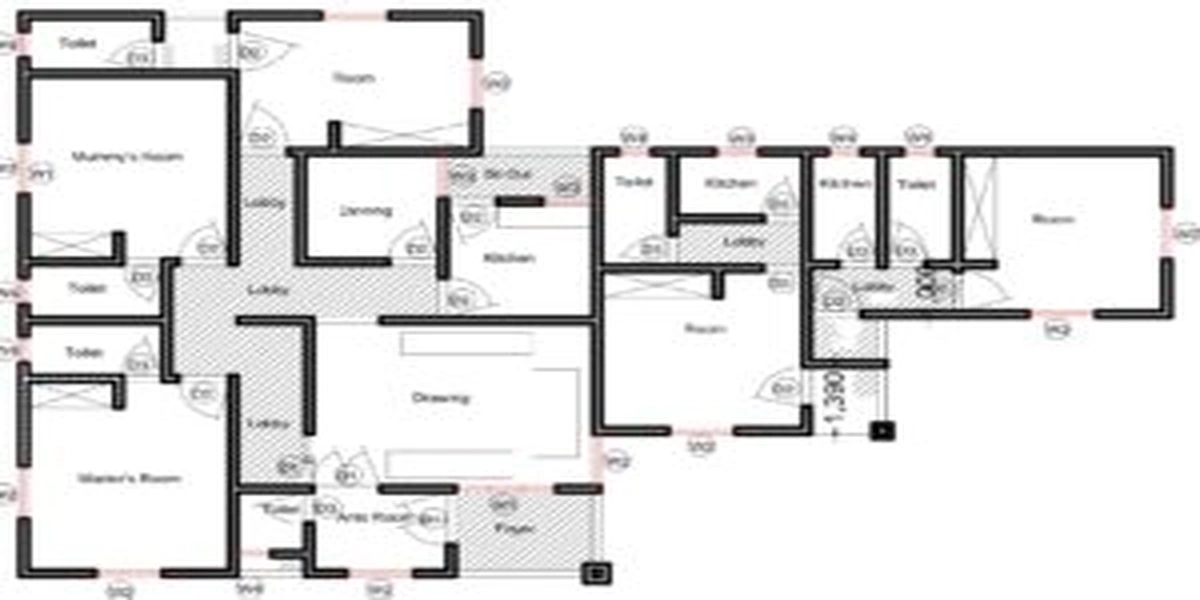
Floor plan for 1 unit of 2 bedrooms and 2 unit of selfcontained
Smart house design ideas for 50×100 plots in Nigeria in 2026 include modern bungalows, duplexes, four-bedroom family homes, open-plan living spaces, well-positioned kitchens, adequate parking, natural ventilation, and functional outdoor areas. A 50×100 plot is large enough for a comfortable, modern family house with space for drainage, a service area, and possible future expansion, provided the building is properly positioned and intelligently designed. The real challenge is knowing how much of the plot to build on, where to position the house, and how to use the remaining space without creating ventilation, drainage, or parking problems.
If you own a 50×100 plot and want to build in Nigeria, you should not choose a house plan simply because it looks beautiful in a picture. The design must suit your family’s needs, construction budget, local planning regulations, and the actual conditions of your land.
For example, a well-designed bungalow may be more affordable and practical for some families, while a duplex may offer more living space and privacy on the same plot. However, the wrong layout can waste valuable land, make rooms uncomfortable, and leave insufficient space for vehicles or essential services.
In this guide, I will walk you through practical house design ideas and floor plan options for a 50×100 plot in Nigeria in 2026, explaining what works, what to avoid, and how to make the most of your land before spending money on construction.
Understanding What a 50×100 Plot Actually Gives You
Before any drawing goes on paper, you need to understand what you are working with physically. A 50×100 plot is 50 feet wide by 100 feet deep, which in metric measurement gives you approximately 15.2 metres by 30.5 metres. The total area is approximately 465 square metres.
That is not a tiny site. A standard two-bedroom flat in Lagos Island rarely exceeds 80 square metres of floor area. A well designed 3-bedroom bungalow in Nigerian estate conditions typically has a floor area of 130 to 160 square metres. The difference between what you can build and the full site area means you have substantial space left over for the compound, parking, garden, service zones and setbacks even after the building footprint is placed.
The challenge is not the land. The challenge is the coordination. A 50×100 plot needs to accommodate the building footprint, the access driveway, parking for at least two vehicles, the perimeter fence, a borehole position, a septic system, a generator position, surface water drainage routes, laundry and service areas, and ideally some planted space. All of these elements need to fit together without any one of them compromising the others.
>I have been on plots where the homeowner started building without coordinating all of these elements and ended up with a borehole sited too close to the septic tank, a generator positioned directly outside the master bedroom window, or a driveway that blocks half the compound. Getting the site plan right before the building plan starts saves money and frustration.
What Nigerian planning regulations say about your plot
Most Nigerian state building regulations specify minimum setbacks from property boundaries. These setbacks vary by state and by building type but the typical minimum setbacks for a residential building on a standard plot in Nigerian urban areas are:
- Front setback from road or fence: 3 metres to 6 metres depending on the estate or area guidelines.
- Side setbacks from boundary walls: 1.5 metres to 3 metres on each side.
- Rear setback: 3 metres minimum.
- On a 50×100 plot applying these setbacks, the maximum building footprint you can occupy is approximately:
- Available width after side setbacks: 50 feet minus 3 metres each side = approximately 9.2 metres to 12.2 metres depending on the setback rule.
- Available depth after front and rear setbacks: 100 feet minus front and rear setbacks = approximately 20 to 24 metres.
This means a building footprint of approximately 9 metres by 20 metres is achievable within typical Nigerian regulation setbacks, which gives 180 square metres of ground floor area. For a bungalow that is a generous single-storey home. For a duplex that is a large two-storey house.
Always verify the specific setback requirements with your local State Ministry of Physical Planning or estate management authority before finalising your design. Requirements vary between Lagos, Abuja, Port Harcourt, Enugu and other states, and non-compliance can lead to enforced demolition.
The Site Plan: Where to Put Everything Before You Put Anything
The site plan is the drawing that shows your entire plot and where every element sits within it. Most Nigerian homebuilders skip the site plan and go straight to the building floor plan. This is a significant mistake.
A properly prepared site plan for a 50×100 plot should show:
- The building footprint with all setbacks dimensioned.
- The driveway route from the gate to the parking area.
- Parking positions for a minimum of two vehicles with enough room to open car doors.
- The gate position and gatehouse or gateman’s quarters if required.
- The borehole position, which should be a minimum of 15 metres from any septic tank or soakaway pit.
- The septic tank and soakaway positions, which should be in the rear or side compound area where maintenance access is practical.
- The generator position with adequate separation from bedroom windows (minimum 5 metres is good practice).
- Surface water drainage routes showing how rainwater from the building roof and compound surface flows to the street drain.
- Laundry and service area position.
- Any planted areas or landscaped zones.
I always say to homebuilders that if you cannot fit all of these elements onto a site plan sketch without something conflicting with something else, your design needs to be reorganised before you pour a single bag of concrete. A building plan without a site plan is like buying furniture before you have measured the room.
How to handle a narrow frontage on a 50×100 plot
The 50-foot width is sometimes the constraint on these plots rather than the depth. If the frontage faces a secondary street or shared access road, you need to fit your gate, driveway entry and pedestrian entrance all within the 50-foot width while leaving the street line clear.
A practical approach is to position the main gate off-centre on the frontage, leaving a wider section of the compound on one side for vehicle turning. This asymmetric arrangement looks natural on site and gives better parking functionality than a centred gate that splits the frontage into two narrow sections.
Bungalow Layout Options for a 50×100 Plot
A bungalow on a 50×100 plot is the most straightforward and most affordable design option. All living happens on a single floor, which makes it ideal for families with elderly parents, young children who need supervision, or anyone who wants the simplicity and lower construction cost of a single storey.
3-bedroom bungalow layout
A practical 3-bedroom bungalow layout for this plot size can include all of the following within a footprint of approximately 130 to 150 square metres:
- ation room behind the sofa.
- Dining area adjacent to the living room and connected to the kitchen.
- Kitchen with a store room or pantry attached.
- Master bedroom with an ensuite bathroom.
- Two additional bedrooms sharing one bathroom.
- A guest toilet accessible from the living or dining area without passing through private areas.
- An entrance lobby or foyer that creates a transition between the front door and the main living area.
- A covered front porch or veranda.
- Rear service door connecting to the back compound.
This arrangement leaves adequate space on the site for a two-car driveway and parking, a side passage for maintenance access, and a rear service yard with room for a borehole, generator position, laundry area and future Boys Quarter construction.
4-bedroom bungalow layout
A 4-bedroom bungalow on this plot is achievable with careful planning but requires keeping room sizes efficient and avoiding the temptation to enlarge the living area at the expense of circulation space. A practical approach is:
- Keep the living room at 4.5 metres by 5.5 metres rather than expanding it to 6 metres by 7 metres which would eat into bedroom space unnecessarily.
- Position the master bedroom suite at the rear of the plan for privacy from the front gate and road noise.
- Use a shared bathroom between two of the secondary bedrooms to reduce the overall plumbing and bathroom tiling area.
- Keep the kitchen practical in size (3 metres by 4 metres is enough for most Nigerian household cooking needs) rather than making it excessively large.
- Use a compact foyer of 2 metres by 2.5 metres rather than an elaborate entrance hall.
With these proportions a 4-bedroom bungalow footprint of approximately 155 to 175 square metres fits on a 50×100 plot while still respecting setbacks.
Boys Quarter option
A separate Boys Quarter (BQ) at the rear of the plot is a common requirement for Nigerian homebuilders who need accommodation for domestic staff, a security guard, or family relatives. On a 50×100 plot, a compact BQ of 20 to 30 square metres consisting of a room, small bathroom and kitchenette can be positioned at the rear boundary within the setback rules if your state allows rear outbuildings at reduced setbacks.
The BQ should have its own entrance from the service yard rather than sharing the main compound entrance, and its plumbing should be connected to the same septic system as the main house with appropriate sizing.
Duplex Layout Options for a 50×100 Plot
A duplex on a 50×100 plot makes sense when you need more total floor area than a bungalow can provide, when you want to separate family living floors from guest or extended family zones, or when you are building in an area where land values make vertical construction more financially rational than expanding horizontally.
Why a duplex works on this plot
A duplex doubles your total floor area without increasing your building footprint. If your bungalow footprint is 160 square metres, adding a full upper floor gives you 320 square metres of total living space. That is enough for a 5 or even 6-bedroom house while the compound and parking remain unchanged.
The additional cost of building the upper floor compared to the cost of acquiring a second plot and building another bungalow is dramatically lower. For families building in high-value estate areas of Lagos, Abuja or Port Harcourt, the duplex option frequently makes better economic sense than spreading a building across a larger single-storey footprint.
Ground floor layout for a 50×100 duplex
A practical ground floor arrangement for a duplex on this plot size includes:
- A formal living room positioned at the front of the house.
- A dining area connected to the kitchen.
- Kitchen with attached store and a rear service door.
- A guest bedroom with its own bathroom for visitors who should not access the upper private floors.
- A visitors’ toilet accessible from the living and dining area.
- An entrance lobby that manages the transition from outside to inside and controls access to the staircase.
- The staircase positioned centrally or toward the side of the plan so it does not cut the ground floor into awkward shapes.
Upper floor layout for a 50×100 duplex
The upper floor of a duplex is the private family zone. A practical arrangement includes:
- Master bedroom suite with a walk-in wardrobe or built-in wardrobe and an ensuite bathroom.
- Three additional bedrooms, two sharing a bathroom and one with its own ensuite if budget allows.
- A family lounge or TV room separate from the formal ground floor living room, giving family members a relaxed space distinct from the formal entertaining area below.
- A balcony accessible from the family lounge or master bedroom, providing outdoor space without requiring compound ground area.
- Landing area at the top of the staircase that provides access to all rooms without unnecessary corridors.
Staircase positioning and why it matters
The staircase in a Nigerian duplex is frequently positioned badly, and this is one of the design mistakes I see most often on sites. A staircase placed in the middle of the ground floor plan creates two disconnected zones on either side that are difficult to furnish and circulate through. A staircase placed too close to the entrance makes the arrival sequence feel immediately cramped.
The ideal staircase position in a compact duplex is toward the side or rear of the entry lobby, where it is accessible from the living area without dominating it. The staircase should have a minimum clear width of 900mm and should not have more than 16 risers between floor levels without an intermediate landing. Safe rise and tread dimensions for a Nigerian residential staircase are 175mm rise and 250mm tread as a minimum.
Room Dimensions That Work in Real Life
Drawings can make any room look spacious. Real life is measured in furniture, movement and daily use. The room dimensions I recommend for Nigerian residential buildings on 50×100 plots reflect actual furniture sizes and the way Nigerian families use their rooms, not just minimum planning standards.
Living room
The minimum practical living room for a Nigerian family home is 4.5 metres by 5.5 metres. This accommodates a 3-seater plus 2-seater sofa arrangement with a coffee table, a television unit, and still allows a 1-metre circulation path behind the seating. A slightly more generous living room of 5 metres by 6 metres is significantly better and is achievable on this plot without sacrificing bedroom space if the overall plan is compact.
The living room should not serve as a circulation corridor between the front entrance and the rest of the house. If residents must pass through the living room to access the staircase or bedroom wing, reconsider the plan.
Dining area
A dining area for 6 people needs a minimum of 3.5 metres by 3.5 metres to accommodate a table of 1.5 metres by 0.9 metres with chair pull-out space on all accessible sides and a serving path from the kitchen. Open plan dining connected to the living room works well on smaller plans because the two zones share the same spatial volume while remaining functionally distinct.
Kitchen
3 metres by 4 metres is the practical minimum for a Nigerian family kitchen that needs to accommodate a cooker, a refrigerator, adequate counter space, storage above and below the counter, and enough floor space for two people to work without colliding.
The kitchen should have a window for ventilation and a direct connection to the dining area. It should also have a rear service door to the back compound so food deliveries, gas cylinder changes and waste removal do not pass through the main living areas.
A kitchen store of 1.5 metres by 2 metres adjacent to the kitchen is one of the
most practically valuable spaces in a Nigerian home and one of the first spaces cut when plans are reduced. It provides storage for food bulk purchases, cleaning equipment, spare gas cylinders and the general accumulation of household items. Do not eliminate it.
Master bedroom
4 metres by 4.5 metres is the practical minimum for a master bedroom that accommodates a king-size bed, two bedside tables, a wardrobe of at least 1.8 metres width, a dressing area and still allows clear floor space on the non-wall sides of the bed for natural movement.
The master bedroom ensuite needs at minimum 1.8 metres by 2.4 metres to hold a water closet, wash hand basin and shower without feeling impossibly tight. 2 metres by 2.5 metres is noticeably more comfortable.
Secondary bedrooms
3.3 metres by 3.6 metres accommodates a double bed or two single beds, a wardrobe and a small desk or study table. This is the practical minimum for a bedroom that will be used by adults or teenagers. For a children’s room that may be used by two young children with bunk beds and toy storage, 3.5 metres by 4 metres is better.
Bathroom
1.8 metres by 2.2 metres is the practical minimum for a bathroom shared between two people, accommodating a shower, WC and wash hand basin. This is tighter than comfortable but workable. 2 metres by 2.4 metres is noticeably better for daily use and easier to keep clean.
Visitors toilet
A cloakroom or visitors toilet needs only 1.2 metres by 1.8 metres to hold a WC and small wash hand basin. This is adequate for short-visit use.
Ventilation: The Design Decision That Determines How Comfortable Your Home Will Be
In Nigerian climate, natural ventilation is the single most important factor determining daily comfort in a house that does not rely entirely on air conditioning. The difference between a well ventilated Nigerian home and a poorly ventilated one is the difference between sleeping comfortably on most nights and lying awake in 30-degree heat when NEPA takes light.
How cross ventilation works and why your plan needs it
Cross ventilation occurs when wind enters through an opening on one side of a room and exits through an opening on the opposite or adjacent side, drawing fresh air through the occupied space as it moves. For cross ventilation to work, the openings on both sides of a room need to be within the same air pressure zone, meaning neither should be blocked by a wall, fence or adjacent building that prevents air from reaching or leaving the opening.
On a 50×100 plot, the depth of the plot (100 feet) works in your favour for ventilation if the building is not too wide. A building footprint that is 9 to 11 metres wide with windows on both long sides will ventilate well because prevailing winds in most Nigerian locations can reach windows on the building’s rear face even though they enter from the front.
A building footprint that is 14 or 15 metres wide pushes bedrooms on the rear of a single-loaded corridor arrangement too far from any effective air source and the interior spaces become uncomfortably warm.
Window positioning for effective natural ventilation
Position windows on opposite walls of the same room wherever possible.
Use casement windows rather than louvre windows where security allows, because casement windows can be angled to direct air into the room.
High-level windows above door or window head height in living rooms allow hot air that accumulates near the ceiling to escape even when lower windows are closed for privacy.
Avoid placing wardrobes, kitchen cabinets or other large built-in furniture in
front of windows after construction. This is extremely common in Nigerian homes and destroys the ventilation design.
Roof ventilation through ridge vents and soffit vents reduces the temperature in the roof space and prevents the ceiling from becoming a heat radiator into the rooms below. This is covered in detail in the Best Roofing Sheets for Nigerian Weather: Complete Guide on this site.
Ceiling height and ventilation
A ceiling height of 3 metres versus 2.7 metres makes a meaningful difference in perceived comfort in Nigerian conditions because the larger air volume in the room takes longer to heat and the increased height puts the occupied zone further from the hot ceiling. The additional construction cost of a 300mm height increase across a whole house is modest (additional block courses and slightly longer door frames) and the comfort improvement justifies it for permanent residential buildings.
Courtyard or light well for deep plan buildings
If the building plan is more than 9 metres deep without ventilation openings on the rear face (which can happen when a rear wall sits close to the plot boundary or a Boys Quarter blocks the rear airflow), consider incorporating an internal courtyard or light well. A 2.5 metre by 2.5 metre courtyard in the centre of a deep plan building creates a ventilation shaft that draws fresh air through interior rooms that would otherwise have no cross ventilation.
This is not a new concept. Traditional Yoruba, Hausa and Igbo domestic architecture all used internal courtyards as ventilation and light sources. The principle is just as effective in a modern Nigerian home as it was in a traditional compound.
Roof Design for a 50×100 Plot: Which Type to Choose and Why
The roof is the most visible architectural element of a Nigerian home from the street and also the element with the most direct impact on comfort, drainage and maintenance cost. On a 50×100 plot the roof design must balance aesthetics, cost efficiency, rain performance and heat management simultaneously.
Hip roof
A hip roof slopes on all four sides toward the eaves, with no vertical gable ends. It is structurally more stable than a gable roof under wind loading because the aerodynamic form produces lower wind uplift forces on the roof structure. In areas prone to strong seasonal winds, the hip roof performs significantly better than a gable.
Visually, a hip roof gives a Nigerian bungalow or duplex a compact, refined appearance that reads as premium from the street. The consistent overhang on all four sides also provides better shade around the perimeter of the building which reduces heat gain through the walls.
The limitation of a hip roof is that it costs approximately 10 to 15 percent more in roofing material than a comparable gable roof because the total sheet area is larger and the complexity of the hip geometry increases installation labour time.
Gable roof
A gable roof slopes on two sides only, with vertical triangular end walls (the gables) at each end. It is simpler and cheaper to construct than a hip roof, and the gable ends can incorporate high-level louvre windows that improve natural ventilation in the roof space.
For budget-conscious builds on 50×100 plots, a clean gable roof with proper overhangs and a good quality Aluzinc sheet is an entirely practical and attractive option. The gable ends should be plastered and painted to match the main walls rather than left as bare blockwork.
Combined or contemporary roof forms
A contemporary Nigerian duplex can use a combination of flat roof sections and pitched roof sections to create a modern architectural appearance. This approach works well when the flat roof sections serve as accessible terrace areas or are used to house solar panels on a south-facing slope.
The technical requirement for flat or low-slope roof sections in Nigeria is that they must have robust waterproofing because even a 1 degree slope is insufficient to shed the volume of water from a Nigerian peak rainfall event. Reinforced bituminous membrane or PVC membrane waterproofing is required on any roof section below 10 degrees slope.
Roof overhangs and their practical value
A roof overhang of 600mm to 900mm on all sides provides shade for the walls below, which reduces heat gain through masonry. It also prevents the top of the external wall from getting wet during rain, which reduces moisture penetration into the block and plaster. Overhangs of this depth also shade windows from direct midday sun while still allowing lower-angle morning and evening light through.
Do not reduce roof overhangs to save money on sheet material. The thermal and moisture protection benefit of a proper overhang is worth significantly more than the saving in roofing material.
Parking and Compound Planning: What Really Works on a 50×100 Plot
Parking is a daily-use element of your compound that many Nigerian homebuilders treat as an afterthought and then spend years managing the consequences. A car needs approximately 2.5 metres of width and 5 metres of length for a parking bay. It also needs enough clear space in front of it to reverse out without a multi-point turn.
Two-car parking arrangement
Two cars parked side by side in front of the building require 5 metres of width and 5 to 6 metres of depth for the parking bays plus additional manoeuvring space. On the 50-foot frontage of this plot, after the perimeter fence is accounted for, approximately 12 to 14 metres of usable frontage is available for the driveway and parking.
A 2.5 metre driveway on one side leading to two parking bays gives practical access. The remaining frontage can be planted with low-maintenance grass or paved with interlocking paving blocks that improve compound drainage compared to solid concrete.
Gate positioning and turning radius
The gate should be wide enough to allow a standard SUV to pass through without requiring precise alignment. A gate opening of 3 metres minimum (3.5 metres is better) is appropriate. The gate track or swing should not obstruct the driveway when open.
Sliding gates are becoming the standard in Nigerian estate development because they do not swing into the compound and reduce the space needed to clear the gate opening. They require a proper concrete track foundation and quality steel fabrication to work reliably long-term.
Generator positioning
The generator needs to be covered (a small concrete roof over the generator position is adequate), connected to the changeover panel by an appropriate cable run, positioned away from bedroom windows and away from the borehole position. A corner of the rear compound or a purpose-built generator housing adjacent to the service yard is the most practical location.
On a 50×100 plot, the generator housing can often be incorporated into the compound perimeter wall construction at the rear, creating a recessed enclosure that keeps the unit protected and out of the way.
Gatehouse on a 50×100 plot
A full separate gatehouse is difficult to accommodate on a 50×100 plot without significantly reducing compound space. A more practical solution is a gateman’s post built into the front fence structure, essentially a covered seat position within the fence pillar arrangement that gives the gateman shelter without requiring a separate structure. If a full gatehouse is required, it should be compact (approximately 3 metres by 4 metres maximum) and positioned at the front corner of the plot adjoining the gate.
Drainage and Flooding: The Issue That Destroys Nigerian Homes That Look Perfect
I have visited Nigerian residential buildings that were beautifully finished, well built and in good locations but had standing water around the foundation for three months every year because the drainage was not planned at the design stage. Persistent moisture around a building foundation damages the waterproofing, promotes mould growth in the lower walls, causes efflorescence in the external plaster and eventually compromises the structural integrity of the foundation.
How to grade your compound properly
Proper site grading means ensuring that the finished ground level around your building slopes away from the foundation in all directions at a minimum gradient of 1 in 50 (20mm fall per metre). This sounds simple but requires deliberate thought during construction because the natural tendency when a site is excavated for foundations is to leave the spoil too close to the building.
The finished floor level inside the building should be a minimum of 300mm above the highest external adjacent ground level. In Port Harcourt and Lagos flood-prone areas, I recommend 600mm to 900mm above external ground to provide genuine flood protection.
Surface drainage channels
Concrete-lined surface drains on each side of the building collect roof runoff from the downpipes and surface water from the compound and direct it to the street drain or a collection point. The drain channel cross-section needs to be sized for the anticipated flow from your roof area during peak rainfall. A 150mm wide by 200mm deep channel is a reasonable minimum for a standard residential plot in moderate rainfall zones. In Port Harcourt or Lagos where rainfall intensity is extreme, 200mm by 250mm channels are more appropriate.
All downpipes from the gutters should discharge into the surface drain channel through a concrete splash pad to prevent erosion of the ground around the downpipe.
Septic tank and soakaway positioning
The septic tank should be positioned in the rear or side compound area where the maintenance tanker lorry can access it for periodic emptying. The soakaway pit should be downhill of the septic tank and a minimum of 15 metres from the borehole. On a 50×100 plot this 15-metre separation is achievable if both the borehole and the septic system are positioned deliberately on a site plan rather than located by the contractor wherever happens to be convenient during construction.
Materials Selection for a 50×100 Plot Build
The material choices for a Nigerian home should reflect not just initial cost but maintenance cost, availability of skilled workers for repair, and performance in Nigerian climate conditions. A material that looks impressive in a showroom but is difficult to repair when it fails five years into the building’s life is not a practical choice for a permanent Nigerian home.
External wall finishes
Sand and cement render (plaster) is the standard external finish for Nigerian sandcrete block buildings. A two-coat render system of 15mm base coat and 5mm finish coat provides adequate weather protection when properly applied and painted with good quality exterior masonry paint.
Textured exterior paint systems (Roughcast, Sandtex or similar) are more durable than standard emulsion paint on external walls because they have higher solid content and better adhesion. They cost approximately 40 to 60 percent more than standard exterior emulsion but last 5 to 8 years between repaints compared to 2 to 3 years for standard emulsion under Nigerian UV and rain conditions.
Floor finishes
Porcelain tiles of 60cm by 60cm format are the right choice for main living areas in Nigerian homes because they are hard, non-porous, easy to clean and visually spacious. The 60cm format also reduces the number of grout joints which makes maintenance easier.
For outdoor areas including the front porch, verandas and compound paved areas, use non-slip ceramic or porcelain tiles specifically rated for external use, or interlocking concrete paving blocks which are cheaper and easier to repair.
Windows
Aluminium framed windows with 1.2mm extrusion minimum are appropriate for Nigerian residentialuse. The window frame profile should include a proper water bar at the sill to prevent capillary infiltration of water under the frame during heavy rain. The gap between the window frame and the blockwork opening should be filled with cement mortar on all four sides and sealed with flexible silicone sealant on the external face.
Mosquito screening is a practical requirement for most Nigerian locations. Powder-coated aluminium mesh screens in separate sliding frames fitted behind casement windows allow the window to open without admitting mosquitoes.
For anyone planning a new build and wanting to understand how material choices interact with structural design and space planning, the plan school section of this site covers the connection between design decisions, material selection and building performance in Nigerian conditions.
Cost Estimates for Building on a 50×100 Plot in Nigeria
Cost estimates for Nigerian residential construction vary significantly by city, by finishing specification and by how well the project is managed. The numbers below are based on 2026 market conditions.
3-bedroom bungalow on a 50×100 plot
| Stage | Cost Range |
|---|---|
| Professional fees and approvals | 1,500,000 to 3,000,000 naira |
| Foundation | 12,000,000 to 18,000,000 naira |
| Blockwork and columns | 18,000,000 to 26,000,000 naira |
| Roof structure and roofing | 7,000,000 to 11,000,000 naira |
| Windows, doors and burglarproof | 5,500,000 to 9,000,000 naira |
| Plumbing and borehole | 4,500,000 to 7,500,000 naira |
| Electrical installation | 3,500,000 to 6,000,000 naira |
| Floor tiles and wall finishes | 5,000,000 to 9,000,000 naira |
| Ceiling and painting | 3,500,000 to 6,500,000 naira |
| Kitchen and sanitary fittings | 2,500,000 to 5,000,000 naira |
| External works and drainage | 3,000,000 to 5,500,000 naira |
| Contingency (10 percent) | 7,000,000 to 10,500,000 naira |
| TOTAL | 73,000,000 to 116,500,000 naira |
4-bedroom duplex on a 50×100 plot
Adding a full upper floor to the above estimate increases the structural and finishing costs by approximately 40 to 55 percent, bringing the total estimate for a 4-bedroom duplex to approximately 102,000,000 to 180,000,000 naira at 2026 prices.
These figures cover a mid-range finishing specification. Budget finishing (lower quality tiles, basic sanitary fittings, standard aluminium windows) can reduce the total by 15 to 20 percent. Premium finishing (large-format porcelain tiles, European sanitary fittings, stone coated roofing) can increase it by 20 to 30 percent.
For a full breakdown of how material costs contribute to these totals, the building materials price guide covers every major material category with 2026 prices across Lagos, Abuja and Port Harcourt.
How to Reduce Building Cost on a 50×100 Plot Without Reducing Quality
Keep the plan simple
A rectangular building footprint uses less material per square metre of floor area than any other shape. Every projection, bay window or plan indentation adds external wall area, foundation perimeter and roof complexity that increases cost without adding to liveable floor area. Design for a simple perimeter and spend the saving on quality materials.
Specify long-span roofing sheets cut to your exact rafter length
Factory-cut long-span sheets eliminate site waste and edge rust. Order them to your exact measured rafter dimension from ridge to eave. The cost of precision cutting at the factory is recovered in the material saved from site offcuts.
Use 24-gauge Aluzinc as the minimum roofing sheet specification
26-gauge sheets save approximately 800 to 1,200 naira per square foot compared to 24-gauge. On a roof of 200 square metres that saving is approximately 160,000 to 240,000 naira. A single repair call-out for a failing roof caused by inadequate gauge will cost more than that. The specification matters.
Build the structure completely before starting any finishing
Finishing materials bought before the structure is complete are exposed to site conditions, get damaged, get stolen or become difficult to match if quantities are underestimated. Complete the roof and make the building weathertight before purchasing a single floor tile.
Get a bill of quantities before accepting any contractor quote
This point cannot be overstated. A quantity surveyor’s bill of quantities prepared from your working drawings is the only document that allows you to compare contractor quotes item by item and identify where one contractor is cheap because of genuine efficiency versus cheap because they have excluded necessary work.
Security and Privacy Planning for a 50×100 Plot
Nigerian residential design treats security not as paranoia but as a practical requirement that shapes building placement on the plot, window arrangement, and compound organisation.
Perimeter fence
A 2.4 metre high block fence with plaster and concrete coping provides adequate physical security for most Nigerian residential neighbourhoods. In higher risk areas, add broken glass or barbed wire on top of the coping or specify an anti-climb profile on the coping instead.
The fence should have a steel gate at the front that is strong enough to resist forced entry. Heavy-duty steel box section frames with 10mm steel sheet infill panels or solid steel bar infill are appropriate for areas with higher security concerns.
Building position relative to the street
Positioning the main living room and master bedroom away from direct sightlines from the street improves privacy. Locating the guest bedroom and formal living room toward the front of the plan creates a buffer zone between the street and the private family areas.
Window opening sizes on boundary sides
Windows on the side of the house facing the neighbour’s plot or the rear plot boundary should be smaller and higher than windows on the interior-facing sides. High-level windows on boundary sides allow light and ventilation without creating viewpoints into adjacent plots.
For a comprehensive understanding of how setback rules and boundary conditions affect your design options on a 50×100 plot, the setback rules and plot planning guide on this site explains Nigerian planning regulations in plain language with practical examples.
Lifestyle Planning: Designing for How Your Family Actually Lives
The best house plan on a 50×100 plot is not the one with the most rooms or the most impressive street elevation. It is the one that supports the way your specific family lives from day to day.
Families with young children
The living room and kitchen should be positioned so that an adult in the kitchen can see or hear activity in the main play area. A compact family room adjacent to the kitchen works better for families with young children than a formal living room separated by a corridor.
Ground floor toilet access is important. Children should not need to climb stairs to access a bathroom from the main living area.
Families with elderly parents
If an elderly parent will live in the house permanently, a ground floor bedroom with ground floor bathroom access is essential. The path from that bedroom to the kitchen and living room should be level, without steps, and wide enough for comfortable movement (minimum 1.0 metre clear width in corridors).
Work from home
A dedicated home office or study is one of the most practical spaces to include in a Nigerian residential design. Even a compact 3 metres by 3 metres room with a window, adequate power points and a door that closes properly dramatically improves the experience of working from home compared to using a corner of the bedroom or a dining table.
Position the study or home office away from the front of the house to reduce road noise impact, and away from children’s play areas for obvious reasons.
Entertaining and guests
Nigerian cultural life involves regular hosting of guests, extended family visits and celebrations. The formal living room and dining area should be easily accessible from the entrance without requiring guests to pass through private family areas. The guest bedroom on the ground floor of a duplex or at the end of a bungalow bedroom wing gives visiting guests their own space without disturbing the daily routine of the household.
Construction Mistakes That Are Specific to 50×100 Plot Builds in Nigeria
Oversized living room that eats into bedroom and service space
I have reviewed plans where the living room was 8 metres by 7 metres on a plot that could not support that footprint without compressing the bedrooms to 3 metres by 3 metres and eliminating the kitchen store. A living room should be as large as the rest of the plan can comfortably support. It should not be determined first and everything else fitted around it.
No service entrance to the kitchen
If the kitchen only opens into the main living areas, every delivery, cooking smell, gas cylinder change, and refuse removal moves through the formal parts of the house. Every kitchen on a Nigerian residential building should have a separate service door to the rear compound.
Staircase positioned as an afterthought in a duplex
The staircase is a structural element that must be positioned during the initial design, not added to the plan after the room arrangement is fixed. A staircase in the wrong position forces awkward circulation patterns that affect daily life for the life of the building.
Drainage left to the contractor to sort out
Drainage is a design element, not a construction detail. If it is not on the drawings, the contractor will handle it based on personal preference and site convenience, which frequently results in water accumulating against the foundation wall.
Skipping soil investigation
A soil test before foundation design costs between 80,000 and 250,000 naira. Foundation failure on a building where the soil was not investigated costs multiples of the entire building value to rectify. This is not optional.
Not planning for solar from the beginning
Solar power adoption in Nigeria is increasing rapidly because the economics are compelling. A roof structure not designed to carry the additional weight of solar panels. With no conduit routes pre-installed and no south-facing orientation. Costs significantly more to retrofit for solar than a building designed for it from the start. Plan for solar now even if you install the panels in year three.
Investment Value of a Well-Designed 50×100 Plot House
A well-designed house on a 50×100 plot in Nigeria is a strong investment with practical size, affordable cost, and broad market appeal.
Its functional layout attracts many buyers or tenants, making resale or rental opportunities easier when you choose to sell.
Well-finished houses in prime Nigerian locations often deliver annual rental yields between 8 and 12 percent.
In Lagos, Abuja, and Port Harcourt, demand for quality 3 and 4-bedroom homes often exceeds supply.
This strong demand helps maintain property value even during difficult economic periods.
A duplex on a 50×100 plot allows owners to live upstairs and rent out the other section.
Rental income can help repay construction costs or reduce mortgage pressure over time.
This flexibility makes duplexes ideal for maximizing returns on manageable Nigerian plot sizes.
The plans library contains completed bungalow and duplex drawings for standard Nigerian plots, including 50×100.
These plans help you understand realistic design possibilities before paying architectural design fees.
The services page explains how professionals approach design on constrained Nigerian plots.
It helps you work with experts who understand practical building conditions across Nigeria.
For international reference on tropical residential design principles including ventilation, solar shading and site planning in hot humid climates, the ASHRAE Handbook of Fundamentals provides the engineering and climate science behind the practical design recommendations in this guide.
Frequently Asked Questions
Q: What size house can I build on a 50×100 plot in Nigeria?
A: After applying standard Nigerian planning setbacks, a building footprint of approximately 9 metres by 20 metres is achievable. This gives 180 square metres of ground floor area, enough for a generous 3 or 4-bedroom bungalow. A duplex on the same footprint doubles the total floor area to approximately 360 square metres.
Q: Can a 4-bedroom duplex fit on a 50×100 plot?
A: Yes. A 4-bedroom duplex fits comfortably on a 50×100 plot when the plan is efficiently arranged. The ground floor accommodates living, dining, kitchen, guest bedroom and visitors toilet. The upper floor holds the 4 bedrooms with bathrooms and a family lounge.
Q: How many cars can park on a 50×100 plot?
A: Two cars can park comfortably in a side-by-side arrangement in front of the building. With careful gate and driveway positioning, three cars are sometimes possible. The arrangement depends on the building position and front setback depth.
Q: What is the best roof type for a Nigerian home on a 50×100 plot?
A: A hip roof gives the best wind resistance and visual quality but costs 10 to 15 percent more than a gable roof. A gable roof is practical, cost-effective and performs well when properly constructed. For a modern contemporary appearance, a combination of flat and pitched roof sections works well on a duplex.
Q: How do I improve ventilation in a house on a 50×100 plot?
A: Position windows on opposite walls of every room to enable cross ventilation. Use casement rather than louvre windows. Include high-level windows in living areas. Install ridge vents and soffit vents to ventilate the roof space. Keep ceiling heights at 3 metres or above.
Q: How much does it cost to build on a 50×100 plot in Nigeria in 2026?
A: A 3-bedroom bungalow costs approximately 73 million to 116 million naira at mid-range specification in 2026. A 4-bedroom duplex costs approximately 102 million to 180 million naira. These figures exclude land purchase cost.
Author
Massodih Okon is a Nigerian built-environment professional with academic and professional experience in urban and regional planning, geography, architectural design, Landscape Design, GIS and land development.
He holds a Master’s degree in Urban and Regional Planning from the University of Uyo and a first degree in Geography and Regional Planning.
Through MassodihPlans, he publishes practical guides on Nigerian house plans, building design, physical planning, site planning, development approval and residential construction. Read the full author profile →
Call to Action
If you are planning to build on a 50×100 plot, start with the layout before you start with blocks. A well thought out plan saves money, improves comfort, and gives your home lasting value. Explore more MassodihPlans articles on Nigerian house plans, small plot design. And construction cost planning to move from idea to a real build with confidence.
Related Posts
- 7 Small Plot Design Mistakes Nigerians Make (And How to Fix Them)
- Modern Duplex House Plan for 50×100 Plot in Lagos
- House Plans: Complete Guide to Floor Plans, Building Drawings, Home Designs & How to Design a House
- House Plan Selection Guide: How to Choose the Right House Plan for Your Land, Budget and Lifestyle
- Land-Buying Checklist: 100+ Things to Check Before Buying Land in Nigeria
- Building Project Budget Template: Complete House Construction Cost Planner
- Homeowner’s Construction Checklist: 150+ Things to Check Before and During Building
- Building Materials Checklist: 100+ Materials You May Need When Building a House
- Site Analysis Checklist: 50+ Things to Check Before Building on Your Land
- House Planning Checklist: 50+ Essential Things to Check Before Building a House (Complete Guide)
- Building Cost Calculator Nigeria: Estimate Your House Cost in 60 Seconds
- Affordable Bungalow Plan for 40×80 Plot in Port Harcourt
- Cost of Roofing a Bungalow and Duplex in Abuja Small Plot Now
- Best 4 Bedroom House Plan for Small Plots in Abuja
- Current Cost of Building a House in Port Harcourt (Professional Analysis)
- Smart Duplex Design for Narrow Plots in Lekki, Nigeria: Complete Practical Guide
- Full Cost Breakdown for Building a Duplex on a Small Plot in Kano Nigeria
- Building Approval in Nigeria: Costs, Requirements, Process and How to Get Your House Plan Approved Fast
- Modern Nigerian House Plan for a 30×60 Plot in Ibadan: The Complete Practical Guide
- Best Small Plot House Designs for Modern Urban Living
- How to Draw a 3 Bedroom Floor Plan in a Small Plot Step by Step
- Best Places to Buy Land in Uyo for Fast Development and High Property Value
- Building Materials Price Guide in Nigeria (Full Cost Guide)