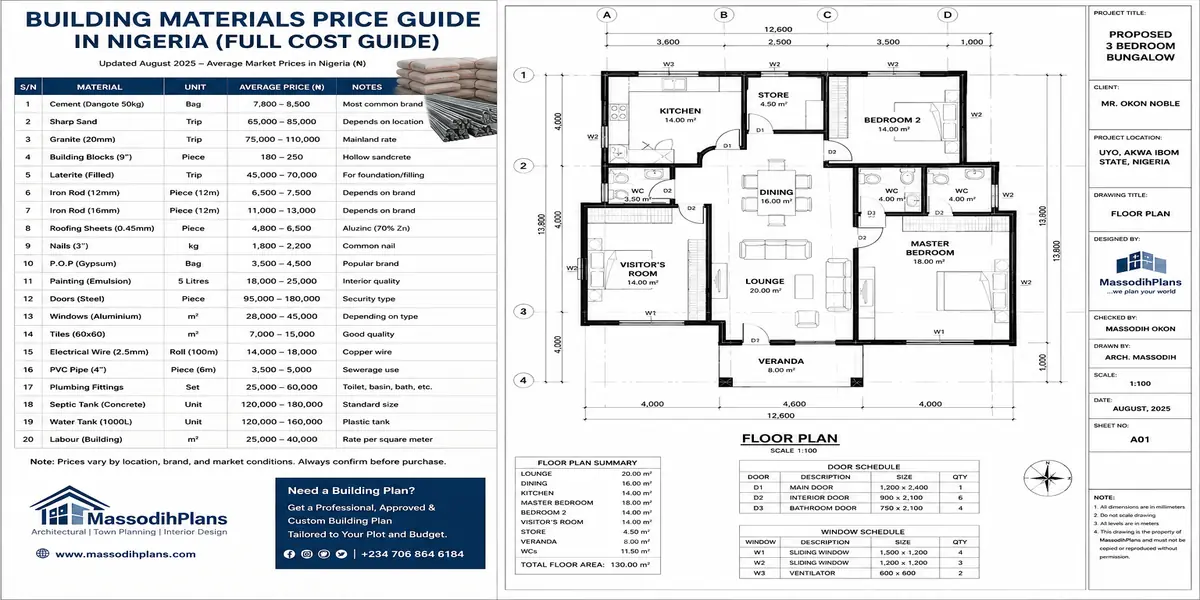
Building Materials Price Guide in Nigeria (Full Cost Guide)
Building materials prices in Nigeria vary by location, supplier, quality, and market conditions, but a bag of Dangote cement may cost around ₦12,500–₦13,000, while a 6-inch sandcrete block may sell for ₦350–₦450. To estimate your total building cost accurately, you need to consider not just cement and blocks, but also sand, granite, reinforcement rods, roofing sheets, doors, windows, plumbing and electrical materials, tiles, paint, labour, transportation, and finishing. For a standard four-bedroom bungalow, the total construction cost can reach tens of millions of naira, depending on the design, location, foundation, material specifications, and level of finishing, excluding land. This guide breaks down the major building material costs in Nigeria, explains how to estimate quantities, and shows you how to plan your budget before purchasing materials.
The real cost of building in Nigeria is often hidden in hundreds of smaller expenses that can quietly push your budget millions of naira above your original estimate.
This guide covers the prices of essential building materials, practical quantity estimates, location-based price differences, and realistic calculations you can use before buying your first truckload of materials.
Construction prices in Nigeria can change dramatically because of transportation costs, fuel prices, exchange rates, supply shortages, location, brand, and the supplier you choose. A price that looks affordable today can become an expensive mistake tomorrow.
Construction budgets can also spiral out of control when materials are purchased without proper quantity estimates or homeowners fail to track where their money is going. Understanding material prices and calculating what your project actually requires can help you avoid unnecessary spending and make better purchasing decisions.
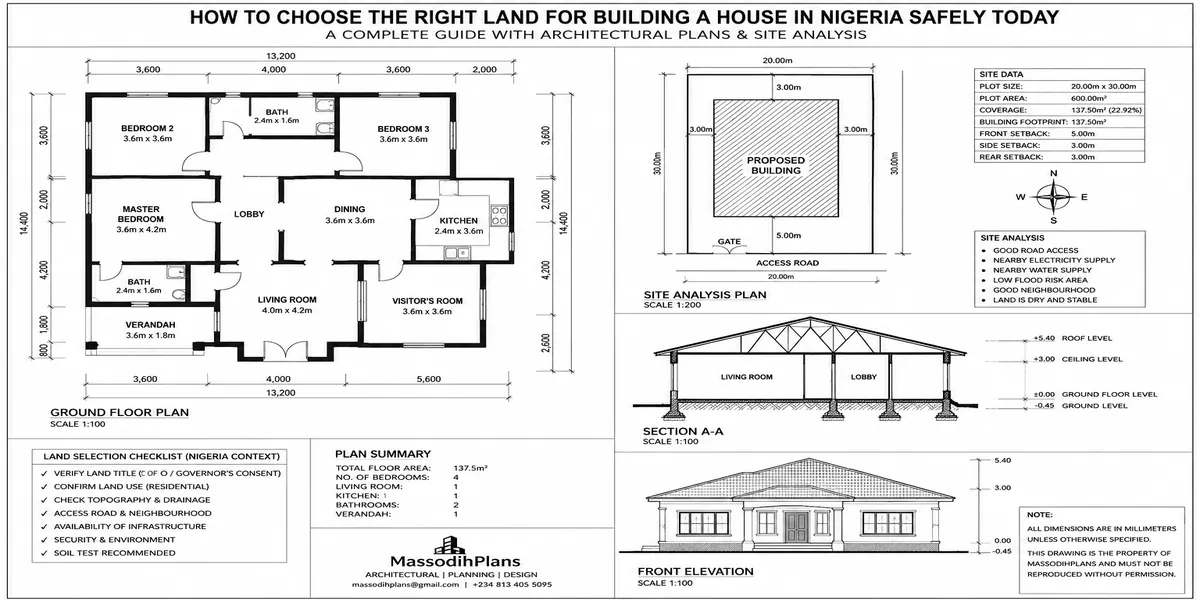
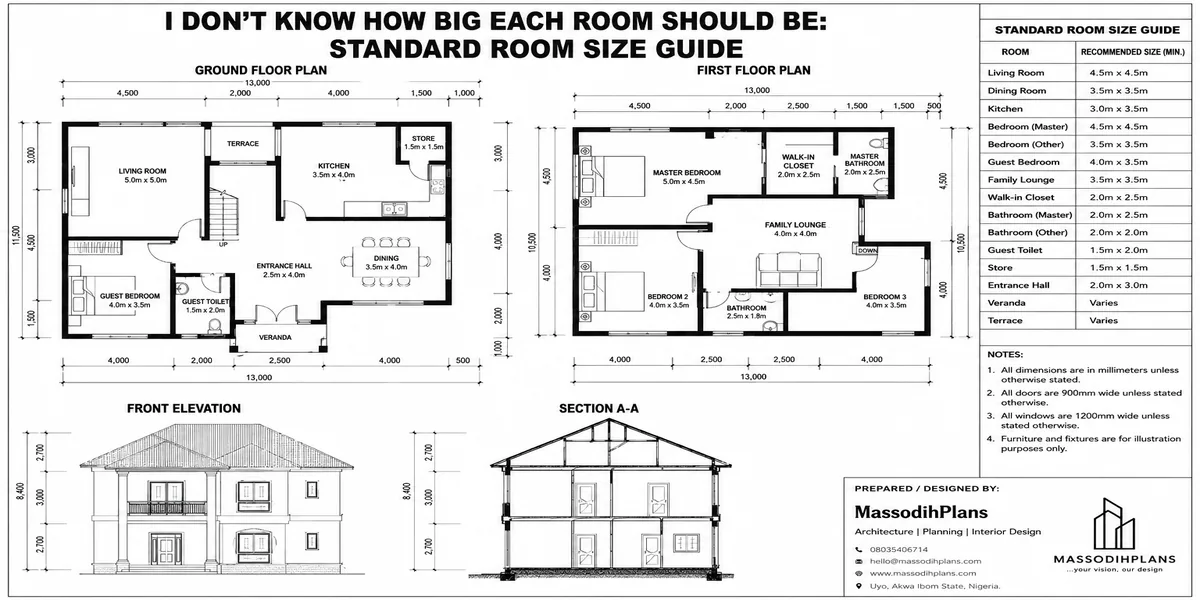
This is designed to help you avoid both problems. By the end, you should have a much clearer picture of what Nigerian building materials actually cost, how much you may need, and where your biggest construction expenses are likely to come from. The design of your house also affects the quantity of materials and labour required. Our complete guide to house plans, floor plans, and home design explains how different layouts and designs influence the way a building is planned and constructed.
Why Building Material Prices in Nigeria Are So Difficult to Pin Down
Before you use any price in this guide, you need to understand why Nigerian material prices move the way they do. This context will help you negotiate better, plan smarter, and avoid the trap of building a budget in January and discovering it is completely wrong by April.
The naira-dollar exchange rate is the master variable
Almost every major building material in Nigeria is either imported or produced using imported inputs. Cement clinker, steel billets for iron rods, aluminium coil for roofing sheets, PVC resin for pipes, ceramic raw materials for tiles. When the naira loses value against the dollar, the manufacturing cost of all of these materials rises within four to eight weeks as existing inventory sells through and new production runs at higher input costs.
Between 2023 and 2025, the naira lost more than 60 percent of its value against the dollar. During that period, cement prices more than doubled. Iron rod prices increased by over 80 percent. Anyone who planned a 2023 build budget and tried to execute it in 2025 was looking at a cost increase of 40 to 70 percent on the structural materials alone.
The practical implication: treat this guide as a baseline for planning and get fresh market quotes immediately before you purchase. Prices from three months ago may be meaningfully different from today.
Fuel costs and transportation amplify the exchange rate effect
Materials manufactured in Lagos or Kano need to reach Abuja, Port Harcourt, Calabar or Warri. With diesel above 1,200 naira per litre in 2026, transport adds 8 to 20 percent to material costs for cities further from production centres. Port Harcourt and Calabar sit at the high end of this transport premium because they are geographically distant from the largest cement and block manufacturing facilities.
Seasonal demand shifts prices meaningfully
Construction activity in Nigeria peaks between October and March, which is the dry season when concrete work, block laying and roofing can proceed without rain delays. During this period, demand for cement, aggregate and labour increases and prices rise accordingly. During the rainy season from April to September, prices soften slightly on most materials except in areas actively building despite rain.
The implication for your budget: if you can stage your purchase of bulk materials like cement and iron rods during the rainy season, you will often pay 8 to 12 percent less than the same purchase in the dry season peak.
Foundation Materials: Prices, Quantities and What No One Tells You
The foundation represents 15 to 20 percent of your total building budget for a standard Nigerian residential structure. It is also the component where cutting corners produces consequences that are genuinely irreversible. A leaking roof can be repaired. Foundation failure is a building-ending event.
Cement
Cement is the single most price-sensitive material in a Nigerian build budget because it is used in every stage from foundation to finishing. The major brands available in Nigeria in 2026 are Dangote Cement, BUA Cement, Lafarge Elephant Cement and Sokoto Cement (Unicem in the south).
2026 prices by city:
- Lagos (Mile 2, Cement Market, Alaba): 10,500 to 13,000 naira per 50kg bag depending on brand and purchase quantity.
- Abuja (Kugbo Market, Nyanya): 11,000 to 13,500 naira per 50kg bag.
- Port Harcourt (Rumuola, Trans-Amadi): 11,500 to 14,000 naira per 50kg bag.
- Kano (Kantin Kwari and building material markets): 10,000 to 12,500 naira per 50kg bag.
Dangote typically prices at the top of these ranges in southern cities due to brand premium and distribution strength. BUA is usually 500 to 800 naira per bag cheaper in areas where their distribution is strong. For structural concrete work, both are appropriate. For plastering and floor screeds, the difference in price matters more because volume is higher.
How much cement does a 4-bedroom bungalow need?
Foundation (footings, ground beam and ground floor slab for 150sqm floor area): approximately 250 to 350 bags.
- Block laying and jointing for walls: approximately 120 to 180 bags.
- Columns and beams: approximately 80 to 120 bags.
- Plastering (internal and external): approximately 200 to 280 bags.
- Floor screed: approximately 60 to 90 bags.
Total cement requirement for a typical 4-bedroom bungalow: approximately 710 to 1,020 bags depending on plan configuration, floor area and specification.
At an average price of 12,000 naira per bag, cement alone represents between 8.5 million and 12.2 million naira of your building budget.
Sharp sand
Sharp sand (coarse river sand or quarry sand) is used for concrete mixes. It should be clean, free of clay, silt and organic material, and have a good particle size distribution. The yellow or orange sand from river or quarry sources is appropriate for structural concrete. Do not use fine beach sand or topsoil-contaminated fill for structural work.
- Lagos: 9,000 to 12,000 naira per ton.
- Abuja: 8,500 to 11,000 naira per ton.
- Port Harcourt: 10,000 to 14,000 naira per ton (higher due to limited good quality local sources).
- Kano: 7,500 to 9,500 naira per ton (excellent local sand supply reduces cost).
A standard 4-bedroom bungalow foundation through to ground floor slab requires approximately 25 to 40 tons of sharp sand.
Gravel and granite chippings
Crushed granite aggregate is the standard coarse material for structural concrete in Nigeria. 3/4-inch (19mm) chippings are used for columns and beams. 3/8-inch (10mm) chippings are used for slabs and thinner elements.
- Lagos: 18,000 to 25,000 naira per ton.
- Abuja: 17,000 to 23,000 naira per ton.
- Port Harcourt: 20,000 to 28,000 naira per ton.
- Kano: 15,000 to 20,000 naira per ton.
A standard foundation through to ground floor slab requires 20 to 30 tons of aggregate. Always verify that your supplier is providing genuine crushed granite rather than laterite gravel or weak sedimentary stone. Granite aggregate from certified quarries will show a hard, sharp, angular surface. Weak stone is rounder and softer and will crumble when struck with a hammer.
Iron rods (reinforcement steel)
Reinforcement bars are sold in standard lengths of 12 metres per piece. The common sizes used in Nigerian residential construction are:
- Y10 (10mm high yield bar): Used for links, stirrups and light reinforcement. 2026 price: 6,500 to 8,000 naira per 12-metre length.
- Y12 (12mm high yield bar): The most commonly used bar for foundations, columns and beams in standard residential builds. 2026 price: 8,000 to 10,500 naira per 12-metre length.
- Y16 (16mm high yield bar): Used for major beams, transfer beams and high-load columns. 2026 price: 14,000 to 17,500 naira per 12-metre length.
- Y20 (20mm high yield bar): Used for heavily loaded elements. 2026 price: 20,000 to 25,000 naira per 12-metre length.
A standard 4-bedroom bungalow with proper engineered design will require approximately 3.5 to 5 tonnes of reinforcement steel in total across foundation, columns, beams and slabs.
Critical warning about substandard iron rods in Nigeria:
The Nigerian market has a significant problem with substandard reinforcement steel that is undersized (the actual diameter is less than stated), has inadequate yield strength, or is made from recycled scrap without proper quality control. These bars bend easily, do not bond well to concrete, and provide inadequate structural strength.
Buy from major local steel mills or authorised distributors. Ask for the mill certificate (test certificate) for the batch. If a dealer cannot provide documentation, buy from someone who can. The consequences of structural failure from inadequate reinforcement are permanent.
Soil testing before you pour
I want to spend a moment on soil testing because almost every Nigerian homebuilder I have worked with initially resisted it as an unnecessary cost. A geotechnical investigation (soil test) for a residential plot costs between 80,000 and 250,000 naira depending on the number of boreholes and tests required. For a single residential plot, a standard soil investigation with 2 to 3 test pits or shallow boreholes and basic laboratory analysis is the appropriate scope.
The information a soil test gives you includes the bearing capacity of the soil (which directly determines what type and depth of foundation you need), the water table level (critical for determining whether your foundation needs waterproofing or raft design), the presence of expansive clay (which requires special foundation design in parts of Abuja and the South-East) and the presence of fill or made ground (especially important on reclaimed or disturbed Lagos and Port Harcourt plots).
Skipping soil testing to save 150,000 naira on a building that will cost 100 million naira is a calculation that makes no sense. The foundation design decisions that a soil test informs are irreversible once concrete is poured.
Block Work and Wall Construction: Prices, Specifications and the Quality Problem
Walls in a standard Nigerian residential building represent the largest single category of material expenditure, typically 25 to 35 percent of the total structure cost. Sandcrete blockwork is the dominant wall construction method and has been for decades, primarily because the materials are locally available, labour is well-understood, and the thermal mass helps moderate interior temperatures.
Sandcrete blocks: prices by type and city
6-inch sandcrete block (150mm nominal thickness):
Standard market price 2026: 350 to 450 naira per block.
- Lagos: 400 to 450 naira per block.
- Abuja: 380 to 430 naira per block.
- Port Harcourt: 410 to 460 naira per block.
- Kano: 320 to 380 naira per block.
9-inch sandcrete block (225mm nominal thickness):
Standard market price 2026: 500 to 650 naira per block.
- Lagos: 570 to 640 naira per block.
- Abuja: 550 to 620 naira per block.
- Port Harcourt: 590 to 660 naira per block.
5-inch sandcrete block (125mm nominal thickness, used for internal partitions): Standard market price 2026: 250 to 320 naira per block.
How many blocks does a 4-bedroom bungalow need?
For a simple rectangular 4-bedroom bungalow with a floor area of approximately 150 to 180 square metres, you will need:
- External walls in 9-inch blocks: approximately 2,800 to 3,400 blocks.
- Internal partition walls in 6-inch blocks: approximately 3,200 to 4,000 blocks.
- Total: approximately 6,000 to 7,400 blocks for the complete building above foundation level.
At an average price of 420 naira for 6-inch and 590 naira for 9-inch, the block material cost alone for a standard 4-bedroom bungalow is approximately 2.8 million to 3.8 million naira before mortar, labour or any other wall-related cost.
The quality problem with Nigerian sandcrete blocks
This deserves direct attention because it is one of the most significant sources of construction failure in Nigerian residential buildings. A properly made sandcrete block for structural wall use should have a compressive strength of at least 3.5 megapascals (N/mm2) at 28 days. This requires a specific mix ratio of cement to sand and proper compaction through mechanical vibration during manufacture.
The blocks you buy from a roadside block-moulding enterprise do not necessarily meet this standard. Many Nigerian roadside block manufacturers use too much sand, not enough cement, and hand-compaction rather than vibration. The resulting blocks are soft, absorb water readily, crack during laying and provide inadequate lateral strength to the wall.
You can do a simple field test: press your thumbnail firmly into the surface of the block. On a good quality block you will not leave a mark. On a substandard block your thumbnail will penetrate slightly into the surface. This is not a precise structural test but it gives you a quick indication.
For structural walls on a permanent building, specify factory-produced or plant-mixed vibrated blocks from a supplier who can show you their mix design. Better manufacturers in the major cities do exist and the price premium of 40 to 80 naira per block is recovered many times over in building quality and durability.
Cement for block laying and plastering
Mortar for laying blocks uses a cement to sand ratio of 1:6 for standard laying and 1:4 for high-strength jointing. One 50kg bag of cement makes enough mortar for approximately 50 to 60 standard blocks when used at 1:6 ratio.
For plastering, one 50kg bag of cement mixed with 4 to 5 parts sand covers approximately 8 to 10 square metres of wall surface at a 12mm render thickness.
Curing is non-negotiable. Laid blockwork and plaster must be kept wet for a minimum of 7 days and ideally 14 days. Blocks allowed to dry out too quickly in the Nigerian sun develop surface cracks that are cosmetically repaired but structurally weak. Every contractor will tell you they cure properly. Supervise it yourself.
Roofing Materials: Full 2026 Price Guide
The roof is the most exposed element of your building and the one with the most immediate financial consequence if it fails. A roof that leaks destroys ceilings, walls, electrical installations and floor finishes, and creates conditions for mould growth that is genuinely difficult and expensive to remediate.
For the complete technical guide to roofing sheet types, gauge specifications, profile selection and installation requirements for Nigerian conditions, the roofing sheets guide on this site covers every detail you need before you order materials or engage a roofing contractor.
Long-span Aluzinc roofing sheets
Long-span aluminium zinc sheets are the standard specification for permanent Nigerian residential roofing. They offer superior corrosion resistance compared to plain galvanized iron, can be ordered in custom lengths that eliminate joints, and carry 15 to 25 year warranties from reputable manufacturers.
2026 prices per square metre installed (including labour, fasteners and ridge):
- 24-gauge Aluzinc: 11,000 to 14,500 naira per square metre.
- 22-gauge Aluzinc (recommended for coastal areas): 13,000 to 17,000 naira per square metre.
- Stone coated Aluzinc: 16,000 to 22,000 naira per square metre.
For supply only (excluding labour):
24-gauge Aluzinc: 7,200 to 8,500 naira per square foot in Lagos; 6,900 to 8,000 naira per square foot in Abuja; 7,600 to 9,000 naira per square foot in Port Harcourt.
Timber trusses
Traditional timber roof trusses using hardwood from Benin and Cross River forest zones are still widely used in Nigerian residential construction. They provide good strength, are familiar to local carpenters and can be fabricated on-site.
The price for timber trusses in 2026 is 45,000 to 70,000 naira per truss span for a standard 5 to 6 metre span. A 4-bedroom bungalow with a hip roof requires approximately 8 to 12 principal trusses plus common rafters and purlins, bringing the timber framing cost to approximately 600,000 to 1,000,000 naira before treatment or installation.
All timber used in roof structures must be treated with a wood preservative against termite and fungal attack. Untreated timber in Nigerian roof spaces typically shows termite activity within 5 to 8 years in the south and 8 to 12 years in the north. Borate-based timber treatments are the most environmentally appropriate and effective for Nigerian conditions. Treatment adds approximately 20 to 35 percent to the timber cost but extends service life many times over.
Steel trusses
Fabricated steel roof trusses are increasingly used in Nigerian residential construction, particularly for larger spans and in flood-prone areas where timber rots over time. Steel trusses cost more upfront but require no anti-termite treatment, can span greater distances without intermediate support, and last the life of the building.
2026 fabricated steel truss prices for a 6-metre residential span: 85,000 to 140,000 naira per truss fully fabricated and hot-dip galvanized.
Windows, Doors and Opening Works: 2026 Prices
Windows and doors in Nigeria serve a dual function of climate management (ventilation and natural light) and security. The design of your openings affects energy consumption, comfort and safety simultaneously.
Aluminium windows
Aluminium framed windows dominate the Nigerian residential market because aluminium does not rust, the profiles are available in standard and custom sizes across every major city, and they accept mosquito netting without additional framing.
Standard casement window 1200mm x 1200mm (4ft x 4ft): 85,000 to 125,000 naira in Lagos; 80,000 to 115,000 naira in Abuja; 90,000 to 130,000 naira in Port Harcourt.
Sliding window 1200mm x 900mm: 65,000 to 90,000 naira.
Louvre window 600mm x 1200mm: 35,000 to 55,000 naira.
Quality variation in Nigerian aluminium windows is significant. The thickness of the aluminium extrusion matters. Budget aluminium windows use 0.8mm to 1.0mm wall thickness extrusions that flex, distort and fail at the corner joints within 5 years. Proper commercial grade aluminium windows use 1.2mm to 1.6mm extrusions that maintain shape and seal for 20 or more years.
Ask your supplier for the extrusion specification before ordering. The price difference between budget and proper specification is approximately 15 to 25 percent, which is worth every naira on a building you intend to keep for 20 years.
Security burglarproof frames
Every ground-floor window in a Nigerian residential building requires a security burglarproof frame. This is not optional in any Nigerian city. Standard pressed steel or welded bar burglarproof frames in 2026 cost:
- Standard 1200mm x 900mm frame: 55,000 to 80,000 naira.
- Heavy-duty 1800mm x 1200mm frame: 90,000 to 140,000 naira.
- Decorative wrought-iron style (artistic burglarproof): 120,000 to 250,000 naira depending on design complexity.
External entrance doors
The entrance door to a Nigerian residence is a security element above all else. Solid hardwood doors (mahogany, iroko, obeche) provide good security but require maintenance including repainting every 3 to 5 years to prevent moisture damage and surface degradation under UV.
- Solid mahogany entrance door 900mm x 2100mm with frame: 350,000 to 650,000 naira.
- Steel security door with hardwood veneer facing 900mm x 2100mm: 280,000 to 450,000 naira.
- Imported pre-hung security door sets with multi-point locking: 650,000 to 1,500,000 naira.
Internal doors
Flush hollow-core doors are the standard for internal rooms in Nigerian residential buildings. They are lightweight, accept standard mortice locks, and are affordable.
- Hollow flush door 800mm x 2100mm with frame: 70,000 to 110,000 naira.
- Solid panel door (bedroom or bathroom): 110,000 to 180,000 naira.
- WC/bathroom door (moisture resistant): 85,000 to 130,000 naira.
A 4-bedroom bungalow with living room, dining, kitchen, 4 bedrooms and 3 bathrooms typically requires 12 to 15 internal doors plus the main entrance and 1 to 2 utility doors.
Plumbing Materials: 2026 Prices and Nigerian Reality
Plumbing in Nigeria operates against a backdrop of intermittent water supply, high groundwater tables in coastal areas, and the near-universal dependence on boreholes for domestic water. This shapes every decision about your plumbing system design.
PVC pipes and fittings
PVC is the standard pipe material for both water supply and drain waste vent systems in Nigerian residential buildings.
- 2-inch (50mm) PVC pressure pipe: 7,500 to 10,000 naira per 6-metre length.
- 3-inch (75mm) PVC drain pipe: 10,000 to 13,500 naira per 6-metre length.
- 4-inch (100mm) PVC drain pipe: 14,000 to 18,000 naira per 6-metre length.
- 6-inch (150mm) PVC drain pipe: 22,000 to 28,000 naira per 6-metre length.
Fittings (elbows, tees, reducers) add approximately 30 to 40 percent to the pipe cost for a standard installation.
PPR (polypropylene random copolymer) pipes are increasingly specified for hot and cold water supply in premium Nigerian residential builds because they do not corrode, have smooth internal surfaces that resist scaling, and are joined by fusion welding rather than solvent cement (reducing the risk of joint failure). PPR pipe costs approximately 40 to 60 percent more than equivalent PVC but is worth the premium for hot water lines and any application where chemical resistance matters.
Borehole installation
In any Nigerian city outside the high-density formal water supply zones of Abuja FCT, a borehole is essentially a necessity rather than an option. Even where municipal water supply nominally exists, it is rarely reliable or available 24 hours a day.
Standard residential borehole costs in 2026:
Drilling and casing a 4-inch diameter borehole to approximately 60 to 90 metres depth (the depth at which clean water is typically found in most Nigerian geological zones): 800,000 to 1,800,000 naira depending on drilling depth and geological conditions.
- Submersible pump (0.75kW to 1.5kW) with rising main and control panel: 350,000 to 700,000 naira.
- Overhead water tank (2,000 to 5,000 litres capacity): 120,000 to 350,000 naira.
- Tank stand construction (steel frame, concrete or block): 180,000 to 400,000 naira.
- Complete borehole installation ready for use: 1,500,000 to 3,500,000 naira.
This is not optional spending. Plan for it from your initial budget. Trying to add a borehole as an afterthought after building is complete disrupts finished landscaping, creates access problems, and often costs more because you are working around completed structures.
Manhole covers and drainage
Every Nigerian residential building requires proper surface water drainage and a septic system. Manhole covers for inspection chambers and septic access cost 35,000 to 60,000 naira each in 2026 for standard precast concrete chamber covers.
A complete septic tank and soak away system for a 4-bedroom residence: 350,000 to 700,000 naira including excavation, precast rings or in-situ concrete, and soakaway pit construction.
Electrical Materials: 2026 Prices and Solar Reality
Electricity supply in Nigeria from the national grid averages between 4 and 12 hours per day in most residential areas. The gap is filled by petrol or diesel generators, inverter battery systems, or solar power systems. Planning your electrical installation for the full spectrum of power sources you will actually use is essential.
Electrical cables
Copper conductor PVC insulated cables are the correct specification for all Nigerian residential wiring. Aluminium conductor cables are significantly cheaper but are not appropriate for residential use because they require special termination fittings that are not standard in Nigerian distribution, and connection problems with aluminium conductors are a major cause of electrical fires.
- 2.5mm twin and earth (standard socket circuit): 800 to 1,100 naira per metre.
- 4.0mm twin and earth (high load circuits): 1,200 to 1,600 naira per metre.
- 6.0mm twin and earth (cooker circuit, sub-mains): 1,800 to 2,400 naira per metre.
- 16mm single core (main consumer unit feed): 3,500 to 5,000 naira per metre.
Changeover switches and distribution boards
- Manual changeover switch (for generator changeover): 120,000 to 180,000 naira.
- Automatic transfer switch (ATS, changes over without manual intervention): 250,000 to 450,000 naira.
- Consumer unit (distribution board, 12-way): 45,000 to 85,000 naira.
Solar power systems
Solar adoption in Nigerian residential construction is accelerating because the economics now clearly favour solar over diesel generation for daily household energy needs. A properly sized solar system eliminates 80 to 90 percent of generator running hours for a household with moderate energy consumption.
A 5kVA solar system with lithium battery storage for a 4-bedroom bungalow in 2026:
- Solar panels (12 x 420W panels): 1,800,000 to 2,400,000 naira.
- Hybrid inverter (5kVA): 650,000 to 1,100,000 naira.
- Battery bank (10kWh lithium iron phosphate): 2,500,000 to 4,000,000 naira.
- Mounting structure and cabling: 350,000 to 600,000 naira.
- Installation: 300,000 to 500,000 naira.
- Complete 5kVA solar system fully installed: 5,600,000 to 8,600,000 naira.
This is a significant upfront cost. Against it you need to set the cost of running a 3kVA generator for 12 hours per day at current fuel prices, which exceeds 700,000 to 1,000,000 naira per year. The solar system pays for itself in 6 to 10 years and has a designed life of 20 to 25 years.
Plan the inverter room location and roof panel mounting points at the design stage. Retrofitting solar onto a building designed without it in mind adds cost and often compromises both the structural integrity of the roof and the efficiency of the panel layout.
Finishing Materials: What It Actually Costs to Complete Your Nigerian Home
Finishing is where a building transitions from a structure to a home and where many Nigerian homebuilders run out of budget. The common pattern is to spend to the roof and then discover that the remaining budget is insufficient for the finishes originally planned. Working out finishing costs during the design stage prevents this.
Floor tiles
Ceramic and porcelain tiles dominate Nigerian residential floor finishing because they are durable, easy to clean, resistant to moisture and available in sizes and patterns that suit every budget.
- Standard ceramic tile 30cm x 30cm (locally produced): 2,500 to 4,500 naira per square metre.
- Good quality ceramic tile 60cm x 60cm (locally produced or South-East Asian import): 5,500 to 9,000 naira per square metre.
- Porcelain tile 60cm x 60cm (premium import from Spain or Italy): 12,000 to 25,000 naira per square metre.
- Marble effect large format tile 80cm x 80cm: 18,000 to 35,000 naira per square metre.
- Tile adhesive and grout: 1,500 to 2,500 naira per square metre additional.
For a 4-bedroom bungalow with 150 square metres of floor area, tiling material alone (at mid-range quality) costs approximately 1.5 million to 2.5 million naira before labour.
Wall paint
Paint quality in Nigeria varies enormously. Premium paint systems provide better coverage (higher spreading rate means less paint for the same area), more durable surfaces, and better colour retention under UV. Budget paints require more coats to achieve coverage and fade faster.
Standard emulsion paint (bedroom walls and ceilings): 20,000 to 28,000 naira per 20-litre bucket. Coverage approximately 80 to 100 square metres per 20 litres at two coat application.
- Premium emulsion paint (living areas, exterior walls): 35,000 to 55,000 naira per 20-litre bucket.
- Exterior masonry paint: 32,000 to 50,000 naira per 20-litre bucket.
- Gloss paint for woodwork and metal: 18,000 to 28,000 naira per 4-litre tin.
A 4-bedroom bungalow with 600 square metres of internal wall and ceiling surface area requires approximately 15 to 20 buckets of emulsion for internal walls plus additional paint for ceilings and external surfaces.
POP (Plaster of Paris) ceilings
POP ceiling systems are the standard finishing for exposed concrete slab undersides and for creating coffered or decorative ceiling profiles. In Nigerian conditions, POP ceilings also serve a thermal function by creating an insulating air gap below the concrete slab.
- Flat POP ceiling with smooth finish: 4,000 to 5,500 naira per square metre.
- POP cornice and border detail: 3,500 to 5,000 naira per running metre.
- Coffered or decorative POP ceiling (sitting room feature): 8,000 to 15,000 naira per square metre.
- Suspended metal frame ceiling with gypsum board (alternative to POP): 5,500 to 8,500 naira per square metre.
In consistently humid areas like Port Harcourt, standard POP installations sometimes develop moisture-related problems including staining and localised delamination. And in these locations, specify moisture-resistant gypsum board for suspended ceiling systems rather than wet-applied POP.
Kitchen cabinets
The kitchen is where Nigerian homebuilders often face a significant gap between expectation and budget reality. European-style fitted kitchen cabinet systems are available in Nigeria but at prices that can easily reach 5 to 10 million naira for a full kitchen fitting.
More practical Nigerian market options:
- MDF carcase with laminate finish (locally fabricated): 1,200,000 to 2,500,000 naira for a standard 4-metre linear kitchen including base and wall units.
- Solid wood (iroko or mahogany) locally fabricated kitchen: 1,800,000 to 3,500,000 naira.
- Imported Chinese knockdown kitchen (basic finish): 1,500,000 to 3,000,000 naira including shipping and duty.
Sanitary fittings
Bathroom fittings are one area where quality directly affects daily experience for the lifetime of the building. Cheap taps, cisterns and shower sets fail within 2 to 3 years in the Nigerian market due to the water quality from many boreholes and the pressure fluctuations from pump-fed systems.
- WC suite (close-coupled WC with cistern, budget local): 55,000 to 85,000 naira per set.
- WC suite (mid-range European brand): 120,000 to 250,000 naira per set.
- Wash hand basin with pillar taps (budget): 45,000 to 75,000 naira.
- Wash hand basin with pillar taps (mid-range): 90,000 to 180,000 naira.
- Bath/shower mixer (budget): 35,000 to 65,000 naira.
- Bath/shower mixer (mid-range European): 120,000 to 280,000 naira.
A 4-bedroom bungalow with 3 bathrooms and a guest WC typically requires one bath/shower suite, two shower suites, four wash basins and associated tapware, representing a total sanitary fitting budget of approximately 1.2 million to 3.5 million naira at mid-range specification.
Labour Costs: What Skilled Workers Actually Cost in Nigerian Construction
Labour is a significant and often underestimated component of Nigerian building costs. The tendency to get informal quotations from labourers who underquote to secure work and then ask for additional payments mid-project is one of the most consistent sources of cost overrun and conflict on Nigerian construction sites.
Daily labour rates:
- General labourer: 8,000 to 12,000 naira per day.
- Skilled mason (block laying): 15,000 to 22,000 naira per day.
- Reinforcement ironbender: 15,000 to 20,000 naira per day.
- Carpenter (formwork and roofing): 18,000 to 25,000 naira per day.
- Plumber: 18,000 to 28,000 naira per day.
- Electrician: 20,000 to 30,000 naira per day.
- Tiler: 15,000 to 22,000 naira per day.
- Painter: 12,000 to 18,000 naira per day.
Professional fees:
Architect (design and construction drawings for a 4-bedroom bungalow): 800,000 to 2,500,000 naira depending on scope and experience.
- Structural engineer (structural calculations and drawings): 500,000 to 1,500,000 naira.
- Quantity surveyor (bill of quantities and cost management): 400,000 to 1,200,000 naira.
- Site engineer or clerk of works (resident supervision): 150,000 to 300,000 naira per month.
These professional fees are not optional luxuries. An engineer-stamped drawing is required for building approval in most Nigerian states. A quantity surveyor’s bill of quantities is the only reliable basis for comparing contractor quotes. Resident supervision catches the problems that cost five times as much to fix after the fact.
Complete Budget Estimate for a 4-Bedroom Bungalow
| Stage | Cost Range |
|---|---|
| Professional fees and approvals | 2,000,000 to 4,000,000 naira |
| Foundation (excavation, concrete, rods, backfill) | 15,000,000 to 22,000,000 naira |
| Block work and columns (walls and columns to eaves) | 22,000,000 to 32,000,000 naira |
| Roof structure and covering | 9,000,000 to 15,000,000 naira |
| Windows, doors and security frames | 7,000,000 to 12,000,000 naira |
| Plumbing and borehole installation | 5,000,000 to 8,500,000 naira |
| Electrical installation | 4,000,000 to 7,000,000 naira |
| Floor tiles and wall finishes | 6,000,000 to 12,000,000 naira |
| Ceiling, POP and painting | 4,500,000 to 8,000,000 naira |
| Kitchen cabinets and sanitary fittings | 3,000,000 to 6,000,000 naira |
| External works (driveway, drainage, fence) | 3,500,000 to 7,000,000 naira |
| Contingency (10 percent minimum) | 9,000,000 to 15,000,000 naira |
| TOTAL | 90,000,000 to 148,500,000 naira |
A duplex on the same plot footprint adds approximately 40 to 60 percent to the structural cost (foundation, blockwork, additional slab) with proportionally similar additions to finishing and services.
City-by-City Material Price Comparison
The price differences between Nigerian cities are real and they compound across a full build budget. Understanding them helps you decide whether to source specific materials from outside your city.
Lagos
Lagos is Nigeria’s largest construction market and has the most suppliers, which creates competitive pricing on some materials but higher transport costs for materials coming into the city and premium pricing on scarce items. Cement at Apapa (close to the port and cement depots) is sometimes 500 to 800 naira per bag cheaper than at Mile 2 or Alaba because of transport savings. For roofing sheets, the concentration of dealers in Ikeja and Apapa creates price competition that benefits buyers.
Transport within Lagos for material delivery adds a variable cost that can range from 10,000 naira for a short trip on the mainland to 80,000 naira or more for a truck crossing the Third Mainland Bridge to the Island.
Abuja
Abuja FCT has a government-regulated construction environment that creates more stable pricing than Lagos but also less price flexibility for negotiation. The major building materials market at Kugbo serves most of the city and material prices are broadly consistent across different areas of the FCT.
Abuja benefits from lower transport costs within the compact FCT compared to Lagos. It is also accessible from quarry sources in Nasarawa and Kogi states, which keeps aggregate prices competitive.
Port Harcourt
Port Harcourt is the most expensive of the three major construction markets for most materials. Transport costs from manufacturing sources, the premium from operating in a flood-prone environment (drainage gravel, raised plinths, steel purlins instead of timber), and the general cost premium of living in an oil economy city all contribute.
However, Port Harcourt has excellent local sand and aggregate sources if you know where to source from, and the local labour market for skilled construction trades is strong.
Kano
Kano is consistently the cheapest major Nigerian market for basic materials like sand, aggregate and blocks because of proximity to source materials and lower transport costs on the flat northern terrain. Cement pricing is competitive due to proximity to northern cement plants.
The limitation for Kano builders is the import of specialist materials like high-specification roofing sheets, aluminium windows and premium sanitary fittings, which must be sourced from Lagos or Abuja and attract significant transport costs.
Practical Cost Saving Strategies That Actually Work
Buy cement and iron rods during the rainy season
Construction activity slows during peak rainy season (June to August in the south) and material prices soften. If you can use this period to purchase and store your cement and iron rods, you will typically save 8 to 15 percent. Store cement in a raised, well-ventilated dry store and use it within 90 days of purchase.
Order roofing sheets factory-cut to your rafter length
Site-cut roofing sheets create waste (you pay for material you cannot use) and exposed cut edges that rust. Long-span sheets ordered to your exact rafter dimension from the factory eliminate waste and come with protected edges. The waste saving alone typically covers the factory cutting charge.
Use local aggregate within 50 kilometres of your site
Imported aggregate from further away costs you in transport. Ask your structural engineer whether locally available stone meets the specification for your project. For most Nigerian residential builds, local granite aggregate from a reputable quarry within reasonable transport distance is entirely appropriate.
Specify a mid-range tile and buy from the manufacturer’s warehouse
The tile market in Nigeria has large markups at retail level. If you are buying more than 100 square metres of a single tile design (which you will be for a full house), approach the importer or manufacturer’s warehouse directly. You will often save 15 to 25 percent on the retail price.
Phase your finishing purchases intelligently
You do not need to buy all your finishing materials at once. The structure from foundation to roof can proceed while you make finishing selections at your own pace. This avoids the cash flow pressure of buying everything simultaneously and gives you time to shop around for better prices on tiles, fittings and cabinets.
Get a proper bill of quantities before you accept any contractor quote
A bill of quantities (BOQ) prepared by a qualified quantity surveyor lists every item of work with quantities and unit rates. When you have a BOQ, you can compare contractor quotes item by item rather than total-to-total. Without a BOQ, you cannot know whether one contractor is cheaper because they have lower overheads or because they have excluded items that will become variations later. The quantity surveyor’s fee pays for itself many times over in procurement savings.
Design Decisions That Affect Your Material Budget
Your building plan has a direct relationship to your material cost. The decisions made at the design stage determine how much concrete, how many blocks, how much roofing area and how much finishing material you need. Understanding this relationship helps you make informed design choices and maximise what you get for your budget.
If you are in the early design stage, exploring the plans library gives you access to completed design solutions at different budget levels and plot sizes. Looking at finished drawings shows you how experienced designers balance space, structure and cost efficiency in Nigerian residential contexts.
For those who want to understand how design decisions translate into structural requirements and material quantities, the plan school covers Nigerian building standards, structural principles and specification decisions in language that any homebuilder can follow without needing an engineering background.
Simple building shapes cost significantly less
A rectangular building footprint uses less concrete and block material per square metre of floor area than an L-shaped, T-shaped or complex irregular plan. Every internal angle in a plan creates additional column positions, additional lintel lengths and additional wall junctions that all add material cost.
A simple 15-metre by 10-metre rectangle that gives 150 square metres of floor area will cost approximately 12 to 18 percent less in structural materials than an L-shaped plan producing the same 150 square metres.
Reducing wall length reduces block and cement requirements
Wide-span open plans with fewer internal partitions use fewer blocks and less cement for jointing and plastering. An open plan living, dining and kitchen area uses approximately 30 to 40 percent less block material than the same floor area divided into separate rooms.
Where privacy is needed for bedrooms, lightweight drylining partitions (steel stud and gypsum board) can replace blockwork at approximately equal cost for material but significantly lower labour cost and with no structural load implications.
Roof pitch and form affect roofing material quantity
A steeper roof pitch increases the sheet area needed for the same plan footprint. Changing from a 20-degree pitch to a 35-degree pitch on a standard Nigerian bungalow increases roofing sheet quantity by approximately 15 to 20 percent.
A hip roof uses more sheet material than a gable roof on the same footprint by approximately 8 to 12 percent. The hip roof sheds wind better and looks more refined architecturally, but the material cost premium is real.
The Nigerian Reality: What Textbooks on Construction Budgeting Do Not Cover
Budget a specific allowance for generator infrastructure
Your building is going to have a generator. Plan for it from the design stage. This means a generator shed or housing (350,000 to 800,000 naira), an underground or above-ground fuel tank with appropriate safety setback (200,000 to 500,000 naira), a proper changeover panel (120,000 to 180,000 naira) and the cabling to connect the generator to your distribution board (50,000 to 150,000 naira depending on distance).
Drainage on your plot is not optional and is not cheap
Nigerian rainfall intensity, particularly in the south, creates surface water management problems that destroy buildings and landscaping if not properly engineered. Concrete-lined surface drains around the perimeter of your building, proper ground sloping away from the structure, and connection to the street drainage channel are minimum requirements.
In flood-prone areas, you may also need a perimeter cut-off drain, a sump pump chamber with automatic discharge pump, and a raised plinth height well above the local flood level. These costs add between 2 and 5 million naira to your external works budget in severely flood-prone locations.
External perimeter wall (fence) is a significant budget item many people forget
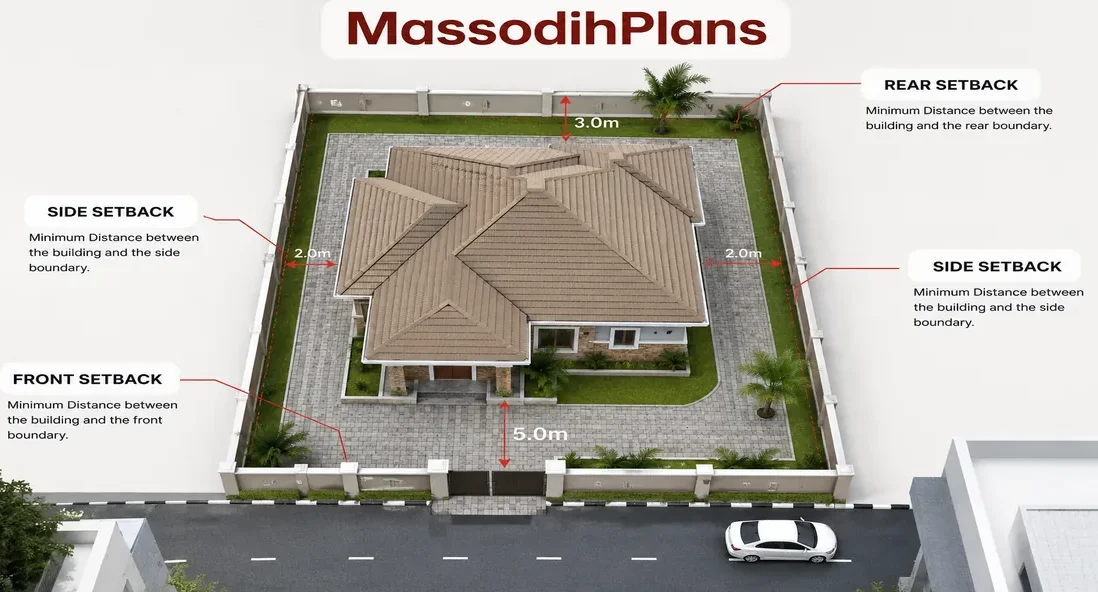
A standard Nigerian residential compound fence in 225mm block with plaster, coping and pedestrian gate covers approximately 50 to 80 running metres on a standard 600 square metre plot and costs 2.5 million to 4.5 million naira fully completed. Many homebuilders plan for the building cost and discover the fence absorbs another 3 to 4 million naira they had not fully allocated.
The 10 percent contingency is not optional
Every construction project in Nigeria experiences variations from the original scope. Soil conditions different from what was expected, design modifications the client requests mid-project, material price increases between pricing and purchase, and items that were overlooked in the original scope all create cost additions. A 10 percent contingency on your total project budget is the industry minimum. I would recommend 15 percent on any project in a volatile price environment like Nigeria.
Connecting Your Budget to Your Design
Building costs are only meaningful when they connect to a specific design. A budget built around a vague description of a 4-bedroom bungalow is not a reliable planning tool. A budget built around a specific measured drawing with room dimensions, wall heights, structural spans and material specifications is a tool you can actually use to procure materials, engage contractors and manage your project.
If you are working with an architect or designer, ask them to prepare a schedule of materials alongside your working drawings. This schedule should list every material type, the quantity needed and the specification required. It is the foundation of your procurement process.
The services page explains how to work with Nigerian built environment professionals who understand local material markets, supply chain realities and construction practice. Working with someone who has experience of actual Nigerian construction sites is the most important cost-saving measure you can take on a project of this scale.
For additional technical reference on the performance specifications of structural materials used in tropical construction, the Building and Road Research Institute publications from Ghana’s Council for Scientific and Industrial Research provide research-backed guidance on tropical building materials that applies directly to West African construction conditions including Nigeria.
For those who want to understand how professional architects approach the connection between design decisions and material cost, the plan school material walks through the logic that drives every quantity in a well-prepared bill of materials.
Common Budget Mistakes and How to Avoid Them
Mistake 1: Pricing materials without professional drawings
You cannot produce a reliable material estimate from a sketch. Cement, block and rod quantities depend on actual dimensions, structural design and specification. Get your working drawings done before you price.
Mistake 2: Accepting a contractor quote without a detailed breakdown
A lump sum quote with no breakdown is a blank cheque you sign in advance. Insist on a priced bill of quantities that shows labour and material separately for every trade.
Mistake 3: Ignoring the cost of approvals and professional fees
Building plan approval, soil testing, structural engineering and architect fees together typically add 3 to 6 percent to your project cost. Budget for them from the start.
Mistake 4: Not accounting for price escalation
If your project runs for 18 to 24 months (which is normal for a 4-bedroom bungalow), material prices will increase during that period. Budget a price escalation allowance of 10 to 20 percent on material costs for the second year of a project.
Mistake 5: Buying cheap structural materials to save on visible finishing
Cutting quality on iron rods, cement or structural timber to save money that you then spend on expensive tiles or kitchen cabinets is structurally irrational. The structure must be right. Finishes can be upgraded later. Structural deficiencies cannot be fixed after the building is complete without major demolition and reconstruction.
Mistake 6: Not planning for the borehole and drainage from day one
These are not optional items and they are not cheap. Every naira in your budget must account for them. A project plan that reaches completion without a working water supply or adequate site drainage is not complete, regardless of how good the finishing looks.
About the Author
Massodih Okon Effiong is a Built Environment Expert and Senior Researcher based in Nigeria. He has a Master’s degree in Urban and Regional Planning, a first degree in Geography and Environmental Management, and professional certificates in Architectural Design, Landscape Design, and GIS. With over 15 years of hands‑on experience in architecture, town planning, GIS, and building economics across Nigerian residential and institutional projects, he understands the real challenges Nigerians face when planning and building homes.
At MassodihPlans, Massodih shares practical Nigerian building guides, modern bungalow and duplex house plans, and built environment resources created specifically for Nigerian homeowners, developers, and property investors. His work is based on real‑life conditions in Nigeria, climate‑responsive design, and cost‑effective planning, aimed at helping everyday Nigerians make smarter, more confident building decisions.
FAQs
Q: How much does it cost to build a 4-bedroom bungalow in Nigeria in 2026?
A: A 4-bedroom bungalow in Nigeria costs between 90 million and 148 million naira to complete in 2026, excluding land. Lagos is typically at the higher end of this range. Abuja and Port Harcourt are broadly similar. Kano is approximately 15 percent cheaper on structural materials.
Q: What is the current price of cement in Nigeria in 2026?
A: Cement costs between 10,500 and 14,000 naira per 50kg bag in 2026. Dangote and Lafarge are at the higher end of this range. BUA is typically 500 to 800 naira per bag cheaper in areas where their distribution is strong.
Q: How much does a 6-inch sandcrete block cost in Nigeria in 2026?
A: A 6-inch sandcrete block costs between 350 and 450 naira per block. Lagos prices average around 420 naira. Abuja is slightly lower at 380 to 430 naira. Port Harcourt prices are 410 to 460 naira.
Q: What is the total number of cement bags needed for a 4-bedroom bungalow in Nigeria?
A: A standard 4-bedroom bungalow requires approximately 710 to 1,020 bags of cement across all stages from foundation through to plastering and floor screeds. The exact quantity depends on plan size, structural configuration and finishes specification.
Q: How much do iron rods cost in Nigeria in 2026?
A: Y12 reinforcement bars cost 8,000 to 10,500 naira per 12-metre length. Y16 costs 14,000 to 17,500 naira per length. Always buy from certified mills and request the batch test certificate.
Q: How can I reduce my building materials cost in Nigeria?
A: Buy cement and iron rods during the rainy season when demand is lower, order roofing sheets factory-cut to your exact dimension to eliminate waste, source aggregate locally within 50 kilometres of your site, buy tiles from the importer’s warehouse rather than retail, and get a proper bill of quantities before accepting any contractor quote.
Q: Is it cheaper to build in Kano or Lagos in 2026?
A: Kano is consistently cheaper than Lagos for structural materials like sand, aggregate and blocks, typically 12 to 18 percent lower on these items. However, imported or specialist materials like premium roofing sheets and aluminium windows cost more in Kano because they must be transported from Lagos.
Related Posts
- Cost of Building a 4 Bedroom Duplex in Lagos (Complete Guide)
- Smart House Design Ideas for 50×100 Plots in Nigeria
- Best Roofing Sheets for Nigerian Weather: Complete Guide
- Bungalow vs Duplex: Which is Better to build in Nigeria Today?
- How to Practically Draw and Design a Duplex for Small Plots
- Modern Duplex House Plan for 50×100 Plot in Lagos
- 7 Small Plot Design Mistakes Nigerians Make (And How to Fix Them)
- House Plan Selection Guide: How to Choose the Right House Plan for Your Land, Budget and Lifestyle
- Land-Buying Checklist: 100+ Things to Check Before Buying Land in Nigeria
- Building Project Budget Template: Complete House Construction Cost Planner
- Homeowner’s Construction Checklist: 150+ Things to Check Before and During Building
- Building Materials Checklist: 100+ Materials You May Need When Building a House
- Site Analysis Checklist: 50+ Things to Check Before Building on Your Land
- House Planning Checklist: 50+ Essential Things to Check Before Building a House (Complete Guide)
- Building Cost Calculator Nigeria: Estimate Your House Cost in 60 Seconds
- What Principles Guide the Design of an Air Force Base Master Plan?
- How Do You Design Army Barracks for Security and Daily Operations?
- Nigerian House Plans for Family Homes in Makurdi, Benue State, Nigeria
- Nigerian Estate Master Plan for Small Plots: Modern Residential Layout Strategies That Maximize Space