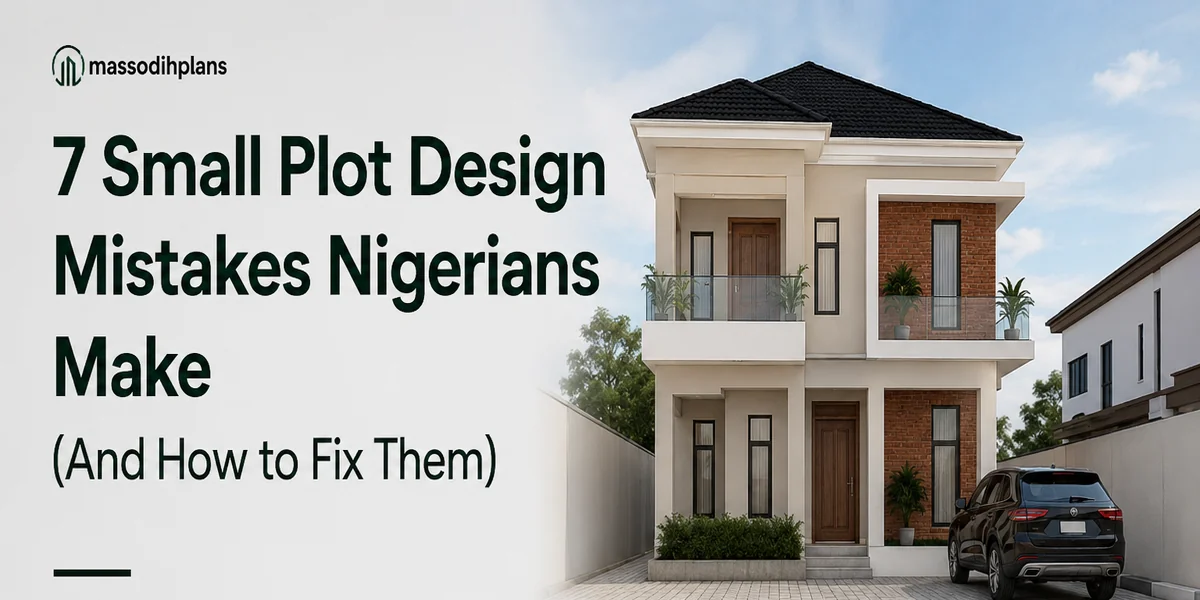
7 Small Plot Design Mistakes Nigerians Make (And How to Fix Them)
How to Avoid the Design Mistakes That Ruin Small Plot Homes in Nigeria
Here’s the honest answer to why your small plot house feels wrong even though nothing collapsed: seven design mistakes account for almost every complaint I hear from Nigerian homeowners after they move in tight rooms, a car that barely fits, a compound that floods, a staircase that swallowed the sitting room, no space for the generator, poor airflow, and a plan nobody could legally defend. None of these are construction mistakes. Every one was decided before the first block was laid, which means every one was preventable.
If you bought land, hired someone to build, and somewhere between the lintel and the roof you started feeling like something was wrong, you are not alone. The rooms feel tight. The car barely fits. Rain turns your compound into a stream. The staircase ate the sitting room. Nobody warned you before it was too late to change.
Here is the truth: these mistakes are almost never made during construction. They are made during planning, or during the absence of real planning. By the time concrete is involved, most of these problems are already locked into the building’s DNA. Good workmanship cannot undo a decision that should have been made properly on paper.
I have worked across Nigerian cities for over fifteen years, on plots from compact Uyo sites to narrow Lagos Island land, and the same seven mistakes keep showing up everywhere. Not because Nigerians do not care. Because the people who should have caught these things either were not involved, or did not speak up in time.
That stops here. Read this before you buy a single bag of cement.
Why Building on a Small Plot in Nigeria Is Harder Than Most People Realise
Land in Nigerian cities is shrinking while demand keeps rising. Lagos plots that were 600 square metres in the 1980s are now being sold in 300 square metre pieces. Abuja estate allocations are routinely 450 square metres or less. In Onitsha, Aba, and Warri, families are building four-bedroom homes on land that would have felt tight for a bungalow a generation ago.
At the same time, Nigerian families are not getting smaller. Three generations under one roof is still common. Children need rooms. Parents need ground-floor access. There has to be space for a generator, a borehole, a gatehouse, and at least one car. And the building needs to look like it was worth the money and sacrifice it took to get the land.
That combination of shrinking plots, growing family needs, and the weight of expectation is what makes small plot design so difficult in Nigeria. There is no margin for casual decisions. Every square metre has to work. That is why getting the design right from the beginning is not optional. It is the whole game.
Mistake 1: Building Without a Certified Architectural Plan
This is the most expensive mistake on this list. And it is also the most common.
Every week across Nigerian cities, people hand a rough sketch to a local builder or describe what they want verbally and construction begins. No certified architectural drawing. And no structural engineering drawing. No approved site plan. Just a general picture of the rooms they want and a contractor who says he has built plenty of houses before.
I have sat with homeowners who did exactly this and ended up with buildings that waste space, violate plot boundaries, cannot receive a Certificate of Occupancy, and have structural problems that are dangerous to correct after the fact. One family in Port Harcourt spent over two million naira fixing a roof structure that was built without any engineering drawing. Another in Lagos had to demolish a gate and part of a fence because the building crossed the setback line. Both situations would have cost almost nothing to avoid at the design stage.
The result of building without a plan is almost always the same. A structurally uncertain building that causes problems during construction and legal problems for years afterward. You spend more money correcting things than the proper drawings would ever have cost you.
A Real Case From Port Harcourt
A young couple building their first home came to us after their roof structure had already gone up, designed entirely by a local carpenter with “years of experience” and no engineering drawing. During a routine inspection ahead of their CofO application, a structural engineer flagged that the roof trusses had no proper bracing and were bearing on walls that hadn’t been reinforced to carry that load. The couple had to pay for a full engineering assessment, partial roof dismantling, and reconstruction over two million naira, on a house that was supposed to be nearly finished. A single structural drawing at the start would have cost a fraction of that.
Why This Keeps Happening
In many Nigerian cities, particularly outside Lagos and Abuja, enforcement of building regulations is inconsistent. People watch their neighbours build without plans, see nothing happen, and conclude that plans are optional. They are not optional. They are foundational, literally and legally.
In Lagos State, the Lagos State Physical Planning Permit Authority requires approved drawings before construction begins. In FCT Abuja, AGIS requires plot allocation documents and approved building plans before any development is permitted. Across all Nigerian states, building without plans exposes you to stop-work orders, fines, and in serious cases, government-ordered demolition.
What to Do Instead
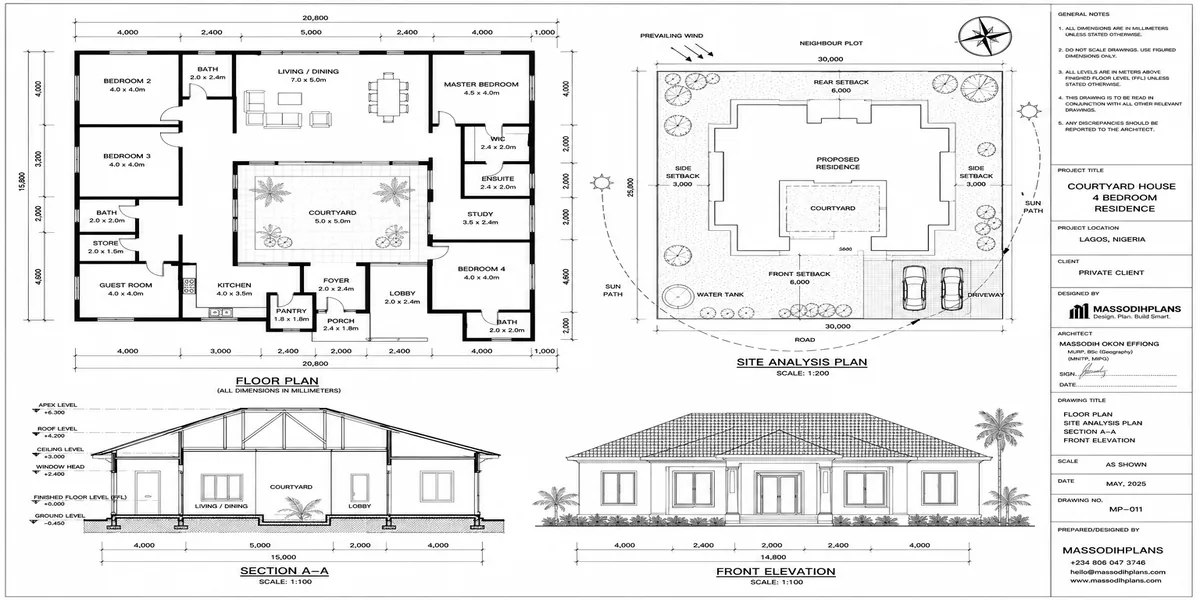
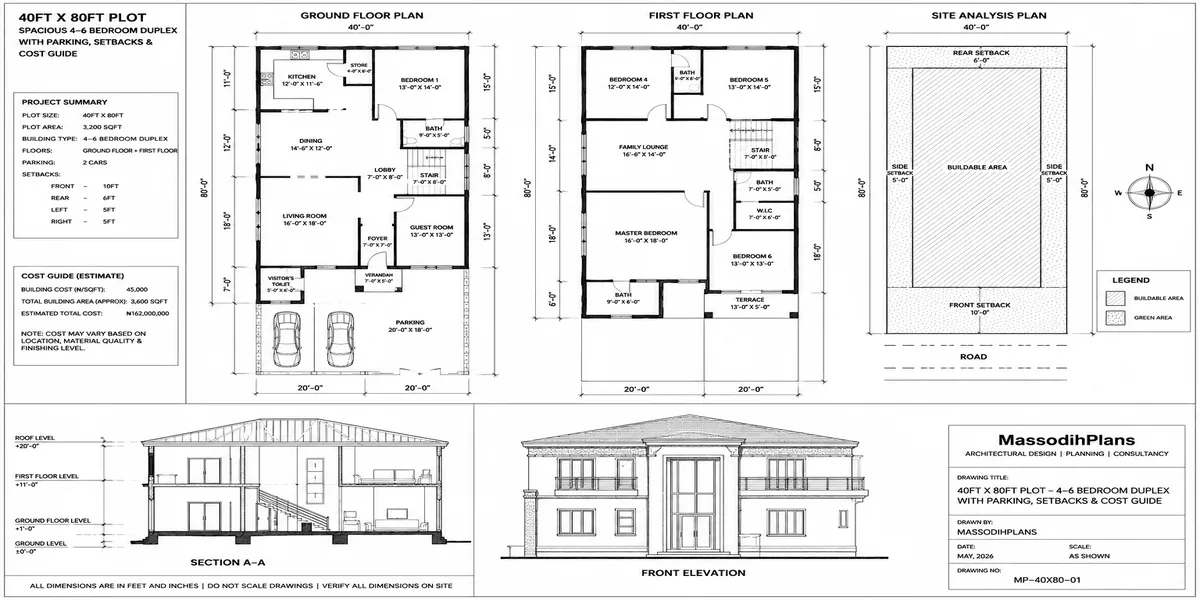
Commission certified architectural drawings from a registered architect before you touch your plot. A proper small plot plan is not just a room arrangement. It includes accurate plot boundaries and setback lines, foundation layout with column positions, floor plans for every storey, a roof plan showing drainage direction, sections showing room heights, and elevation drawings showing the final external appearance.
You should also understand what you are approving before you approve it. Many homeowners look at a floor plan and nod without really knowing what they are seeing. I will come back to this point later in the guide because it is important.
A proper plan saves you money, prevents structural failure, and protects your investment legally from day one.
Mistake 2: Ignoring Mandatory Setbacks
Setback violations are quietly ruining small plots across Nigeria.
A setback is the minimum required distance between your building and your plot boundary. In most Nigerian urban areas, the front setback runs from 3 to 6 metres depending on the road classification. Side setbacks typically run from 1.5 to 3 metres on each side. Rear setbacks are usually 3 metres or more depending on your local planning authority.
Most Nigerian homeowners ignore all of these. They want to use every inch of land they paid for. And on the surface that feels logical. Why would you leave space you own empty?
Here is why. Because building to the boundary does not actually give you more usable space. It gives you walls with no airflow, no maintenance access, no drainage channel, no room for your car to manoeuvre, and a building that cannot be legally certified.
I once visited a newly completed home in Uyo where the owner had built his fence right against the neighbouring wall on both sides. The builder had followed instructions exactly. The windows on the side walls had nothing to ventilate against. Inside, the rooms were dark and stuffy even in the morning. The owner spent money installing air conditioning in rooms that simply needed 1.5 metres of clearance and a proper window. That distance was free. The air conditioning was not.
A Real Case From Lagos
A client on the Mainland built his perimeter fence flush with both side boundaries to “not waste an inch.” Two years later, a road widening project by the local government required inspection of properties along that street. His fence and part of his gatehouse were found encroaching on the required side setback and were marked for removal. He lost the gatehouse structure entirely and had to rebuild his fence line at his own cost, on top of the fine. The land he thought he was “gaining” by ignoring setbacks cost him far more than if he’d simply respected the boundary from day one.
The Real Consequences of Setback Violations
When you build too close to the boundary, your windows end up facing a wall less than a metre away with no breeze possible. During flooding season in Lagos, Warri, or Port Harcourt, water has nowhere to go except toward your building because the perimeter drainage channels required by proper setback compliance were never built. Maintenance workers cannot reach the exterior walls for repairs. And if a planning authority inspects, the exposure is serious.
What to Do Instead
Respect your setbacks. Then design brilliantly within the remaining buildable area.
On a standard 15 by 30 metre plot with a 3-metre front setback, 1.5-metre side setbacks, and a 3-metre rear setback, your buildable footprint is roughly 9 by 24 metres. That is 216 square metres per floor. Two floors gives you over 400 square metres of usable space. That is more than enough for a comfortable four-bedroom home with proper circulation, ventilation, and family privacy.
The setbacks are not the obstacle. The absence of a skilled architect who knows how to work within them is the obstacle.
Mistake 3: Trying to Fit Everything on the Ground Floor
This mistake has a name. I call it horizontal greed. It is the instinct to put every room on one level because stairs feel complicated, expensive, or wasteful.
What actually happens when you try to fit a sitting room, dining area, kitchen, master bedroom, two other bedrooms, a visitor toilet, and a store on the ground floor of a small plot building is this: every room becomes a box. The sitting room ends up 3.5 metres wide. The master bedroom has no room for a wardrobe without blocking the door. The dining room becomes a corridor to the kitchen. The guest toilet opens directly into the seating area. Nobody has privacy. Nobody has comfort.
I had a client in Calabar who came to me after construction. His ground floor bungalow on a 15 by 30 metre plot had five rooms. Each one was so tight that his children could not study with the door closed without feeling like they were in a store. He asked me if anything could be done. I told him what he did not want to hear: a staircase and second floor would have cost him less than the discomfort was costing him every single day.
A Real Case From Ibadan
A family insisted on a single-storey five-bedroom layout on a plot that comfortably suited a duplex. To fit everything in, the architect they used compressed the sitting room to just over three metres wide and removed a planned store entirely. Within a year of moving in, the family was renting external storage space and had installed a partition in the sitting room to create a makeshift study corner for their teenage son effectively rebuilding, informally, the second floor they’d refused to build properly the first time.
How to Think About It Differently
A properly designed staircase on a compact Nigerian home takes up roughly 4 to 5 square metres on each floor. That is the cost. What it buys you is a complete separation of your home into two distinct zones that make daily life significantly more comfortable.
Ground floor: sitting room, dining area, kitchen, guest toilet, and a study or guest room. First floor: master bedroom with bathroom, two or three children’s bedrooms, and a shared family bathroom. Day zone downstairs. Private zone upstairs. Guests can visit and use the toilet without walking past anyone’s bedroom. Children can sleep without being disturbed by evening activity downstairs.
This is not a luxury arrangement. It is the standard that makes a duplex significantly more liveable than a bungalow on the same plot. The staircase is not the problem. The fear of the staircase is what creates overcrowded, uncomfortable ground floors in Nigerian homes.
Mistake 4: Poor Ventilation in a Hot, Humid Nigerian Climate
Nigeria sits close to the equator. In Ibadan, Onitsha, Warri, Abeokuta, and Port Harcourt, temperatures regularly exceed 30 degrees Celsius, and humidity makes the heat feel worse than the thermometer reads. Even in Lagos, which has Atlantic breeze on its side, a poorly ventilated home becomes genuinely miserable from February through May.
The ventilation mistakes I see on Nigerian small plot homes are consistent and almost entirely avoidable.
A Real Case From Warri
A client’s completed bungalow had bedrooms with single windows facing directly onto a neighbour’s wall less than a metre away. By the second dry season, the family was running two split air conditioning units almost continuously just to make the bedrooms tolerable at night. Their monthly generator fuel and electricity cost for cooling alone came to roughly what a proper cross-ventilated redesign, done at the drawing stage, would have cost to prevent entirely.
What Goes Wrong
Windows placed on only one wall so no cross-breeze can move through the room. Kitchens on the western side of the building, absorbing the harshest afternoon sun and heating the whole house from that corner. Bathrooms with no windows at all, relying on exhaust fans that require electricity you may not have consistently. Bedrooms with the only window facing a boundary wall one metre away, with no real airflow possible. Flat roofs with no ventilation provision, which turn into heat radiators that bake the upper floor from above.
A client in Benin City once told me his upstairs bedroom was always at least five degrees hotter than downstairs. When I visited the house, the reason was immediately clear. His first floor had a concrete flat roof with no overhang, no ventilation provision, and the only bedroom window faced west. The roof collected heat all day and radiated it down into the room through the night. A hip roof and a differently positioned window would have cost the same amount to build. The difference in comfort would have been enormous.
What to Do Instead
Design every major room for cross-ventilation. That means windows or ventilation openings on at least two opposite or adjacent walls. Louvred windows remain one of the most practical and affordable tools for controlled natural airflow in Nigerian homes, and they work well with the security realities most Nigerian families live with.
Position your kitchen on the eastern or northern side of the building. Morning light is cooler. The kitchen avoids the worst afternoon heat that hits the western wall daily.
Where the plot allows it, a small internal light well or open shaft of even 1.5 by 1.5 metres can transform the airflow through a compact building. Rising hot air escapes upward. Cooler air is drawn in from lower windows. The house breathes without depending on electricity.
Choose a hip roof over a flat roof. A hip roof sheds rain on all four sides, allows rising hot air to escape at the ridge, and reduces heat buildup on the upper floor significantly compared to a flat concrete roof with a parapet. The construction cost difference is much smaller than the long-term comfort difference.
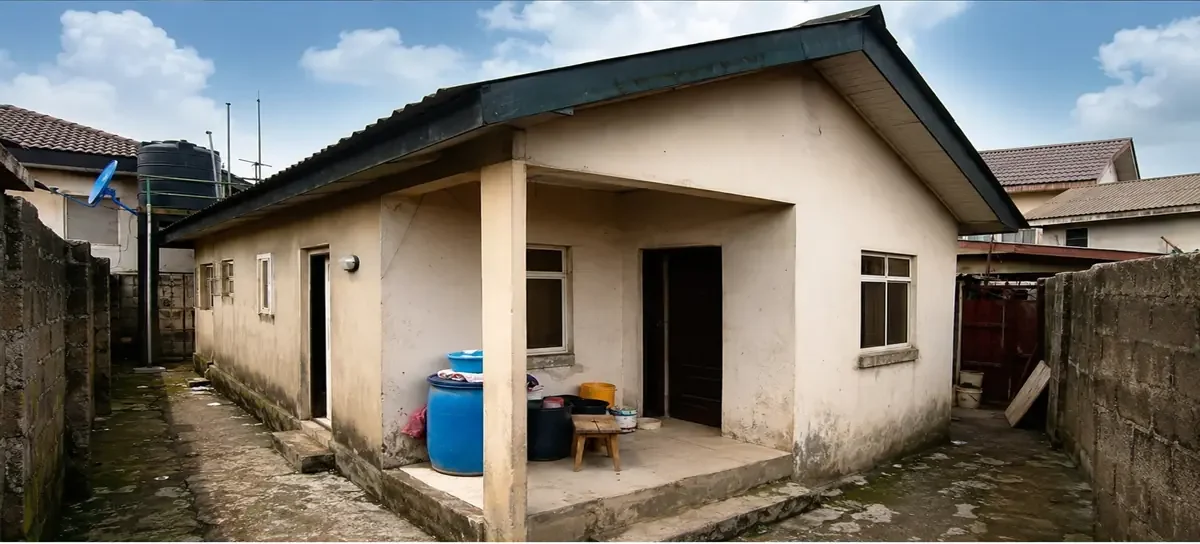
A cramped single-storey layout with little space for ventilation
Mistake 5: No Parking Space or Dangerously Inadequate Parking
In any Nigerian urban area today, a house without proper parking is both frustrating to live in and harder to rent or sell at full value. Yet parking is one of the first things sacrificed when a small plot design starts feeling tight, usually in favour of one extra bedroom or a wider sitting room.
The extra bedroom feels like a gain on paper. The missing parking reveals itself as a loss every single day.
A Real Case From Abuja
A landlord built a compact two-bedroom rental property with no dedicated parking, reasoning that “tenants can park on the street.” The property sat vacant for four months longer than a comparable property two plots away that had proper parking. When he finally let it, it was to a tenant without a car, at a rent roughly 20 percent below what a similar unit with parking commanded in that same street.
What Bad Parking Planning Looks Like in Practice
A gate that opens directly onto a busy road, requiring the driver to reverse blindly into traffic every morning. A compound so narrow that the car parks but cannot turn, meaning a daily series of reversals to exit. A design where the car ends up partly on the setback area, which creates disputes with neighbours and planning authorities. A property that rents below comparable homes in the same area simply because tenants with vehicles have crossed it off their list.
I know a landlord in Lagos Mainland who spent three years wondering why his property sat vacant longer than neighbouring houses of similar size. When a property agent finally told him directly, the answer was simple: no proper parking. Any tenant with a car, which is most of the serious tenants in that market, had already eliminated his property at first viewing.
What to Do Instead
Reserve a minimum of 3 metres by 6 metres within your compound footprint for parking from day one of the design. If the plot is narrow, design for tandem parking where vehicles park one behind the other along the depth of the compound.
One of the most effective strategies for compact Lagos and Abuja plots is the covered carport under a first-floor overhang. Part of the upper floor projects forward over the ground level, sheltering the parking area below. No extra land is consumed. The parking is covered. The upper floor gains additional space. And the projection shades the ground floor from afternoon sun as a bonus.
Design your gate opening at a minimum of 3.5 metres, and ideally 4 metres. A gate designed for a small sedan will not accommodate the SUVs and pickup trucks that many Nigerian families now own. That daily stress of squeezing in and out is entirely avoidable at the design stage.
Mistake 6: Ignoring Drainage and Flooding on the Site
This is the mistake that turns a beautiful new house into an annual disaster. And in Nigeria, it affects more locations than any other mistake on this list. From Ajah and Alakuko in Lagos to Rumuola and Diobu in Port Harcourt, from Ogunpa area in Ibadan to low-lying parts of Benin City, poor drainage planning causes property damage worth hundreds of millions of naira every single rainy season.
The tragedy is that good drainage is almost entirely a design decision. It costs very little extra to get right during planning. It costs enormously to correct after the building is finished.
The Drainage Mistakes I See Consistently
Compounds graded toward the building instead of away from it, which directs every raindrop toward your walls and foundation. No perimeter drain channels around the building, so surface water has nowhere to go except into the lowest point, which is usually the ground floor. Finished floor levels that sit at or below street level, meaning the street floods directly into the house during heavy rain. Soakaway pits positioned too close to the foundation, which saturates the surrounding soil and weakens the ground support beneath your columns over years. No provision for stormwater discharge from the roof, so rainwater cascades off the eaves and directly against the base of the external walls every rainy season.
I visited a property in Port Harcourt after a flooding season where the owner had replaced tiles, repaired a POP ceiling, and rewired several electrical fittings at a total cost of over three million naira. When I walked the site, the cause was immediately visible. The compound sloped toward the building. There were no perimeter drains. The finished floor level was barely 200 millimetres above the compound grade. All three problems could have been fixed at the design stage for almost nothing.
What to Do Instead
These five drainage provisions should be non-negotiable in every Nigerian small plot design:
Set your finished ground floor level at a minimum of 600 millimetres above the compound grade. The compound grade itself should slope away from the building at a minimum fall of 1 in 50.
Install perimeter drain channels around the building that connect to the street drain or a properly sized soakaway. These channels intercept surface water before it reaches your walls.
Extend your roof eaves to a minimum overhang of 600 millimetres on all sides. This throws rainwater clear of the base of the walls instead of running it down the face of the building.
Install gutters and downpipes that connect roof drainage directly to the perimeter drain channels, not just to the open compound surface.
Position soakaway pits a minimum of 3 metres from any foundation wall, and at least 10 metres from any borehole. These are minimums. More distance is always better on a small plot.
Mistake 7: Forgetting Generator Bay, Borehole, Water Storage, and Gatehouse
This is the mistake that separates a floor plan drawn by someone who genuinely understands Nigeria from one drawn by someone who does not.
Let me be honest about the Nigerian infrastructure reality. NEPA supply will fail you regularly, regardless of where you build. Your generator will run, sometimes daily, sometimes for twelve hours at a stretch. Public water supply is unreliable in most Nigerian urban areas. Your compound needs a gatehouse if you value consistent security. Your diesel or petrol needs proper storage. None of this is speculation. It is the daily reality of Nigerian residential life.
A beautiful floor plan that makes no provision for any of these is not a beautiful floor plan. It is an incomplete one.
A Real Case From Enugu
A homeowner completed his house without any generator bay in the design. The generator ended up running from a corner of the covered car porch, right beside the main entrance. Exhaust fumes regularly drifted into the sitting room whenever the front door was open, and the constant noise was loudest in the room the family used most. Retrofitting a proper enclosed generator bay after the fact required breaking into a finished porch slab and rerouting electrical conduit that had already been plastered over a job that cost more than double what it would have cost as part of the original design.
What Happens When These Are Not Planned
The generator ends up in the corridor, the kitchen, or a converted bathroom, creating noise, fumes, and fire risk inside a space never designed for it. The borehole gets drilled wherever there is space left after construction, sometimes dangerously close to the foundation or the septic tank. The gateman sleeps in the store or an improvised corner that creates daily management problems. The diesel drum sits unprotected in the open compound. The electrician runs exposed cables across walls and ceilings after the fact because no conduit route was planned during construction.
I have seen all of these in real properties across Nigerian cities. Every single outcome was preventable at the design stage.
What to Do Instead
From day one of your design process, allocate specific space for each of these items.
Generator bay: A covered external enclosure of at least 1.5 by 2 metres, positioned away from bedroom windows and the main entrance door. It should include a concrete pad, ventilation louvres on at least two sides, an exhaust duct directed away from any occupied space, and a dedicated conduit path built into the wall from the generator position to the main distribution board.
Borehole position: Decided before construction begins. Minimum 10 metres horizontally from the septic tank and soakaway, and as close as practical to the water storage tank to minimise pumping pipe runs.
Overhead water tank: If you are using an elevated tank, the structural plan should include the tank platform from the beginning. Adding water tank load to a roof structure that was not designed for it is a real structural risk.
Gatehouse: On most Nigerian small plots, a compact 3 by 3 metre gatehouse adjacent to the gate can be incorporated within or alongside the front setback zone. In most Nigerian residential estates, a standard gatehouse is expected, permitted, and adds measurable value to the property.
The Design Approach That Actually Works on Small Nigerian Plots
After working across Nigerian cities for over fifteen years, the homes that succeed share the same characteristics regardless of their budget level.
They go vertical. Two storeys on a plot below 600 square metres is almost always the better choice. The duplex model separates living zones, improves family privacy, and produces more usable space per square metre of land than any bungalow arrangement on the same footprint.
They respect the site before they respect the floor plan. Setbacks, drainage, solar orientation, wind direction, and proximity to flooding risk are all studied before the room layout is decided. The site informs the design, not the other way around.
They plan for Nigerian infrastructure first. Generator, borehole, water storage, and gatehouse are in the drawings from day one. These are not afterthoughts. They are core design elements.
They design for how Nigerian families actually live. Children need to move freely through the house. Guests need a toilet that does not require them to walk through the bedroom corridor. Elderly parents need a ground floor room with easy bathroom access. Someone in the family is increasingly working from home and needs natural light and quiet during the day.
They think about tomorrow without overcrowding today. A small plot home designed with future expansion in mind, whether an additional floor, a boys quarters above the gatehouse, or a rental apartment at the rear, is a significantly more valuable long-term investment than one that maxes out the buildable area immediately and leaves no room to grow.
How to Read an Architectural Drawing Before You Approve It
This section is for every Nigerian homeowner who has ever looked at a floor plan and nodded without fully understanding what they were seeing. I say this without judgment because it happens often, and the consequences can be expensive.
You should never approve a building plan you cannot confidently read. A floor plan is not just a sketch. It is the official agreement between you, the architect, and the builder. Once construction begins, that drawing becomes the reference document for measurements, room arrangement, setbacks, windows, stairs, and structural positioning.
The plot boundary lines on a plan represent the exact edges of your land. The setback lines show the legal distance the building must maintain from the fence. If the structure crosses those lines, the design violates development regulations, and you should ask questions before approving it.
Room dimensions reveal the actual size of each space. A bedroom that looks large on paper might be 3.2 metres wide in reality, which is comfortable. Or it might be 2.6 metres wide, which can feel cramped. You need to know the difference before construction starts.
Window locations show where natural light and ventilation will come from. In Nigeria’s climate, this matters greatly. If a bedroom has windows on only one wall, or if the kitchen window faces west, you should ask your architect why.
Elevation drawings show what the building will look like from the outside. If the elevation does not match your expectations, the time to address it is before construction, not during.
The Plan School section of this site contains a step-by-step guide that explains every element of a Nigerian architectural drawing in plain language, helping you review your plans confidently before signing off.
Building Regulations in Nigeria: What You Actually Need to Know
Most Nigerian homeowners know that building regulations exist. Very few know what is specifically required and why it matters practically for their project.
Here is what is required across the major Nigerian building jurisdictions.
In Lagos State, the Lagos State Physical Planning Permit Authority handles building plan approval. You submit your architectural and structural drawings, pay the assessment fees, and receive a development permit before breaking ground. LASBCA, the Lagos State Building Control Agency, inspects construction at various stages to verify compliance.
In FCT Abuja, the Abuja Metropolitan Management Council and AGIS handle plot allocation and development permits. Approved building plans are required before construction begins, and the FCT Administration inspects buildings for compliance with the National Building Code.
In other Nigerian states, the relevant state ministries of physical planning and urban development handle permit issuance. The process varies by state, but the requirement for approved drawings before construction is consistent across virtually all Nigerian jurisdictions.
The National Building Code of Nigeria sets minimum standards for structural design, materials quality, fire safety, ventilation requirements, and room size minimums for all residential buildings. Every house built in Nigeria should meet these standards regardless of whether local enforcement is consistent in your area.
Setback and Approval Requirements Across Nigeria
Requirements vary by state and even by specific development zone, so always confirm with your local planning authority before finalizing a design. Here’s a general comparison to guide your expectations:
| State/City | Approving Authority | Typical Front Setback | Typical Side Setback | Typical Rear Setback |
|---|---|---|---|---|
| Lagos | Lagos State Physical Planning Permit Authority (LASPPPA) | 3–6m (by road class) | 1.5m each side | 3m minimum |
| FCT Abuja | AGIS / Abuja Metropolitan Management Council | 3–6m | 1.5–3m each side | 3m minimum |
| Rivers (Port Harcourt) | Rivers State Ministry of Urban Development | 3–6m | 1.5m each side | 3m minimum |
| Akwa Ibom (Uyo) | AKSUDB | 3m minimum | 1.5m each side | 3m minimum |
| Oyo (Ibadan) | Oyo State Ministry of Physical Planning | 3–4.5m | 1.5m each side | 3m minimum |
| Delta (Warri/Asaba) | Delta State Ministry of Lands, Survey and Urban Development | 3–6m | 1.5m each side | 3m minimum |
| Enugu | Enugu State Ministry of Physical Planning | 3m minimum | 1.5m each side | 3m minimum |
| Kano | Kano State Ministry of Urban Planning | 3–6m | 1.5m each side | 3m minimum |
| Anambra (Onitsha/Awka) | Anambra State Ministry of Housing and Urban Development | 3m minimum | 1.5m each side | 3m minimum |
| Cross River (Calabar) | Cross River State Urban Development Authority | 3m minimum | 1.5m each side | 3m minimum |
Note: figures shown are general minimums seen across most residential zones; specific roads, estates, and zoning classifications can require more. Always verify with your state authority or a registered town planner before finalizing setback assumptions on your design.
The Real Cost of Getting These Things Wrong
Every mistake in this guide has a financial cost. These are not hypothetical figures. They reflect the real remediation costs I have seen Nigerian homeowners face when these mistakes had to be corrected after the building was finished.
Building without a certified plan: Structural corrections and rework after construction has begun can cost 500,000 to 5 million naira depending on what needs to be undone. Legal exposure from unapproved construction adds potential fines and stop-work order costs on top of that.
Setback violations: Demolition or structural modification to comply with a planning order can cost 1 million to 10 million naira or more, depending on how much of the building is affected.
Overloaded ground floor: Retrofitting a staircase into a building not designed for one typically costs 800,000 to 2.5 million naira and involves significant disruption to the completed structure.
Poor ventilation: The ongoing cost of depending on air conditioning to compensate for inadequate natural ventilation adds 150,000 to 400,000 naira per year in electricity and generator fuel costs that a well-ventilated building would not require.
Inadequate parking: A rental property without proper parking in Lagos or Abuja rents for 15 to 30 percent below an equivalent property with proper parking. Over ten years of rental income, that gap compounds into a significant amount.
Poor drainage: A single serious flood event in a poorly drained Lagos or Port Harcourt home can cause 1.5 million to 5 million naira in damage to tiles, ceilings, electrical fittings, and furniture.
Missing infrastructure spaces: Retrofitting a generator bay, relocating a borehole, or adding a gatehouse after main construction is completed typically costs 400,000 to 1.5 million naira more than incorporating these from the original design.
Quick Reference: The 7 Mistakes and Their Fixes
Mistake 1: Building without a certified architectural plan. Fix: Commission proper drawings from a registered architect before any site work begins.
Mistake 2: Ignoring mandatory setbacks. Fix: Identify your exact setback requirements and design your building to work brilliantly within the compliant buildable area.
Mistake 3: Trying to fit everything on the ground floor. Fix: Embrace the duplex model. Separate public and private zones across two floors with a properly proportioned staircase.
Mistake 4: Poor ventilation planning. Fix: Design every room for cross-ventilation. Orient the kitchen away from the west wall. Choose a hip roof over a flat roof.
Mistake 5: Inadequate or missing parking. Fix: Reserve 3 by 6 metres for parking from day one of the design. Design the gate opening at a minimum of 3.5 metres wide.
Mistake 6: Ignoring drainage and flooding risk. Fix: Set finished floor level at minimum 600 millimetres above grade, slope the compound away from the building, install perimeter drain channels, and extend roof eaves to 600 millimetres minimum on all sides.
Mistake 7: Forgetting generator bay, borehole positioning, water storage, and gatehouse. Fix: Allocate specific space for every infrastructure element before the floor plan is finalised.
Print this. Take it to your next plan review meeting
Save This: The Small Plot Design Checklist
Before you approve any building plan in Nigeria, confirm:
- Certified architectural drawing from a registered architect not a sketch
- Structural engineering drawing included, especially for roof and upper floors
- Setback lines clearly marked and respected on all four sides
- Staircase and upper floor considered if ground floor feels tight
- Every major room has windows on at least two walls
- Kitchen positioned away from the west-facing wall
- Minimum 3m x 6m parking space reserved, gate opening at least 3.5m wide
- Finished floor level at least 600mm above compound grade
- Perimeter drainage channels included in the site plan
- Roof eaves extend at least 600mm on all sides
- Generator bay, borehole position, and gatehouse space allocated before floor plan is finalized
- Borehole positioned at least 10m from septic tank/soakaway
Frequently Asked Questions
What is the minimum plot size to build a 4-bedroom duplex in Nigeria?
A 4-bedroom duplex can be designed on a plot as small as 50 by 100 feet, which is approximately 15 by 30 metres, as long as the design respects all required setbacks and goes vertical across two floors. After the standard front, side, and rear setbacks, the remaining buildable footprint on this size plot is typically more than sufficient for a comfortable modern 4-bedroom home.
What setbacks are required for residential buildings in Lagos?
Lagos State guidelines typically require a front setback of 3 to 6 metres depending on road classification, side setbacks of 1.5 metres on each side, and a rear setback of 3 metres minimum. Always confirm the exact requirements with your local planning authority because specific estate rules and road classifications vary.
How do I improve ventilation in a Nigerian home on a small plot?
Design each bedroom and living space with windows on at least two walls wherever the plot allows. Position your kitchen on the eastern or northern side of the building. Consider a small internal courtyard or light shaft even if it is only 1.5 by 1.5 metres. Choose a hip roof over a flat roof. Louvred windows remain one of the most cost-effective and practical ventilation tools for Nigerian homes.
Can I include a gatehouse on a small plot in Nigeria?
Yes. In most Nigerian residential estates and urban areas, a compact gatehouse of approximately 3 by 3 metres positioned adjacent to the gate or within the front setback zone is permitted. Rules vary by state and estate management. Confirm your specific local authority requirements before incorporating it into the plan submission.
What is the best roof type for a small plot home in Nigeria?
Hip roofs are consistently the most effective for Nigerian small plot homes. They shed rainwater on all four sides, resist wind damage better than gable roofs, perform better thermally when designed with proper ridge ventilation, and reduce rainwater splashing against the base of your external walls. Combination hip-gable roofs are also common and retain most of the hip roof’s practical advantages.
How far should a borehole be from a septic tank in Nigeria?
Standard practice and most Nigerian state environmental guidelines require a minimum horizontal distance of 10 metres between a borehole and any septic tank or soakaway pit. On a small plot, this requires deliberate positioning from the design stage before any construction begins.
Is it cheaper to build a bungalow or a duplex on a small Nigerian plot?
A bungalow costs less per floor to construct. However, because a bungalow on a small plot produces fewer usable rooms and a more cramped layout, the cost per square metre of comfortable, functional space is frequently higher than a well-designed duplex on the same plot. A duplex also commands higher resale and rental value in Nigerian urban markets, which affects your long-term financial return.
What does a soil test cost in Nigeria and is it necessary?
A standard soil bearing capacity test for a residential plot in Lagos or Abuja typically costs between 150,000 and 400,000 naira. On soft, waterlogged, or previously filled ground, it is absolutely necessary. Without knowing what the soil beneath your foundation can support, your structural engineer is making an educated guess. Getting that guess wrong on a Lagos Island, Ajah, or reclaimed land plot can mean differential settlement, structural cracking, and repairs that cost many times the price of the soil test that would have prevented them.
Planning to Build on a Small Plot of Land? Let MassodihPlans Help You Get It Right.
A small plot does not mean you have to compromise on comfort, functionality, or good design. With the right planning, you can make the most of your available land, avoid costly design mistakes, and create a home that suits your needs and budget.
At MassodihPlans, we provide professional architectural design drawings, building plans, site and layout plans, and land-use planning services tailored to your project.
Before you start building, let us help you make better use of every square metre of your land.
Ready to plan your building project? Visit MassodihPlans.com to explore our services and take the next step towards a well-planned home.
About
Massodih Okon is a Nigerian built-environment professional with academic and professional experience in urban and regional planning, geography, architectural design, Landscape Design, GIS and land development.
He holds a Master’s degree in Urban and Regional Planning from the University of Uyo and a first degree in Geography and Regional Planning.
Through MassodihPlans, he publishes practical guides on Nigerian house plans, building design, physical planning, site planning, development approval and residential construction. Read the full author profile →
Related Posts
- Cost of Building a 4 Bedroom Duplex in Lagos (Complete Guide)
- Smart House Design Ideas for 50×100 Plots in Nigeria
- Building Materials Price Guide in Nigeria (Full Cost Guide)
- Best Roofing Sheets for Nigerian Weather: Complete Guide
- Bungalow vs Duplex: Which is Better to build in Nigeria Today?
- How to Practically Draw and Design a Duplex for Small Plots
- Modern Duplex House Plan for 50×100 Plot in Lagos
- House Plans for Sloping Land in Jos, Plateau State, Nigeria: Smart Nigerian Designs
- How to Practically Draw and Design a Duplex for Small Plots
- Affordable Bungalow Plan for 40×80 Plot in Port Harcourt
- Cost of Roofing a Bungalow and Duplex in Abuja Small Plot Now
- Best 4 Bedroom House Plan for Small Plots in Abuja
- Full Cost Breakdown for Building a Duplex on a Small Plot in Kano Nigeria
- Building Approval in Nigeria: Costs, Requirements, Process and How to Get Your House Plan Approved Fast
- How to Draw a 3 Bedroom Floor Plan in a Small Plot Step by Step
- Best Places to Buy Land in Uyo for Fast Development and High Property Value
Others
- 7 Cheapest Areas to Buy Affordable Land in Uyo Before Prices Increase
- 4 Bedroom Duplex Plan for 100×150 Plot in Nigeria
- What Is a Survey Plan and Why Do Property Owners in Nigeria Need One?
- Cost of Blocks, Cement, Iron Rod and Roofing Sheets in Uyo: Real Prices From the Field Now
- Cost of Building a House in Uyo: Honest Budget Guide for Property Owners
- Architectural Engineering and Architectural Design Courses for House Building Plans
- Building Regulations Every Nigerian Property Developer Must Know
- Land Use Act and Building Development in Nigeria: What Every Landowner Should Know
- How to Choose Roofing Materials for Nigeria’s Climate: Advice for Overseas Homeowners
- Building a House in Nigeria While Living Abroad: Complete Approval and Documentation Guide
- How Is a Modern Court Building Designed for Safety and Efficiency? (Complete Guide)
- How Do You Design a Functional Mosque Building Plan Step by Step?
- How to Draw Building Elevations Step by Step (Manually and in AutoCAD): Complete Guide for Beginners
- How to Draw a Building Plan Section A-A, B-B: Step by Step Complete Beginner’s Guide
- How to Draw a Roofing Plan Step by Step (Manually and in AutoCAD): Complete Guide with Practical Examples
- AutoCAD House Plan Tutorial for Beginners: Learn to Draw Plans Step by Step
- What Is a Beacon Number on a Survey Plan in Nigeria? Meaning, Uses and Importance
- Best Roofing Options for Houses in Gusau city of Zamfara State, Nigeria: Prices and Durability