How to Build a Luxury Duplex on a Small Lekki Plot Without Wasting Space
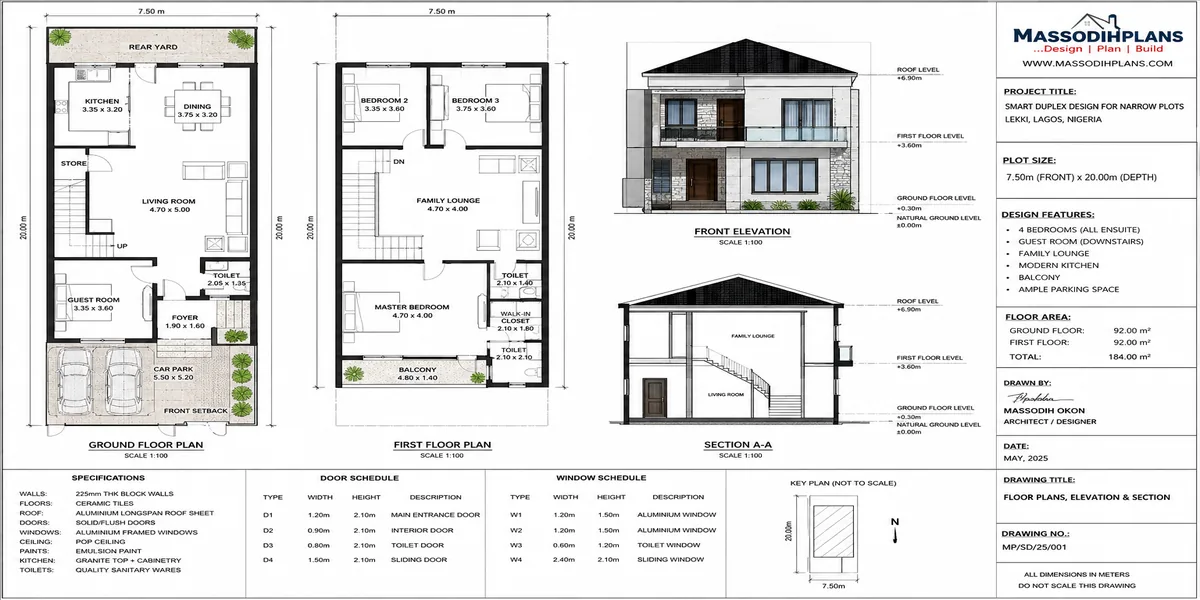
Smart Duplex Design for Narrow Plots in Lekki
You can build a comfortable, modern and well-ventilated duplex on a narrow plot in Lekki, and a 40 × 80 ft plot can accommodate far more than many prospective homeowners assume. The real question is not simply “Is the land big enough?” but “Can the house plan make every metre of the site work?”
On a well-planned 40 × 80 ft Lekki plot, it is possible to create a practical four-bedroom duplex with parking for two cars, functional drainage, space for a generator and borehole, adequate ventilation, outdoor circulation and a compound that does not feel painfully cramped. The difference between a successful narrow-plot home and an uncomfortable one usually comes down to the quality of the planning—not just the size of the land.
That is where good house plans, floor plans and building design become critical. Room sizes, stair placement, setbacks, window positions, parking, service areas, drainage and natural airflow must be considered together rather than designed independently.
In this guide, we will go beyond attractive drawings and show you how to approach a narrow-plot duplex in Lekki practically including suitable plot dimensions, space planning, setbacks, parking, ventilation, drainage, staircase positioning, room arrangement, common design mistakes, estimated space requirements and the features that can make a small site feel surprisingly spacious.
By the end, you will understand exactly what can fit on your plot, what should not be sacrificed, and how to avoid expensive design mistakes before construction begins.
What Makes a Lekki Plot “Narrow” and Why It Is Not a Problem
The word “narrow” in Nigerian real estate usually means the plot width is between 30 and 60 feet while the depth is between 60 and 100 feet. In Lekki Phase 1, Lekki Conservation Road, Chevron Drive, Orchid Road, VGC, and similar areas, many landowners today are working with exactly these dimensions because wider plots have either been taken, subdivided, or priced beyond what an individual family can reasonably spend.
Here is what these plot sizes actually look like on the ground:
| Plot Dimensions | Total Area (sq ft) | Total Area (sq m) | Suitability |
|---|---|---|---|
| 30 x 60 ft | 1,800 sq ft | 167 sq m | Very compact urban duplex, tight but achievable |
| 40 x 60 ft | 2,400 sq ft | 223 sq m | Comfortable modern duplex with careful planning |
| 40 x 80 ft | 3,200 sq ft | 297 sq m | Ideal balance of plot cost and functionality |
| 45 x 90 ft | 4,050 sq ft | 376 sq m | Spacious narrow plot duplex with strong options |
| 50 x 100 ft | 5,000 sq ft | 465 sq m | Full luxury compact duplex, very achievable |
The 40 by 80 foot plot is the one I see most often in Lekki’s newer estates, and it is honestly the sweet spot. The land is affordable enough to be realistic for middle-income professionals, and the site is large enough to deliver a duplex that does not feel cramped once you are inside.
The mistake most people make is thinking “narrow” means small inside. It does not. A narrow plot limits your building footprint width, not your total floor area. A two-storey duplex on a 40 by 80 plot gives you double the floor area of a bungalow on the same land. That is why vertical planning on narrow urban plots is intelligent, not a compromise.
The First Thing You Must Do Before Any Design Begins
I have watched several Lekki duplex projects run into serious problems not because the architect drew a bad plan, but because the owner bought the land and commissioned a design without first verifying what the estate regulations actually allow.
Before any drawing starts, do these four things:
Confirm the setback requirements for that specific estate. Lekki has many different estate management authorities and government zones with different rules. In some estates the front setback is 3 metres. In others it is 6 metres. That difference alone can take away 10 feet of buildable depth from your plot.
Check whether there are height restrictions. Some gated estates in Lekki restrict buildings to two floors. Some allow three. A duplex typically means two habitable floors, which is usually within limits, but confirm this before paying an architect.
Understand the drainage covenant. Lekki flooding is real. Many estates now have specific drainage covenants that specify where surface water must be directed and at what finished ground level the building must sit. Ignoring this creates problems during rainy season that no amount of interior luxury can fix.
Verify the title before designing. This sounds obvious but designing an expensive duplex on a plot whose title has encumbrances or boundary disputes is a risk many Nigerian homebuilders take without realizing it.
Once you have those four things confirmed in writing, then you sit down with a designer.
Understanding the Setback Calculation: What Your Plot Actually Gives You After Regulations
Let me show you exactly what happens to a 40 by 80 foot plot in a typical Lekki estate after mandatory setbacks are applied. Using the common Lekki estate setback of 6 metres front, 3 metres rear, and 1.5 metres each side:
| Dimension | Full Plot | After Setbacks |
|---|---|---|
| Width | 40 ft (12.2 m) | ~27.6 ft (8.4 m) after 1.5 m each side |
| Depth | 80 ft (24.4 m) | ~56.6 ft (17.2 m) after 6 m front and 3 m rear |
| Buildable Ground Footprint | 3,200 sq ft | ~1,562 sq ft (145 sq m) |
That 145 square metre ground footprint is the actual area you are designing within. It sounds tight until you remember this is just the ground floor. On two floors, you have 290 square metres of living space. A well-designed three-bedroom duplex in Victoria Island often occupies around 250 to 280 square metres. So this plot, properly handled, delivers a legitimate full family duplex.
The 6-metre front setback is the one that surprises people most. On a 40-foot wide plot, that front setback means your building front face is nearly 20 feet back from your fence line. That space is not wasted. It becomes your driveway, parking court, and the breathing room that makes the house feel welcoming from the street instead of shoved up to the gate.
Ground Floor Layout: How to Design Every Metre to Work
On a narrow plot, the ground floor carries the most planning pressure because it has to simultaneously serve public use (receiving guests, cooking, dining), private use (a ground floor bedroom in most Nigerian designs), and functional use (service access, staircase, passage to the rear).
I always start the ground floor layout with the staircase position, not the living room. The reason is that the staircase is the one element that cannot easily move once it is positioned. It determines circulation on both floors. Get it wrong and you waste corridor space on both levels.
Staircase First Principle
On a narrow plot duplex, I recommend positioning the staircase either along one side wall near the centre of the plan depth, or at the rear of the plan if the building depth allows. Never in the middle of the plan width, because that cuts the building into two narrow strips that reduce room flexibility.
A side-wall staircase on a narrow plot:
Takes up 1.1 metres to 1.2 metres of building width Runs along the party wall side where windows are not practical anyway Frees the central zone of the plan for properly dimensioned rooms Creates a natural visual spine to the building interior
If you want to understand the full drawing and design logic behind positioning a staircase correctly on a compact plot, the guide on how to practically draw and design a duplex for small plots takes you through the process step by step.
Recommended Ground Floor Room Arrangement
| Space | Recommended Dimension | Notes |
|---|---|---|
| Entrance Porch | 1.5 m deep x full building width | Covered, creates weather transition |
| Living Room | 5.0 m x 4.5 m | Open plan towards dining |
| Dining Area | 3.5 m x 3.0 m | Flows from living, adjacent to kitchen |
| Kitchen | 4.0 m x 3.5 m | Cross ventilated, rear access |
| Pantry or Store | 2.0 m x 1.5 m | Adjacent to kitchen |
| Guest Bedroom | 4.0 m x 3.8 m | Ensuite, ground floor privacy |
| Guest Bathroom | 2.0 m x 1.8 m | Ensuite attached to guest room |
| Visitor’s Toilet | 1.5 m x 1.2 m | Near living room, no shower |
| Staircase | 1.1 m minimum width | Side wall position preferred |
| Laundry Nook | 2.0 m x 1.5 m | Near rear, connects to back compound |
This arrangement means every ground floor space is within a few steps of where it needs to be. Guests reach the toilet without entering private areas. The kitchen connects to the rear service yard without cutting through the living room. The staircase does not block natural movement from front to back.
Open Plan Living on a Narrow Ground Floor
Combining the living room and dining visually, without full walls between them, creates a spatial experience that is noticeably wider than the actual building dimensions suggest. I have designed narrow plan duplexes where the interior living zone felt as generous as some 50 by 100 foot plot houses, simply because the open plan arrangement allowed the eye to travel unobstructed from the front wall to the kitchen wall.
This is not about knocking down walls carelessly. It is about understanding that a Nigerian family in 2026, especially in Lekki where the lifestyle is urban and social, does not need a separate, formal sitting room enclosed by walls. They need a connected social space that flows naturally.
Upper Floor Layout: Family Privacy Done Properly
The upper floor is where the family actually lives. The master bedroom, the children’s rooms, the family lounge, the study space. These are the private zones, and they must feel private. A corridor that is too long wastes square metres. A landing that is too small feels cramped. The goal is a floor layout where family members move naturally without unnecessary long walks, while each bedroom retains genuine acoustic separation.
Recommended Upper Floor Room Arrangement
| Space | Recommended Dimension | Notes |
|---|---|---|
| Master Bedroom | 5.0 m x 4.5 m | Ensuite bathroom, built-in wardrobe |
| Master Ensuite Bathroom | 2.5 m x 2.0 m | Shower, WC, vanity basin |
| Master Wardrobe | 2.0 m x 1.2 m (walk-in if possible) | Better than fitted furniture |
| Family Lounge | 4.0 m x 4.0 m | Between master and secondary rooms |
| Secondary Bedroom 1 | 3.8 m x 3.6 m | Own wardrobe provision |
| Secondary Bedroom 2 | 3.8 m x 3.6 m | Shares bathroom with secondary 1 |
| Shared Bathroom | 2.0 m x 1.8 m | Serves secondary bedrooms |
| Balcony | 1.5 m minimum depth | Off master or family lounge |
| Study Nook | 2.0 m x 1.5 m | Off family lounge or landing |
| Landing | 2.0 m x 2.0 m minimum | Connects staircase to all rooms |
The family lounge between the master and secondary bedrooms is something I always try to include in Nigerian duplex designs for one practical reason: it keeps children out of the master bedroom corridor during the morning rush. The master has its own direct entrance from the landing. The children go through the family lounge. The spaces are connected but the movement patterns do not collide.
How to Handle Ventilation in a Lekki Narrow Plot Duplex
Ventilation is the most consistently ignored aspect of Nigerian residential design, and it shows in how uncomfortable houses become after the third or fourth year when families start to understand that the generator running the air conditioning is costing them a significant monthly sum.
Lekki is coastal. The relative humidity regularly sits above 80 percent from March through October. Without proper cross ventilation, interior temperatures in a poorly designed building remain above 30 degrees Celsius even at night. With proper cross ventilation and shading, the same building can be comfortable without air conditioning for most of the year.
Cross Ventilation: The Non-Negotiable Rule
Every habitable room on both floors must have openings on at least two walls, or an opening on one wall that faces a ventilated space (courtyard, side passage, rear compound) that connects to the prevailing breeze direction.
In Lekki, the prevailing breeze generally comes from the southwest during the wet season and the northeast during the harmattan period. A building oriented with its longer axis running east to west, with the main openings facing south and north, captures the southwest breeze through the south-facing rooms while allowing the warmer eastern morning sun into secondary spaces only.
This sounds technical but it is not. In practice it means: do not put all your windows on the front (south) elevation only. Put windows on the rear (north) as well. This allows air to enter from the front and exit through the rear, creating the through-breeze that keeps a tropical building habitable.
Staircase Ventilation
The staircase void is one of the most effective natural ventilation mechanisms in a two-storey building, and most Nigerian architects waste it.
A staircase that rises from ground to upper floor creates a vertical air channel. Hot air rises. If you add a high-level opening at the top of the staircase wall, or better yet a small skylight above the staircase landing, hot air exits the building naturally and draws cooler air in from the lower ground-floor openings. This is called the stack effect and it works without any electricity.
The specific implementation: Add a high-level louvre or awning window at the top of the staircase wall, minimum 600 mm wide by 400 mm tall Position it on the side of the building that faces the prevailing wind Do not enclose the landing ceiling completely. Leave the staircase void open to the upper floor landing
This single design decision makes a measurable difference in how the building feels in April and May.
Kitchen Ventilation Reality
Nigerian cooking is not the light-cooking that most architectural textbook ventilation calculations assume. Egusi soup, banga soup, fried fish, and suya smoke generate heat, steam, and odour volumes that a single kitchen window cannot clear.
The kitchen on this duplex should have:
A rear-facing cross ventilated window at mid-wall height A high-level exhaust provision (extract fan provision) over the cooking area A rear service door that can be opened during cooking for immediate pressure release No enclosed ceiling directly above the stove position
I have visited newly completed Lekki duplexes where the kitchen was perfectly finished but had one small window facing a 1.5-metre side passage with a wall on the other side. Within six months the owner installed three air conditioning units in that kitchen. The ventilation fix would have cost nothing at design stage.
Drainage Planning for Lekki Conditions
Lekki flooding is not a new conversation. Every October a portion of Lekki floods. The flooding is a combination of inadequate estate drainage infrastructure, building on reclaimed or low-lying land, and individual buildings that were designed without understanding how rainwater behaves on their specific site.
Your duplex design must account for drainage from the very first site plan sketch, not at the finishing stage when the compound is being interlocked.
Finished Floor Level
The single most important drainage decision you make is the level of your finished ground floor relative to the street or estate road level. Your finished floor level should be a minimum of 600 mm (2 feet) above the estate road crown level. If your neighbouring completed buildings are higher than the road, raise your finished floor level to match the highest neighbour, not the road.
Many Lekki homebuilders see a raised ground floor as a cost because it requires more sand fill, more reinforcement at the ground beam level, and a longer access ramp or more entrance steps. That cost is real. But it is a fraction of the cost of a flooded ground floor once.
Surface Water Direction
Your compound interlocking, paving, or hard surface must be sloped away from the building in all directions. This sounds obvious but I have seen newly completed Lekki compounds where the paving slopes towards the building because the interlock contractor followed the aesthetics rather than the drainage logic.
Practical rule: every hard surface in the compound should have a minimum 1 in 50 slope (2 percent) away from the building towards the perimeter drainage channel or street channel.
Soakaway and Septic Position
On a narrow plot in Lekki, the soakaway position is always a challenge because you need:
A minimum separation of 3 metres between the soakaway and any building foundation A minimum separation of 15 metres between the soakaway and any borehole Rear compound access for future maintenance
On a 40 by 80 plot with a 3-metre rear setback, the rear compound area is typically 3 metres by the building width, which is approximately 8 metres. That is 24 square metres of rear compound. This is enough for a correctly sized soakaway and septic system if the design is coordinated from the beginning, but there is zero margin for poor positioning.
For detailed current costs of drainage materials and septic construction, the building materials price guide in Nigeria has a full breakdown of what you should expect to pay.
Roofing: What Works on a Narrow Plot Lekki Duplex
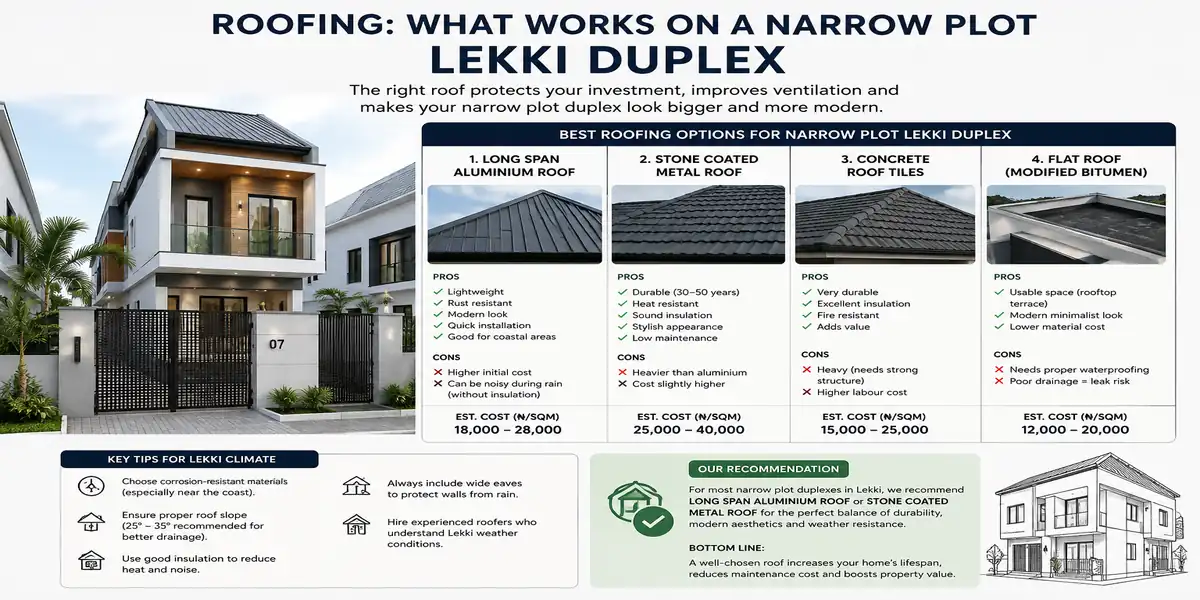
The roof choice on a narrow plot duplex affects cost, drainage performance, aesthetic appeal from the street, and long-term maintenance. There are two main roof approaches that work well on this building type and one approach that is consistently problematic.
The Hidden Roof (Parapet Roof) Approach
This is the roof type I recommend for narrow plot duplexes in Lekki and it is the type that delivers the modern, contemporary appearance that most Lekki homeowners want.
The hidden roof uses a parapet wall around the perimeter of the building to conceal an internal roof slope. From the street, the building looks flat-roofed and architectural. From above, the actual roof is sloped internally to drain water to internal gutters or through outlets in the parapet wall.
Advantages: Clean, modern architectural appearance Hides the roofing sheet material from street view, improving aesthetics significantly Parapet walls provide a degree of noise and wind protection Works well with the linear, compact appearance of a narrow plot building
Challenges that must be managed: The internal gutter and parapet outlet must be properly designed and maintained. A blocked parapet outlet in a Lekki rainy season can cause roof ponding that leaks into the building. I have seen this happen on multiple Lekki properties. The internal roof slope must be a minimum of 1 in 40 to allow water movement even during heavy downpour conditions. The outlet pipes must be a minimum of 100 mm diameter, not the decorative 50 mm pipes some contractors install.
Combination Roof Approach
This combines a parapet at the front of the building with a conventional sloped roof at the rear. The front elevation looks modern and flat, while the rear has a visible slope that drains water efficiently.
This approach costs slightly less than a full hidden roof because it requires less parapet wall construction. It is also more forgiving on drainage because the rear slope drains directly to the rear compound rather than through internal gutters.
Roofing Material for Coastal Lekki
On this point I will be direct: do not use ordinary galvanized iron roofing sheets on any Lekki property. Lekki’s salt-laden coastal air destroys ordinary zinc coatings within four to five years. You will see rust bleeding through the coating, then visible holes, then leaks.
The correct materials for Lekki are:
Aluzinc or Galvalume long-span sheets in 24-gauge minimum thickness Stone-coated roofing tiles if budget allows (excellent corrosion resistance) High-quality PVDF-coated colourbond-type sheets
The best roofing sheets for Nigerian weather guide goes into deep detail on gauges, coatings, and price ranges across different product types. Read it before you buy any roofing material for a Lekki property.
Roofing: What Works on a Narrow Plot Lekki Duplex
Compound Planning: Every Square Metre Has a Job
On a narrow plot, nothing in the compound can be accidental. The compound space that remains after the building footprint and setbacks is limited, and it must carry parking, the generator, the borehole, the soakaway, the surface drainage system, movement space, the service yard, and ideally some landscaping.
Here is how to organize these elements practically.
Parking
Two car spaces minimum. This is not negotiable for a Lekki duplex in 2026. A family that builds a four-bedroom duplex will have at minimum one car and almost certainly two. Guest parking is a separate issue, but your compound must handle the resident vehicles without either vehicle blocking the other.
On a 40 by 80 plot, after the building footprint and the 6-metre front setback, the front compound is approximately 20 feet deep by the full building width. Two side-by-side parking spaces require approximately 5 metres per space, so 10 metres of frontage. On an 8.4-metre wide building footprint, two cars will be tight side-by-side. The solution is tandem parking (one car in front of the other) with the gate centrally located, or a single car space with a generous turning apron.
Tandem parking works fine for a couple who coordinate their movements, which is the reality of most young Lekki households. What it cannot handle well is a household with four cars or frequent guest parking. If that describes your household, this plot dimension requires serious compound planning discipline from the start.
Generator Position
The generator must be:
At minimum 5 metres from any bedroom window Ventilated on at least two sides Accessible for fuel filling without moving vehicles Within practical cable run distance of your transfer switch
The side passage on a narrow plot, if at least 1.5 metres wide, can accommodate a compact generator enclosure along the side boundary. This keeps it out of the main compound view, provides natural ventilation through the passage, and puts it away from the bedroom windows which are typically on the upper floor rear.
Never place the generator in the front compound directly below the master bedroom balcony. I have seen this on a completed Lekki duplex and the owner eventually built an acoustic enclosure that cost more than a proper initial positioning would have.
Borehole Position
The borehole must be a minimum of 15 metres from the soakaway or septic tank in any direction. On a narrow plot, this separation requires coordination at the site plan stage, not after the building is complete.
Typically on a 40 by 80 plot, the borehole sits near the front compound area (to the side of the parking space) while the soakaway sits at the rear. This 15-metre separation is roughly the depth of the building plus both setbacks, which on this plot measures approximately 17 metres from front to rear compound. The separation is achievable but must be planned.
Security: Design It In, Not Bolted On
Security in Lekki is not optional. It is a design requirement. A narrow plot duplex that does not consider security from the layout stage ends up with retrofitted CCTV cameras mounted at awkward angles, perimeter lighting installed on extension cables, and a gatehouse that was originally meant to be a small store.
Gatehouse or Security Post
On a narrow plot, a full gatehouse is often not achievable without eating into compound circulation. The practical solution is a security alcove built into the perimeter fence at the gate position. This is a recessed 1.2-metre by 1.5-metre shelter within the fence wall, deep enough to protect a security guard from rain, with a sliding or hinged service window facing the gate.
This configuration takes zero additional compound space and provides basic security accommodation that can be upgraded to a full gatehouse if you ever expand to a wider rear compound or boys quarter.
CCTV Coverage
At the design stage, plan conduit runs (empty pipes inside the wall) from the following positions to a central equipment room or panel:
Gate entry point Front entrance porch Rear service door Staircase landing (for internal coverage) Generator enclosure
Installing conduits during construction costs almost nothing. Cutting channels into finished walls to route cables later costs significant money and damages finishes.
Balcony Visibility
The upper floor balcony, positioned on the front elevation, naturally provides elevated visibility of the gate area and front compound. This is a security advantage that costs nothing extra. A family member on the balcony can see who is at the gate before the gate is opened. Design the balcony with an unobstructed sight line to the gate entry point rather than positioning it at the side or rear where it serves comfort but not security.
Natural Lighting in a Narrow Plan Building
A building that is narrow in width can easily become dark internally if window placement is treated as an afterthought. On this duplex, natural lighting requires deliberate design decisions on every floor.
Vertical Windows Over Horizontal Windows
A tall narrow window (600 mm wide by 1,800 mm tall) admits significantly more light than a wide shallow window (1,200 mm wide by 900 mm tall) for the same glazing area, because the tall window allows light to penetrate deeper into the room interior. On a narrow plan building where rooms can only be day-lit from one or two sides, vertical windows are the more effective choice.
Light-Coloured Interior Finishes
This is practical advice that costs nothing extra: specify cream, off-white, or light warm tones for interior walls rather than deep colours. In a narrow plan room with limited window area, a deep grey wall absorbs available daylight and makes the room feel smaller and darker than it is. A cream or warm white wall reflects the daylight and creates a brighter, more spacious feeling.
This is particularly important in the secondary bedrooms on the upper floor, which are often the rooms with the smallest window area.
Glass Balustrades on the Staircase
A closed balustrade on the staircase, especially a solid wall on both sides, creates a dark enclosed passage. Open steel or glass balustrades allow light to pass through the staircase zone from the staircase window or landing opening, brightening the ground floor entry area as well as the upper floor landing.
Glass balustrades also create a sense of spatial connection between floors that makes the building feel more generous internally, which matters on a narrow plan where every metre of visual space is valuable.
Construction Cost Estimate for a Narrow Plot Duplex in Lekki (2026)
Material prices in Nigeria fluctuate and any guide that gives you a single precise figure is being dishonest with you. What I can give you is a realistic stage-by-stage cost range based on current market conditions in Lagos, with clear notes on what drives the variation within each range.
| Construction Stage | Estimated Cost Range | What Drives the Higher End |
|---|---|---|
| Substructure (foundation and ground beam) | N12M to N20M | Soft soil requiring raft or piled foundation |
| Ground floor slab and decking | N8M to N15M | Larger floor plate, more reinforcement |
| Blockwork and structural frame | N18M to N30M | Higher reinforcement specification, complex columns |
| First floor decking | N8M to N14M | Same as ground, depends on span |
| Roofing (structure and covering) | N10M to N22M | Hidden roof design, premium sheet material |
| Electrical and mechanical rough-in | N7M to N16M | Generator changeover system, security conduits |
| Plumbing rough-in | N5M to N10M | Borehole pump installation, hot water provision |
| Finishing (tiles, ceilings, painting, joinery) | N20M to N45M | Imported tiles, custom joinery, premium paints |
| External works (compound, fence, gate, drainage) | N8M to N18M | Interlocking type, gate material, drainage complexity |
| Estimated Total | N96M to N190M | Depending on finish quality and soil conditions |
The biggest single variable in this range is finishing. A duplex finished with mid-range Nigerian porcelain tiles, standard POP ceilings, and locally available paint can come in at the N96M to N120M range. The same structure finished with imported Spanish or Italian large-format tiles, custom ceiling designs, engineered wood flooring in the bedrooms, and premium fittings can reach N150M to N190M.
For a detailed stage-by-stage Lagos duplex cost breakdown with specific contractor rates and material quantities, the guide on the cost of building a 4 bedroom duplex in Lagos covers this in depth.
Cost-Saving Decisions That Do Not Sacrifice Quality
Simplify the structural frame shape. Every projection, cantilevered slab, or curved wall element adds to your structural cost. A clean rectangular plan costs significantly less to build than a plan with multiple bays, projections, and re-entrant corners. On a narrow plot, a clean rectangle is also the most space-efficient shape anyway.
Buy roofing material early. Roofing sheet prices in Lagos track the naira exchange rate closely because most premium sheets are imported or use imported base material. If you buy early in your project timeline rather than waiting until the structure is ready for roofing, you reduce the price volatility risk significantly.
Standardize your tile sizes. Using one or two tile formats throughout the building rather than different sizes for every room reduces cutting waste and simplifies procurement. A 60 by 60 cm porcelain tile used throughout the entire building means buying in bulk from one supplier rather than multiple smaller orders.
Supervise reinforcement yourself. Reinforcement bars are the single most common material on Nigerian construction sites where substitution happens. A contractor who reduces your column reinforcement from the specified 6 bars of 16 mm to 4 bars of 12 mm has made a structural change that will not be visible after the concrete is poured. Verify reinforcement placement yourself or engage a professional to do so before every concrete pour.
The building materials price guide for Nigeria gives you the current market rates for cement, blocks, iron, tiles, and other materials so you can verify what your contractor is telling you.
Material Selection for Lekki’s Coastal Environment
Lekki is not just Lagos. It is coastal Lagos, and that distinction matters for every material you specify on this building.
Walling Materials
Sandcrete blocks remain the standard Nigerian wall material and they are perfectly appropriate for a Lekki duplex. The important thing is block quality control. Blocks produced on site or from small local producers often have inconsistent sand-to-cement ratios that result in weak blocks. Specify blocks from a reputable producer with consistent quality, or supervise on-site block production to ensure the mix is correct.
For external walls below the ground floor window level, consider adding a damp-proof course at the base of the wall to prevent ground moisture from rising into the wall body. This is especially relevant in Lekki where the water table is high and the ground is often saturated.
External Finishes
Textured acrylic paint or elastomeric paint outperforms ordinary emulsion paint on external walls in coastal conditions. It is more flexible, resists hairline cracking better, and repels water more effectively. The additional cost over standard exterior emulsion is modest and the performance difference over a five-year period is significant.
Stone cladding on the lower portion of the facade, from ground level to approximately one metre height, adds an excellent aesthetic element while also providing a more durable surface in the splash zone where rainfall and compound water create the most aggressive surface conditions.
Metal Elements
Any metal element on the exterior of a Lekki building, including railings, balcony balusters, window frames, gate elements, and louvre frames, should be either galvanized steel with proper primer and topcoat, stainless steel, or aluminium. Ordinary mild steel painted directly without galvanizing will begin rusting within two rainy seasons in Lekki’s salt air.
The Investment Case for a Narrow Plot Lekki Duplex
For investors and homeowners with an eye on property value, the case for a well-designed narrow plot duplex in Lekki is straightforward.
Land in Lekki continues to appreciate. A narrow plot purchased today in a good Lekki location is almost certainly worth more in three years than it is now, and a well-designed, well-finished duplex on that plot multiplies the return further because rental demand in Lekki remains strong across the upper-middle income bracket.
Rental performance data for Lekki duplexes in 2025 and 2026 shows that a modern four-bedroom duplex in Lekki Phase 1 and surrounding estates commands annual rents ranging from N18M to N40M depending on location, finish quality, security, and parking. At the lower end of that range, a building that costs N110M to construct at mid-range finishing generates a gross yield of approximately 16 percent per year on construction cost, excluding land. That is a strong performance for a real estate investment in any market.
The key word is “well designed.” A poorly designed duplex on the same land, with ventilation problems, drainage issues, inadequate parking, and poor finish quality, will attract lower rental demand or stay vacant while tenants choose better designed alternatives.
Browse the Plans Library to see floor plan options and elevation styles that deliver the finish quality Lekki renters and buyers expect.
Common Mistakes on Narrow Plot Duplexes in Lekki
I want to be specific here because generic advice like “avoid poor supervision” does not help anyone. These are the actual mistakes I see on Lekki narrow plot duplex projects.
Mistake 1: Designing the Facade First
Many clients come to me with a phone full of Instagram pictures of modern duplex elevations they love. The conversation they want to have is about what the building looks like from the street. The conversation we need to have first is about what happens inside and how the plot works.
A beautiful facade on a poorly planned interior is a house that photographs well and lives badly. Design the plan first. The elevation follows from a good plan naturally.
Mistake 2: Ignoring the Side Passage Width
A 1.5-metre side setback gives you a 1.5-metre passage between your building wall and your fence. After wall thickness on both sides (typically 300 mm combined), the usable passage width is approximately 1.2 metres. That is enough for a person to walk through, for pipe maintenance access, and for the generator enclosure.
If you reduce the side setback below 1.5 metres to gain interior space, you create a passage that cannot be used for maintenance, cannot be walked through comfortably, and becomes a dead zone that collects debris and moisture. Never compromise the side passage width beyond the minimum.
Mistake 3: Oversized Staircase
A staircase on a narrow plot duplex does not need to be a grand design statement. A staircase with a 1.1-metre clear width, comfortable 175 mm riser height, 250 mm tread depth, and a good quality steel or glass balustrade is perfectly elegant and takes minimum floor area.
An oversized staircase of 1.5-metre width with a wide winding turn consumes 15 to 20 percent more floor area and delivers the same function. On a narrow plot where every 0.3 metres of width matters, that trade-off is not justified.
Mistake 4: No Ante Room or Lobby Buffer
The front door should not open directly into the living room. In a well-designed Nigerian duplex, there is always a small lobby or ante room, even if it is just 1.5 metres deep, between the front door and the main social space.
This buffer serves three functions. It prevents guests from seeing directly into the living room before they are received. It provides a small zone for shoes, bags, and the initial greeting. And it reduces the direct heat and rain splash exposure of the living room during the moments when the front door is open.
I have seen Lekki duplexes without this buffer where the tenant permanently keeps the living room curtains drawn because passing pedestrians and compound visitors have a direct sight line into the sofa area from the open front door. A simple 1.5-metre lobby prevents this permanently.
Mistake 5: Rushing the Slab Level Decision
The ground floor slab level (your finished floor level) is one of the most expensive things to change after construction begins. If you get it wrong, either too low and the building floods, or excessively high and you create access challenges for older family members, correcting it requires significant rework.
Take time at the beginning to establish the exact finished floor level relative to the estate road, your neighbour’s floor levels, and the confirmed drainage direction. Do not let the contractor set this based on how much sand fill is already on site. Set it based on a survey and a deliberate decision.
Future Expansion Options Even on a Narrow Plot
A narrow plot does not mean your building is finished when the second floor is completed. There are legitimate expansion options worth planning for at the structural design stage.
Pent Floor or Roof Terrace
If the structural design accounts for a third floor load from the beginning, you can add a pent floor apartment or rooftop leisure terrace later. The additional cost at structural design stage to plan for this is modest, roughly the cost of increasing column and foundation sizes by one step. The cost of trying to add a third floor to a structure not designed for it is prohibitive and sometimes impossible.
For families who are growing or investors who see the Lekki rental market continuing to strengthen, a pent floor or roof apartment is a significant future value addition worth planning for now.
Detached Boys Quarter at Rear
A rear compound of 3 metres by 8 metres, as remains on a 40 by 80 plot after setbacks and building footprint, is not large enough for a conventional Boys Quarter. But a compact utility structure of approximately 15 to 18 square metres is achievable at the rear boundary if your estate regulations permit outbuildings at the rear setback.
This structure can serve as a domestic staff room, a secure equipment room for borehole and generator control panels, or a compact self-contained rental unit generating additional income.
Solar Installation Readiness
Lekki electricity supply is no different from the rest of Lagos. Planning for solar installation is not a luxury future option; it is a realistic current need that should be considered at structural design stage.
Structural readiness for solar means the roof structure is designed to carry additional panel loads, conduit runs for DC cable from roof to inverter room are installed during the rough-in phase, and an inverter room location is identified within the building from the beginning.
Building Supervision: What to Check and When
This section is for the homeowner who is managing their own build without a full-time site supervisor. I want to give you specific checkpoints, not general advice.
Before foundation concrete is poured: Verify that the column positions are set out correctly and match the approved plan dimensions. Measure the setbacks yourself from the boundary to the proposed column positions. Verify that the reinforcement bar sizes match the structural drawings. Look at the number of bars in each column cage before any concrete enters.
Before ground floor slab concrete: Confirm the slab level against the established finished floor level benchmark. Check that all conduits for electrical and plumbing are in place before the concrete covers them. Verify slab thickness by checking how high the reinforcement mesh sits above the base.
Before decking (first floor slab) concrete: Ensure the decking formwork has proper support and remains level. Verify the correct positioning of the top and bottom reinforcement layers inside the slab. Ensure workers install sleeves for all service penetrations before pouring the concrete.
Before roofing: Ensure the roof structure has adequate bracing and confirm that the roofing sheet gauge matches the specification. Check the parapet wall height and confirm the correct positioning and sizing of the drainage outlets.
Before tiling: Walk every room and check that walls are plumb and floor levels are consistent. A tiler working on an uneven screed produces inconsistent tile joints that look bad permanently.
If you want professional plan production and site documentation support before your project starts, the professional design and architecture services available through MassodihPlans can handle the technical documentation that protects you throughout construction.
Orientation: Positioning the Building for Natural Comfort
Building orientation on a Lekki narrow plot is often constrained by the plot position on the estate road, but there are still decisions to be made.
If your plot faces south (building front faces south towards the road), this is the best orientation for Lekki conditions. The front elevation catches the southwest prevailing breeze during the wet season while the rear catches the northeast harmattan wind in the dry season. Both orientations allow some natural airflow through the building.
If your plot faces north (building front faces north), the living areas on the ground floor will receive the morning sun from the east through their side windows, which is acceptable. The challenge is that the rear of the building faces south and will receive direct afternoon sun on what is typically the kitchen and service area. Manage this with rear roof overhangs extending at least 600 mm beyond the wall line and rear-facing louvre shading over windows.
A west-facing plot (building front faces west) is the most challenging orientation for Lekki. The afternoon sun beats directly on the main facade from approximately 1pm to 6pm, heating the front rooms significantly. Manage this with deep covered porches (minimum 1.8 metres depth), vertical shading fins or brise-soleil on the west elevation windows, and reduced glazing area on the west face.
Orientation, Lifestyle Suitability, and Who This Duplex Works For
This narrow plot duplex design type works best for specific household profiles, and understanding which profile fits helps you make better design decisions.
Young professional couples in their 30s and 40s who work from home part of the time, entertain regularly, and want a house that feels modern and comfortable without excessive maintenance obligations. The compact luxury approach fits this household precisely.
Families with two to three children in the primary school and secondary school age range. The upper floor family lounge acts as a homework and entertainment zone that keeps children out of the parents’ bedroom area. The staircase design needs careful safety attention for this household type, with handrail continuity and adequate landing lighting.
Diaspora Nigerians returning to Lekki or maintaining a Lagos base. The compact, well-finished duplex is a practical alternative to an oversized house that requires extensive caretaking during periods of absence. A well-designed duplex with quality materials requires less maintenance than a larger house built with cheaper materials.
Investors building specifically for the rental market. The four-bedroom duplex format in Lekki attracts the broadest rental market, covering young families, corporate tenants, and diaspora short-term stays. The design should prioritize durability of finishes, quality of plumbing fixtures, and ease of maintenance over personalized design features.
Explore more Nigerian-specific house design approaches in the Plan School section, which covers everything from reading floor plans correctly to understanding what Nigerian building regulations actually require.
A Note on Hiring Professionals: What You Actually Need
You need at minimum three professionals on a Lekki duplex project: an architect for the architectural drawings and estate approval submission, a structural engineer for the foundation design and structural frame calculations, and a registered quantity surveyor or building services consultant if you want an honest bill of quantities before construction starts.
The architect alone cannot substitute for the structural engineer, and the structural engineer cannot replace the architect. They do different things and on a Lekki narrow plot where the structure must work precisely within the setbacks, the coordination between both disciplines is not optional.
Some clients ask me if they can use a draughtsman instead of a registered architect to save cost on the design. In estates with formal management that require approved drawings and registered architect certification on submissions, this shortcut will create problems at the approval stage. In less regulated areas it may work practically, but the quality of structural and ventilation coordination in a draughtsman-produced plan versus an architect-produced plan is typically noticeable.
You can reference the International Code Council’s residential building design guidelines as an internationally recognised reference framework for understanding minimum space and structural requirements for residential buildings. The Lagos State Urban and Regional Planning Law, which governs residential development in Lekki, operates within similar minimum standard principles for habitability, setbacks, and structural integrity.
Frequently Asked Questions
What is the best plot size for a duplex in Lekki?
A 40 by 80 foot plot is the most practical balance for a modern Lekki duplex. It provides enough depth for a four-bedroom duplex, two car parking, front and rear setbacks, and proper compound organization without the cost of a wider or deeper plot.
Can a duplex actually fit on a 30 by 60 foot plot in Lekki?
Yes, but the design must remain extremely disciplined. The layout can only accommodate one vehicle or a tandem two vehicle arrangement, side passages need minimum clearance, and room sizes become smaller than comfortable if you try to fit four bedrooms. A three-bedroom configuration works better on a 30 by 60 plot.
How much does it cost to build a narrow plot duplex in Lekki in 2026?
Depending on finishing quality and soil conditions, a realistic range is N96 million to N190 million. The floor and tile finishing choices alone can account for N25 million to N40 million of variation within that range. Build to the structural quality regardless of where your budget sits on the finishing spectrum.
Why is the hidden roof popular on Lekki duplexes?
The hidden or parapet roof creates the clean, contemporary street appearance that is consistent with Lekki’s premium estate environment. It also reduces the visual bulk of a two-storey building on a narrow plot by eliminating the visible roof mass. The trade-off is that the internal drainage must be carefully designed and maintained.
Is a narrow plot duplex a good rental investment in Lekki?
Yes, when it is well designed and well finished. Lekki rental demand for four-bedroom duplexes remains strong, and a compact, modern, properly ventilated duplex in a good location commands rents that deliver strong returns on construction cost. Design quality directly affects rental value.
How many cars can park in a narrow plot compound?
Most well-planned narrow plot duplexes accommodate two cars, typically in tandem arrangement (one behind the other) due to the limited frontage width. Three-car households will find a narrow plot compound challenging without significant compound design creativity.
Which direction should a Lekki duplex face for best ventilation?
South-facing is ideal for Lekki conditions because it captures the southwest prevailing breeze in the wet season and is manageable in harmattan. West-facing is the most challenging orientation because of afternoon sun exposure, which requires additional shading design.
Does my Lekki estate require plan approval before I start building?
Almost every formal Lekki estate and all Lagos State planning zones require approved drawings before construction starts. Proceeding without approval risks a stop-work order or demolition enforcement. The approval process through the Lagos State Physical Planning Permit Authority (LASPPPA) takes time, so begin the approval submission process before you intend to break ground.
Final Thought
A narrow plot does not limit what your house can feel like inside. It limits how wide the building can be, and how many metres separate you from your boundary walls. The interior, the airflow, the light, the family comfort, the investment performance; these depend on design intelligence, not on plot width.
The difference between a Lekki duplex that truly delivers comfort and one that only impresses from the street depends on whether the designer understands ventilation, circulation, drainage, and Nigerian family life before drawing the first wall. This guide builds on that understanding.
If you need a design produced for your specific Lekki plot, with dimensions, setback calculations, and estate-ready drawings, the professional design services at MassodihPlans are available for exactly that purpose.
For more Nigerian house plan options across different plot sizes and building types, the Plans Library has architect-approved designs ready for review.
Related post to complete the lesson
- House Plan Selection Guide: How to Choose the Right House Plan for Your Land, Budget and Lifestyle
- Land-Buying Checklist: 100+ Things to Check Before Buying Land in Nigeria
- Building Project Budget Template: Complete House Construction Cost Planner
- Homeowner’s Construction Checklist: 150+ Things to Check Before and During Building
- Building Materials Checklist: 100+ Materials You May Need When Building a House
- Site Analysis Checklist: 50+ Things to Check Before Building on Your Land
- House Planning Checklist: 50+ Essential Things to Check Before Building a House (Complete Guide)
- Building Cost Calculator Nigeria: Estimate Your House Cost in 60 Seconds
- What Nigerian House Plans Are Best for Swiss Property Investors?
- Nigerian House Plans Suitable for Hot Weather in Sokoto
- Duplex vs Bungalow in Benin City: Which Should You Build?
- How Do I Get Land Survey and Building Approval in Nigeria From Switzerland? A Step-by-Step Guide for Diaspora Property Owners
About Author
Massodih Okon is a built environment professional with a background in architecture and urban planning. He specializes in practical Nigerian house design guidance through MassodihPlans.com.. He has a Master’s degree in Urban and Regional Planning, a first degree in Geography and Environmental Management, and professional certificates in Architectural Design, Landscape Design, and GIS. With over 15 years of hands‑on experience in architecture, town planning, GIS, and building economics across Nigerian residential and institutional projects, he understands the real challenges Nigerians face when planning and building homes.
At MassodihPlans, Massodih shares practical Nigerian building guides, modern bungalow and duplex house plans, and built environment resources created specifically for Nigerian homeowners, developers, and property investors. His work is based on real‑life conditions in Nigeria, climate‑responsive design, and cost‑effective planning, aimed at helping everyday Nigerians make smarter, more confident building decisions.