Best Roofing Sheets for Nigerian Weather: Complete Guide
Roofing sheets in Nigeria now define the durability, comfort, beauty and long-term value of a building. Whether you are a homeowner, a builder or a property developer, the roofing sheet you choose will decide how your building handles heavy rain, harsh sun, salt air and heat for the next 20 years or more.
The best roofing sheet depends on your location, budget, and how much heat, rainfall and humidity your roof must survive. For most permanent Nigerian homes, quality Aluzinc (aluminium-zinc coated steel) gives the best balance of corrosion resistance, durability and price, provided the coating, thickness and installation are right. Stone coated sheets suit premium homes and noise-sensitive rooms. Fibre cement suits schools, churches and factories. In this guide I walk you through every option, current price ranges, gauge, brands, how to verify genuine material, how to calculate quantities, and the installation mistakes that cause leaks.
In a hurry on site? Jump to the price section and the quick comparison table below. If you are still planning, read on. It will save you money.
What Is a Roofing?
Roofing is the process and the materials used to create the protective upper covering of a building. It shields the structure from rain, sun, wind, dust and other environmental factors. And it covers more than the sheets themselves. It includes the structural layers underneath, such as rafters, purlins, nails, screws, underlayment, ceilings and accessories, all working together to keep the building safe and functional.
In Nigeria this matters even more because of our tropical climate, heavy rainfall and rising temperatures. The roofing sheet you choose is a critical decision, not a finishing detail.
The Important Roles of Roofing in Building Construction
Weather protection: The roof is your first line of defence against heavy rain, intense sun and strong winds.
Structural protection: A good roof prevents water intrusion that slowly weakens walls, ceilings and foundations.
Comfort: The material, colour and ventilation of your roof control how much heat enters the building and how much cooling you need.
Aesthetics and value: Design, colour and profile enhance the look of the building and its market value.
Sound insulation: The right material reduces the noise of heavy rainfall and other external disturbances.
A roof therefore supports durability, comfort, energy efficiency and appearance all at once, which is why understanding your sheet options matters.
Quick Comparison: Roofing Sheets at a Glance
| Sheet Type | Best For | Lifespan (Southern Nigeria) | Noise in Rain | Relative Cost |
|---|---|---|---|---|
| Galvanised Iron (GI) | Temporary structures only | 5 to 8 years | Loud | Lowest |
| Aluzinc / Galvalume | Standard permanent homes anywhere | 20 to 30 years | Loud | Moderate |
| Stone Coated | Luxury homes, noise-sensitive rooms | 25 to 40 years | Quiet | High |
| Aluminium | Coastal and architectural applications | 20+ years | Loud | High |
| Fibre Cement | Schools, churches, factories, noise control | 20 to 30 years | Very quiet | Moderate to high |
| PVC / Polycarbonate | Carports, sheds, skylights only | 8 to 15 years | Loud | Low to moderate |
Why Nigerian Weather Is Uniquely Hard on Roofing Materials
Nigeria is not one climate. It is about five different weather realities in one country, and a sheet that performs well in Kano can fail within three years in Port Harcourt if you do not understand why.
The sun
From March to October in the south, roof surface temperatures in Lagos can exceed 75°C on a cloudless afternoon. Cheap paint cracks, blisters and peels at that temperature, and once the paint goes, the coating underneath starts oxidising. The UV index sits between 9 and 11 for most of the year. Premium sheets use PVDF or SMP paint systems built for this. Ordinary polyester paint starts visibly fading within 18 to 24 months.
The rain
Port Harcourt receives roughly 2,300 to 2,800 mm of rain a year and Lagos about 1,700 mm. Peak downpours in the Niger Delta can drop 80 to 100 mm in an hour, driving water sideways and upward into overlaps and screw holes. Long-span sheets and well-engineered interlocking profiles handle this. Short sheets with poor overlaps do not.
Coastal corrosion
Salt air attacks unprotected metal constantly. Plain galvanised iron corrodes visibly within four to six years in coastal cities. This is why Aluzinc (55% aluminium, 43.4% zinc, 1.6% silicon) matters so much along the coast. The aluminium forms a dense oxide layer salt air struggles to penetrate, and the zinc protects cut edges.
Humidity and condensation
In the South-South, relative humidity stays above 85% for most of the year. Warm humid air rises into the roof space at night, meets cooler metal and condenses on the underside of the sheets. Over the years this rots timber purlins, damages ceilings and creates that musty smell many owners wrongly blame on the foundation. I cover the fix in the ventilation section.
Regional timing
In the south (Lagos, Port Harcourt, Calabar, Uyo) heavy rain runs roughly March to October, so aim to have your roof sealed before March. And in the Middle Belt (Abuja, Jos, Makurdi) rains run April to October, often with strong winds ahead of the storm. In the north (Kano, Sokoto) the season is shorter, June to September, but storms are sudden and intense, so installation quality matters just as much.
Types of Roofing Sheets in Nigeria: What They Are, What They Cost, Who Should Use Them
All prices below are reference ranges from my March 2026 market surveys, expressed per square metre of installed sheet width unless stated otherwise. Naira prices follow the exchange rate, so always get at least three written quotes.
1. Galvanised Iron (GI) Sheets
Galvanised steel sheets are steel coated with zinc to prevent rusting. They are strong, cheap and able to carry heavy loads, which is why they are common on warehouses, industrial buildings and temporary structures. The zinc coating is only about 20 to 30 micrometres thick, so in humid southern conditions it is essentially a temporary solution. They work acceptably in the drier far north.
Price: about ₦3,600 to ₦5,800 per square metre for standard 26 gauge in the major markets, with higher gauges and premium quality reaching about ₦8,600.
Use for: site offices, market sheds, poultry and agricultural storage. Avoid for permanent homes if you have a better option.
Lifespan: 5 to 8 years in the south, up to 12 years in drier northern cities.
2. Aluzinc Roofing Sheets
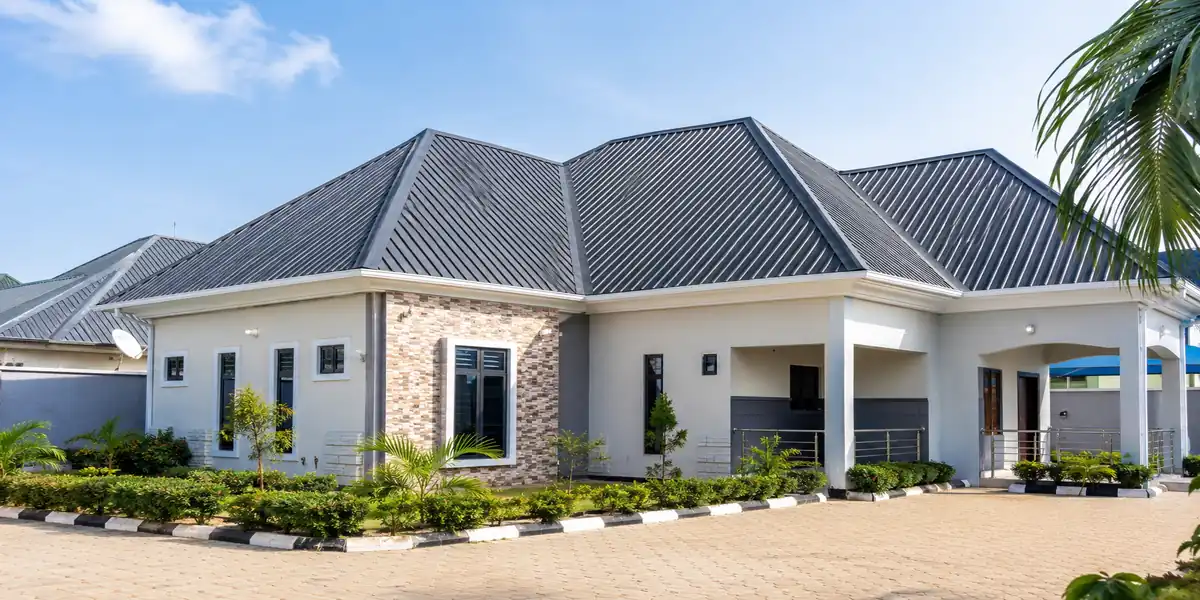
This is the standard I recommend for most permanent Nigerian buildings. Aluzinc is steel with a hot-dip coating of aluminium, zinc and silicon, giving three to six times the corrosion resistance of plain galvanised sheet. It also reflects more solar radiation, which helps keep the roof space cooler. It comes pre-painted in dozens of colours with SMP or PVDF systems, and quality painted Aluzinc holds colour for 15 to 20 years.
Aluzinc is widely sold in corrugated, long-span, and plain or coated profiles. Bundles are typically 15 sheets, and bundle prices commonly run about ₦55,000 to ₦90,000 depending on gauge, profile, brand and location.
Price per square metre (painted, 24 gauge): about ₦6,900 to ₦9,000 depending on city. 22 gauge runs about ₦7,700 to ₦10,200.
Use for: permanent homes, warehouses and commercial projects anywhere, especially coastal cities, the Niger Delta and areas with industrial pollution.
Lifespan: 20 to 30 years with minimal maintenance.
3. Galvalume Roofing Sheets
Galvalume and Aluzinc are essentially the same product under different trade names. And Galvalume is the original American name, developed by Bethlehem Steel, while Aluzinc is the name used by European and Asian manufacturers. Dealers sometimes price Galvalume slightly higher even though performance is nearly identical, so compare the aluminium content of the coating (about 55%) rather than the name.
Price: roughly ₦6,500 to ₦10,500 per square metre depending on city, brand and grade. Use it in the same situations as Aluzinc.
4. Stone Coated Roofing Sheets
Stone coated sheets combine the strength of steel with the look of traditional tiles. A steel base (usually Aluzinc) is coated with acrylic adhesive and embedded with kiln-fired stone granules. The result tackles three problems at once: heat, noise and aesthetics. Rain noise is reduced, a thermal buffer cuts heat transfer, and the tile appearance comes at a fraction of the weight. Stone coated sheets weigh roughly 6 to 9 kg/m², compared with 40 to 50 kg/m² for clay tiles, so your roof structure can be lighter and cheaper.
Profiles include wood shake, shingle, bond and classic, and price varies with gauge, design and colour.
Price per square metre: standard locally produced sheets start from about ₦4,700 to ₦5,200, premium local ranges run about ₦5,200 to ₦7,200, and top-tier or imported brands such as Gérard and Decra reach roughly ₦9,000 to ₦15,000. Imported brands carry 30 to 40 year warranties but cost 40 to 60% more than local alternatives.
Use for: luxury estate homes, Mediterranean-style architecture, buildings where rain noise is a real problem, such as bedrooms under the roof, home offices and nurseries.
Lifespan: 25 to 40 years.
5. Aluminium Roofing Sheets
Aluminium does not rust. It forms an oxide layer immediately on exposure to air, which protects it even in salt air. It is lightweight, sleek and suits modern residential, commercial and even industrial buildings. The limitations are that it is softer than steel, dents more easily, and expands and contracts more with temperature, so fixing details need careful engineering.
Common types are longspan, steptiles and Metcoppo. Light-gauge longspan (0.45 to 0.55 mm) runs about ₦5,600 to ₦7,400 per square metre. Thicker longspan (0.60 mm and above) runs about ₦8,600 to ₦15,800. Steptiles and Metcoppo designs cost a bit more than plain longspan, about ₦6,700 to ₦9,600 depending on gauge and brand. In Lagos, premium alloy and thickness can reach ₦10,500 to ₦17,000.
The final price depends heavily on profile and thickness. Aluminium is excellent for secondary applications such as soffits, cladding and ceilings. For primary roofing in heavy-rain regions, steel-based sheets are often more practical.
6. Fibre Cement Roofing Sheets
Fibre cement sheets are made from a cured mixture of cement, cellulose fibres and mineral reinforcement. They are not metal, and that changes the whole performance profile. They offer excellent fire resistance, acoustic insulation and weather resistance. Heavy rain on fibre cement produces a dull, muted sound instead of metal drumming.
The trade-offs are real. They are heavier than metal, so your trusses and purlins must be designed for the load from the start. They are also brittle. A cracked sheet needs full replacement, not a patch.
They are usually sold per sheet. A common size is 1.2 m × 2.4 m (2.88 m²). A 6 mm sheet sells for around ₦12,500, roughly ₦4,340 per square metre, and prices rise with 8, 10 and 12 mm thicknesses. Across thicknesses and profiles, expect about ₦4,340 to ₦7,000 per square metre. Imported options vary widely, about ₦3,000 to ₦20,000 per sheet depending on quality, finish and minimum order.
Use for: schools, churches, factories and warehouses. I would not specify it for a standard residential duplex unless noise reduction is a stated priority.
Lifespan: 20 to 30 years, less if handled and installed carelessly.
7. PVC and Polycarbonate Sheets
These lightweight, transparent or semi-transparent sheets suit areas that need natural light: carports, walkways, greenhouses, sheds and skylight panels. They are tough, flexible and impact resistant, with prices of about ₦9,000 to ₦31,000 per sheet depending on thickness and colour.
I want to be direct here. I have seen homeowners persuaded to use PVC for primary residential roofing on price alone, and it did not end well. Under intense Nigerian sun, a PVC roof that looks fine in year one can show discolouration and micro-cracking by year three or four. Use it for carports, sheds and skylights, not as the main roof of a permanent home.
Lifespan: 8 to 15 years, longer for shaded secondary uses.
Understanding Gauge: The Most Important Number on Your Order Form
Gauge measures metal thickness, and the numbering is counterintuitive: lower gauge numbers mean thicker metal.
- 26 gauge Aluzinc: 0.40 to 0.45 mm
- 24 gauge Aluzinc: 0.50 to 0.55 mm
- 22 gauge Aluzinc: 0.65 to 0.70 mm
A difference of 0.1 to 0.2 mm is not trivial. Thicker sheets resist denting, take foot traffic during installation, flex less between purlins and hold paint systems better.
Recommended gauge by building type
- Temporary farm buildings and sheds: 26 gauge is acceptable (5 to 8 years of use).
- Standard single-storey bungalow, inland: 24 gauge minimum.
- Duplex or two-storey: 22 to 24 gauge, because of longer spans and greater wind exposure.
- Coastal buildings within about 20 km of the sea: 22 gauge minimum.
- Large-span industrial or commercial buildings: 22 gauge minimum.
- Roofs carrying solar panels: 22 gauge, with steel purlins and a structural assessment.
The gauge cheat to watch for. When you order 24 gauge, you expect 0.50 to 0.55 mm. Some dealers supply about 0.42 mm and loosely call it “24 gauge”. Carry a digital vernier caliper (about ₦3,500 at an electrical market) and measure 5 to 10 sheets from different positions in the stack. If the material is consistently below specification, do not buy.
Major Roofing Sheet Brands in Nigerian Markets
Astec: An established Nigerian manufacturer with facilities in Lagos and Kano, imported coil, genuine PVDF paint systems and 15 to 20 year paint warranties. Buildings I supervised in 2017 and 2018 with Astec sheets still hold their paint well. Price premium over generic brands is roughly 10 to 18%.
Falcon: Strong in long-span production, with sheets up to 12 m in a single piece, which removes a major leak point on large roofs. Showrooms in Lagos, Abuja, Port Harcourt and Kano.
Globe: A budget-friendly domestic option. Fine for northern applications, but its Aluzinc line often uses polyester rather than SMP or PVDF paint, so colour degrades faster on the coast. Spend extra for a better paint system in southern and coastal locations.
BlueScope (Zincalume and Colorbond): Available through specialty importers. Engineered for tropical coastal environments, with warranties of around 25 years, but a premium of 35 to 55% over comparable Nigerian-made Aluzinc. Whether that is justified depends on how long you will hold the property.
How to Verify You Are Getting Genuine Roofing Material
This is where many homeowners lose money without realising it, until the “Aluzinc” they paid for rusts like plain galvanised iron.
Check the SON mark. Genuine manufacturers carry Standards Organisation of Nigeria certification, visible on packaging or delivery documents, not just claimed verbally.
Ask for the mill certificate. It confirms the coating composition (about 55% aluminium, 43.4% zinc, 1.6% silicon for true Aluzinc). A dealer who cannot show any coil documentation is a warning sign.
Test the material yourself. Measure thickness with a caliper and examine the coating in sunlight. Genuine Aluzinc has a distinctive spangled finish, but treat this as a supporting check, not a replacement for measurement.
Buy from authorised dealers. It does not guarantee zero risk, but it gives you a traceable point of accountability that roadside stockists cannot.
The few thousand naira saved on unverified material is rarely worth a roof that fails five years early.
2026 Roofing Sheet Prices: Market Survey
These prices come from my personal market surveys in March 2026, per square metre. Treat them as reference points, not fixed numbers.
Lagos (Ikeja and Apapa)
| Sheet Type | Gauge | Price per m² | Approx. per 6 m × 1 m sheet |
|---|---|---|---|
| Galvanised iron | 26 | ₦3,800 to ₦4,200 | ₦22,800 to ₦25,200 |
| Aluzinc painted | 24 | ₦7,200 to ₦8,500 | ₦43,200 to ₦51,000 |
| Aluzinc painted | 22 | ₦8,100 to ₦9,800 | ₦48,600 to ₦58,800 |
| Stone coated | Various | ₦11,500 to ₦14,000 | ₦69,000 to ₦84,000 |
| BlueScope imported | 24 | ₦12,000 to ₦15,500 | ₦72,000 to ₦93,000 |
Abuja (Kugbo and Nyanya)
| Sheet Type | Gauge | Price per m² |
|---|---|---|
| Galvanised iron | 26 | ₦3,600 to ₦4,000 |
| Aluzinc painted | 24 | ₦6,900 to ₦8,000 |
| Aluzinc painted | 22 | ₦7,700 to ₦9,200 |
| Stone coated | Various | ₦10,500 to ₦13,500 |
Port Harcourt (Rumuola, Rumuokoro and Trans-Amadi)
| Sheet Type | Gauge | Price per m² |
|---|---|---|
| Galvanised iron | 26 | ₦4,100 to ₦5,000 |
| Aluzinc painted | 24 | ₦7,600 to ₦9,000 |
| Aluzinc painted | 22 | ₦8,500 to ₦10,200 |
| Stone coated | Various | ₦9,500 to ₦15,000 |
Port Harcourt prices typically run 5 to 10% above Lagos because of transport costs and high construction demand from the oil services sector.
What affects the price daily: sheet type, thickness, brand, market demand, exchange rate movement and location.
Hidden costs most quotes leave out
- Screws with EPDM washers: ₦1,200 to ₦2,500 per bundle of 100 (a 150 m² roof uses 4 to 6 bundles)
- Ridge caps: ₦3,500 to ₦5,000 per running metre
- Gutters (200 mm half-round aluminium): ₦4,500 to ₦7,500 per metre
- Downpipes (100 mm): ₦2,500 to ₦4,500 per metre
- Underlayment (15 lb asphalt felt): ₦400 to ₦800 per m²
- Professional labour: ₦800 to ₦1,500 per m², including fastening, flashing and ridge work
- Purlin treatment: ₦400 to ₦700 per linear metre
- Flashing per penetration: ₦8,000 to ₦25,000
Always ask your contractor for a complete installed price per square metre, not just material. It is the only fair way to compare quotes.
How to Calculate the Number of Roofing Sheets You Need
Footprint: Measure the building at ground level. Example: 12 m × 9 m = 108 m².
Slope factor: 15° pitch ×1.04; standard 25 to 30° ×1.15; steep 40° ×1.31. Add 5% more for a hip roof. Example: 108 × 1.15 × 1.05 = 130.4 m².
Overhang: Typically 450 mm at eaves and 300 mm at gables, adding roughly 14 to 18 m². Total: about 146.4 m².
Coverage: A standard 6 m sheet gives about 6 m² effective cover after overlap.
Sheets: 146.4 ÷ 6 = 24.4, so 25 sheets.
Wastage: Add 8 to 10% for site-cut sheets, or 3 to 5% for factory-cut long-span. 25 × 1.09 ≈ 28 sheets.
Spares: Order 2 extra sheets from the same batch and store them flat and dry. Colour matching across batches is hard, and it shows from the street.
Quick check: roof area ÷ 6, × 1.10 for a gable roof or × 1.15 for a hip roof, plus 2 spare sheets.
Installation Mistakes That Cost Nigerian Homeowners Serious Money
In every leaking roof I have been called to inspect after its first full rainy season, the problem was installation, not the sheet. Premium Aluzinc installed badly fails just as completely as cheap sheet.
1. Purlin spacing that is too wide.
Maximum centre-to-centre: 800 mm for 26 gauge, 1,000 mm for 24 gauge, 1,200 mm for 22 gauge. Over-wide spacing causes oil-canning ripples and elongated screw holes that become nearly impossible to seal. Specify spacing on your drawings and check with a tape before sheeting starts.
2. Wrong fasteners.
Use self-drilling hex-head screws (25 to 35 mm, class 4) with bonded EPDM washers. I regularly see ordinary nails, screws without washers, cheap plastic washers that crack within 18 months, and galvanised screws on Aluzinc, which causes galvanic corrosion. Tighten until the washer just begins to compress. A heavily bulging washer means over-tightening and a future leak.
3. Skipping underlayment.
It adds ₦400 to ₦800 per m², and contractors skip it under client budget pressure. But damage to ceilings, wiring and furniture costs many times more. In Port Harcourt, with six months of near-constant rain, it can be the difference between a dry house and one that smells of mildew by year three. Use minimum 15 lb felt or a synthetic membrane, lapped 150 mm horizontally and 300 mm vertically, fixed at 200 mm centres.
4. Reversed sheet overlaps.
Start at the eaves and work up to the ridge, with each upper sheet lapping over the one below. On side laps, face the overlap away from the prevailing rain-bearing wind (southwest in most of Nigeria), working from the northeast side toward the southwest.
5. No sealant under ridge caps.
Run a continuous bead of butyl tape or neutral-cure silicone under every ridge cap. It costs ₦2,000 to ₦5,000 and takes minutes.
6. Ignoring thermal expansion.
A 6 m Aluzinc sheet can move 4 to 6 mm between a cool harmattan morning and a hot afternoon. For long-span sheets over 4 m, use fixed fasteners at the ridge and sliding fasteners at the eaves.
7. Poor valley flashing.
Valleys carry the highest water volume. Use heavier flashing (20 gauge minimum) and lap sheets at least 200 mm onto it.
8. Unprotected cut edges.
Angle grinder cutting destroys the coating and rust appears within weeks in humid coastal air. Prefer factory-cut long-span sheets, or seal every cut edge with cut-edge sealant or zinc-rich cold galvanising compound.
9. Unplanned penetrations.
Retrofitted cuts for pipes, flues and solar conduits, patched with sealant, are the biggest source of leaks in homes over five years old. Plan penetrations before sheeting, and use pre-formed flashing boots. Sealant alone lasts two to three rainy seasons.
How to Spot a Roofing Contractor Who Will Cause Problems
Cannot explain purlin spacing: Ask what spacing they recommend for your gauge and expect a specific answer.
Will not show you fasteners: Inspect the screws and washers before work begins.
Refuses a written scope: Insist on a simple agreement covering sheet specification, purlin spacing, fasteners, underlayment and payment milestones.
Demands full payment upfront: Withhold 15 to 20% until you have inspected the finished roof during actual rainfall.
The best contractors are rarely the loudest. Those who calmly explain their decisions and welcome questions are usually the ones who know what they are doing.
Roofing Sheet Profiles: Which Works Best in Nigeria?
Corrugated: The most common profile. Fine on slopes above 10°, but overlaps are never perfectly watertight.
Trapezoidal / box profile: Stiffer than corrugated for the same metal thickness, allowing longer spans and better laps. Most large industrial and commercial roofs use it.
Standing seam: The premium option. Raised, interlocking seams sit above the waterline and hidden clips remove exposed screw holes, eliminating the two most common failure points. Costs more and needs skilled installers, but worthwhile for a building you will hold for 20 years or more.
Ventilation: The Roofing Factor Nobody Talks About
An unventilated roof space in southern Nigeria can reach 70 to 80°C by midday in the dry season, then condense moisture on the sheets at night. Over time that rusts purlins, rots timber, bubbles ceiling paint and invites termites.
- Ridge vents let hot air escape continuously (about ₦3,500 to ₦6,000 per running metre).
- Soffit vents at the eaves supply cool replacement air. Without them a ridge vent just pulls air through random gaps.
- Gable louvers add another ventilation path.
Rule of thumb: about 1 m² of ventilation opening per 150 m² of ceiling area, split equally between high (ridge) and low (eaves) positions.
Colour Selection for Nigerian Conditions
On a 40°C afternoon a black Aluzinc roof may reach 85 to 90°C while a cream one of identical material sits around 65 to 70°C. That 15 to 20°C gap carries straight into your ceiling temperature.
- Cream or off-white: best thermal performance; shows dirt in polluted urban areas.
- Light grey or silver: good thermal performance and a modern look.
- Terracotta or brick red: moderate performance; popular in estates.
- Forest green: moderate performance; suits landscaped environments.
- Charcoal: poor thermal performance; use only where aesthetics matter most and ceiling insulation compensates.
Which Roofing Sheet Is Quietest in Heavy Rain?
Bare Aluzinc, Galvalume and aluminium are the loudest, because rain on thin taut metal with an air gap beneath creates a drum effect. Stone coated sheets are noticeably quieter because the granule layer dampens vibration, so I recommend them for bedrooms under the roof line and home offices. Fibre cement is the quietest of all thanks to its mass. For an existing metal roof, adding underlayment and, where budget allows, rigid foam insulation under the sheets reduces drumming meaningfully.
Planning for Solar, Rainwater and Fire Safety
Solar. If you will stay 10 years or more, design the roof for panels now: purlins that carry an extra 20 to 25 kg/m², pitch of 15 to 25°, the main roof area facing south, a clear unobstructed roof, steel purlins at panel fixing points, and pre-installed conduit to the inverter location.
Rainwater harvesting. A 200 m² roof in Port Harcourt can collect an estimated 400,000 to 500,000 litres a year. You need 200 mm gutters (150 mm overflow in heavy storms), leaf guards, a first-flush diverter and settling and filtration before use. Aluzinc and stone coated runoff is cleaner than runoff from plain GI.
Fire and insurance. Metal and fibre cement sheets do not support combustion. The risk sits beneath: untreated timber purlins and unventilated roof spaces near generators, inverters and battery banks. Make your electrical and roofing contractors coordinate on cable routing and ventilation. If you plan to insure the building, confirm with your insurer whether roofing material and installation standard affect your premium.
Flood-prone sites. In flood-prone zones of Port Harcourt, Lagos Mainland or river floodplains, use hot-dip galvanised steel purlins instead of timber.
Realistic Roofing Budget Example (2026)
A standard 4-bedroom bungalow with a 180 m² footprint, 25° pitch and hip roof has a roof surface of roughly 230 m².
- Aluzinc 24 gauge sheets: 230 m² × ₦7,800 = about ₦1,794,000
- Ridge caps (30 m × ₦4,500): ₦135,000
- Gutters and downpipes (80 m × ₦6,000): ₦480,000
- Underlayment (230 m² × ₦600): ₦138,000
- Fasteners and flashings: about ₦150,000 to ₦250,000
- Labour (230 m² × ₦1,200): about ₦276,000
Total: roughly ₦3.0 to ₦3.4 million depending on brand, gauge and site needs.
Upgrading to 22 gauge adds roughly 10 to 15% to sheet cost. Stone coated adds 40 to 60%. Imported BlueScope adds 30 to 50%. Because prices follow the dollar, budget a 15% contingency between planning and purchase, and buy all materials (sheets, ridge caps, gutters, fasteners, underlayment) in a single order once your block work reaches lintel level.
Choosing the Right Roofing Sheet: A Checklist
- Climate: Heavy rain, UV and humidity favour Aluzinc, stone coated or aluminium.
- Budget and long-term cost: Cheap sheets that need early replacement cost more over time.
- Architecture: Modern homes suit sleek Aluzinc or stone coated; industrial buildings often use galvanised or fibre cement.
- Maintenance: Pick materials with long lifespans and strong coatings.
- Installation and supply quality: Even the best sheet fails when badly installed or sourced from unreliable suppliers.
Quick Reference Summary
Best overall for southern Nigeria: Aluzinc, 24 gauge minimum, Astec or Falcon, SMP or PVDF paint, light terracotta or cream.
And the Best for coastal Lagos, Port Harcourt, Warri, Calabar: Aluzinc or Galvalume, 22 gauge, standing seam if budget allows, with ridge and soffit ventilation.
Best for Abuja, Jos, Kaduna, Kano: Aluzinc 24 gauge. Galvanised 24 gauge is acceptable in low-humidity areas on a tight budget.
Best for luxury estates: Stone coated Aluzinc, or standing seam Aluzinc for minimalist architecture.
Minimum gauge for permanent homes: 24. Do not let a dealer persuade you that 26 gauge will do for a building you intend to keep.
Roofing sheets are more than a covering. They shape the safety, comfort and value of your building. With the right sheet, verified material and proper installation, your roof becomes a lasting foundation for the whole project.
Start with a properly drawn plan before buying a single sheet. Explore the plans library to see how roofing is integrated across building types, read the plan school for the technical principles in plain language, and visit the services page if you need professional help designing and specifying your roof. For deeper technical data on Zincalume and Colorbond, see the BlueScope technical resources.
Frequently Asked Questions
What is the best roofing sheet for Nigerian weather?
Aluzinc, 24 gauge minimum, for permanent buildings. For coastal cities such as Lagos, Port Harcourt and Calabar, use 22 gauge Aluzinc or Galvalume because of salt-air corrosion.
How much do roofing sheets cost in Nigeria in 2026?
Painted 24 gauge Aluzinc runs about ₦7,200 to ₦8,500 per square metre in Lagos and ₦6,900 to ₦8,000 in Abuja. Port Harcourt typically runs 5 to 10% above Lagos. Alu zinc bundles of 15 sheets commonly sell for ₦55,000 to ₦90,000. Stone coated starts around ₦4,700 per square metre for standard local sheets and reaches ₦15,000 for premium or imported ranges.
What is the difference between Aluzinc and Galvalume?
They are essentially the same product, steel hot-dip coated with about 55% aluminium and the rest mainly zinc. Aluzinc is the European and Asian name, Galvalume the original American trade name. Performance in Nigeria is virtually identical.
What gauge should I use for a permanent home?
24 gauge for standard inland homes. Use 22 gauge for coastal properties, duplexes, spans over 3 m and roofs that will carry solar panels.
How do I calculate how many roofing sheets I need?
Multiply the footprint by the slope factor (1.15 for standard pitch), add overhang area, divide by 6 m² per 6 m sheet, then add 10% wastage for a gable roof or 15% for a hip roof, plus 2 spare sheets.
Why does my new roof leak?
Most leaks in new roofs come from installation errors: wrong or over-tightened fasteners, reversed overlaps, unflashed penetrations, no sealant under ridge caps and purlin spacing that is too wide.
Are stone coated sheets worth the extra cost?
For premium homes, yes. You get quieter rain, better heat buffering and tile aesthetics at lower weight, with a 25 to 40 year lifespan, at roughly 40 to 60% more than standard Aluzinc.
Which roofing sheet is cheapest, and is it a good idea?
Galvanised iron and PVC are cheapest, but both have short lifespans in southern conditions. They suit temporary or secondary structures, not permanent homes.
Author
Massodih Okon is a Nigerian built-environment professional with academic and professional experience in urban and regional planning, geography, architectural design, Landscape Design, GIS and land development.
He holds a Master’s degree in Urban and Regional Planning from the University of Uyo and a first degree in Geography and Regional Planning.
Through MassodihPlans, he publishes practical guides on Nigerian house plans, building design, physical planning, site planning, development approval and residential construction. Read the full author profile →
Related Reading
- Cost of Building a 4 Bedroom Duplex in Lagos (Complete Guide)
- Smart House Design Ideas for 50×100 Plots in Nigeria
- Building Materials Price Guide in Nigeria (Full Cost Guide)
- Bungalow vs Duplex: Which is Better to build in Nigeria Today?
- How to Practically Draw and Design a Duplex for Small Plots
- Modern Duplex House Plan for 50×100 Plot in Lagos
- 7 Small Plot Design Mistakes Nigerians Make (And How to Fix Them)
- Nigerian Estate Master Plan for Small Plots: Modern Residential Layout Strategies That Maximize Space
- Affordable Bungalow Plan for 40×80 Plot in Port Harcourt
- Cost of Roofing a Bungalow and Duplex in Abuja Small Plot Now
- Best 4 Bedroom House Plan for Small Plots in Abuja
- Current Cost of Building a House in Port Harcourt (Professional Analysis)
- Smart Duplex Design for Narrow Plots in Lekki, Nigeria: Complete Practical Guid
Related Posts
- Small Residential Estate Layout Design in Nigeria: Smart Master Plan Ideas for Limited Land
- Industrial Estate Layout Design in Nigeria: Smart Master Plan for Small Industrial Plots
- Full Cost Breakdown for Building a Duplex on a Small Plot in Kano Nigeria
- Building Approval in Nigeria: Costs, Requirements, Process and How to Get Your House Plan Approved Fast
- Modern Nigerian House Plan for a 30×60 Plot in Ibadan: The Complete Practical Guide
- Best Small Plot House Designs for Modern Urban Living
- How to Draw a 3 Bedroom Floor Plan in a Small Plot Step by Step
- Best Places to Buy Land in Uyo for Fast Development and High Property Value
- 7 Cheapest Areas to Buy Affordable Land in Uyo Before Prices Increase
- 4 Bedroom Duplex Plan for 100×150 Plot in Nigeria
- Affordable Architectural Drawing Services in Nigeria
- Nigerian duplex plans with modern roofing
- Beginner’s Guide to House Plan Drawing in Nigeria
- Best Nigerian Duplex Designs for 40×80 Plots
- 25 Narrow PLot House Plans That Maximize Every Inch of Your Plot
- Nigerian House Plans Suitable for Hot Weather in Sokoto